
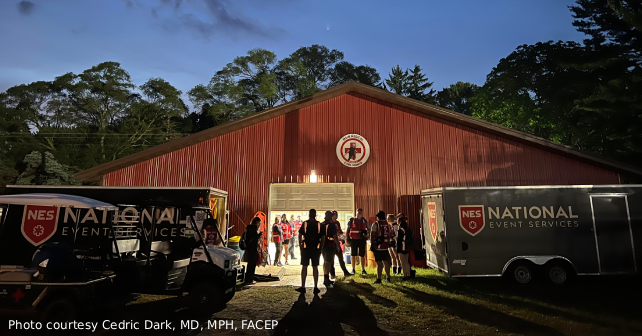
“When promoters are looking for a site for a camping festival, they’re often looking for that austere location,” Mr. Diienno said. “But that means hospital care can be an hour or more away. We make sure there are plenty of qualified health care professionals on-site to handle the common injuries you see. But we also make sure we can get somebody to the nearest hospital quickly when that’s necessary. In addition to providing people on staff like emergency physicians, we work with the local community to make sure we’re not going to overwhelm their services.”
Explore This Issue
ACEP Now: October 2025 (Digital)In Manchester, Tennessee, home to the Bonnaroo outdoor music and arts festival, the local hospital had just two emergency beds, Mr. Diienno explained. The county’s EMS system operates five ambulances year-round. For a festival swelling the population by 80,000, that could be a recipe for disaster. But not with some planning.
National Event Services builds temporary medical systems on-site: staffed tents, stocked pharmacies, and helicopter landing zones capable of accommodating multiple aircraft simultaneously. Many patients never leave the event.
“Physicians and nurses will do sutures on-site, manage dehydration, splint fractures, treat overdoses,” he said. “Anything short of ICU-level care is done right there. It keeps people safe and lets them stay at the event they paid good money to attend.”
The more remote the setting, the more challenging things become.
Emergency physician Dominique Wong, MD, has decades of experience in event medicine, tactical medicine, law enforcement, and disaster medicine. One event that still makes her nervous thinking about it is the Scouting America National Jamboree, an event that was held at the Summit Bechtel Reserve, an 11,000 acre austere environment in central West Virginia. The 2019 Scouting Jamboree was hosted by the Summit and attended by more than 40,000 Scouts and volunteers from over 130 countries.
The terrain alone presents obstacles, she said.
“Most of it isn’t accessible by ambulance, and the nearest Level 1 trauma center is an hour away by ground,” said Dr. Wong, a past secretary of the Event Medicine Section who currently volunteers as Chair-Elect of the Tactical and Law Enforcement Medicine Section and serves as secretary of the Disaster Medicine Section. “Anything can be a challenge. We had a cardiac arrest during a Spartan race there on a steep hill where an ambulance couldn’t reach. A tiny local EMS agency had built these ATV-pulled stretchers, and that’s how we got him out. He survived. Two years later, he came back and ran the race again.”
Pages: 1 2 3 4 | Single Page



One Response to “Event Medicine: Where Fun and Safety Sing in Perfect Harmony”
October 11, 2025
BossSalve, articolo molto interessante! Mi ha fatto riflettere su come la medicina degli eventi richieda una preparazione unica per gestire situazioni in ambienti “austeri” lontani dagli ospedali, proprio come accade spesso qui in Italia con eventi in zone montane o rurali. Volevo chiedere: in contesti così remoti, con pazienti che potrebbero avere condizioni croniche come l’insufficienza surrenale, come si integra la conoscenza di farmaci di mantenimento a lungo termine, ad esempio il Florinef (fludrocortisone), nella vostra valutazione iniziale e nella comunicazione con il controllo medico? https://vtemsdistrict8.org/unveiling-the-role-of-florinef-in-emergency-medicine-for-vermonts-first-responders Grazie per qualsiasi insight!