Logo

Log In Sign Up |  An official publication of: American College of Emergency Physicians
Navigation
  • Home
  • Multimedia
    • Podcasts
    • Videos
  • Clinical
    • Airway Managment
    • Case Reports
    • Critical Care
    • Guidelines
    • Imaging & Ultrasound
    • Pain & Palliative Care
    • Pediatrics
    • Resuscitation
    • Trauma & Injury
  • Resource Centers
    • mTBI Resource Center
  • Career
    • Practice Management
      • Benchmarking
      • Reimbursement & Coding
      • Care Team
      • Legal
      • Operations
      • Quality & Safety
    • Awards
    • Certification
    • Compensation
    • Early Career
    • Education
    • Leadership
    • Profiles
    • Retirement
    • Work-Life Balance
  • Columns
    • ACEP4U
    • Airway
    • Benchmarking
    • Brief19
    • By the Numbers
    • Coding Wizard
    • EM Cases
    • End of the Rainbow
    • Equity Equation
    • FACEPs in the Crowd
    • Forensic Facts
    • From the College
    • Images in EM
    • Kids Korner
    • Medicolegal Mind
    • Opinion
      • Break Room
      • New Spin
      • Pro-Con
    • Pearls From EM Literature
    • Policy Rx
    • Practice Changers
    • Problem Solvers
    • Residency Spotlight
    • Resident Voice
    • Skeptics’ Guide to Emergency Medicine
    • Sound Advice
    • Special OPs
    • Toxicology Q&A
    • WorldTravelERs
  • Resources
    • ACEP.org
    • ACEP Knowledge Quiz
    • Issue Archives
    • CME Now
    • Annual Scientific Assembly
      • ACEP14
      • ACEP15
      • ACEP16
      • ACEP17
      • ACEP18
      • ACEP19
    • Annals of Emergency Medicine
    • JACEP Open
    • Emergency Medicine Foundation
  • About
    • Our Mission
    • Medical Editor in Chief
    • Editorial Advisory Board
    • Awards
    • Authors
    • Article Submission
    • Contact Us
    • Advertise
    • Subscribe
    • Privacy Policy
    • Copyright Information

European Association of Urology Guidelines for Evaluating, Managing Blunt Renal Trauma

By Mark Pierce, MD | on November 17, 2015 | 0 Comment
Features
  • Tweet
  • Click to email a link to a friend (Opens in new window) Email
Print-Friendly Version

The ACEP Clinical Policies Committee regularly reviews guidelines published by other organizations and professional societies. Periodically, new guidelines are identified on topics with particular relevance to the clinical practice of emergency medicine. This article highlights recommendations for evaluation of blunt renal trauma published by the European Association of Urology in 2014.

You Might Also Like
  • ACEP Clinical Policy: Blunt Abdominal Trauma
  • Myths in Emergency Medicine: Computed Tomography Pulmonary Angiograms as Imaging Standard, and Radiographs for Pelvic Trauma
  • Acute Fibrinolysis Shutdown Is Common after Trauma
Explore This Issue
ACEP Now: Vol 34 – No 11 – November 2015

In 2014, the European Association of Urology published its “Guidelines on Urological Trauma.”1 The guidelines are quite expansive and offer recommendations on management of renal, ureteral, bladder, urethral, and genital trauma. In this article, I will highlight the recommendations on renal trauma that are applicable to emergency physicians.
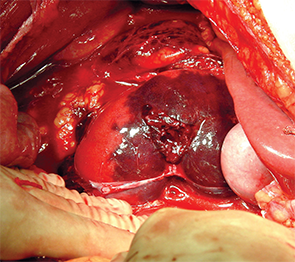
Renal fracture: intraoperative

Renal fracture: intraoperative
PHOTOs: Diku P. Mandavia

These guidelines are based on a relevant literature review of several databases including MEDLINE, Embase, and Cochrane. The authors point out that most of the findings and recommendations are based on case reports and retrospective case series and recognize that the paucity of high-quality randomized controlled trials makes it difficult to make compelling recommendations. The European Association of Urology uses a grade A through C recommendation paradigm. Grade A recommendations are based on good-quality and consistent studies, including at least one randomized trial. Grade B recommendations are based on well-conducted clinical studies without randomized clinical studies. Lastly, Grade C recommendations are made without directly applicable clinical studies of good quality.
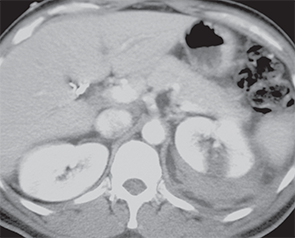
CT of a left renal fracture

CT of a left renal fracture
PHOTOs: Diku P. Mandavia

However, there is a big caveat to this paradigm. As the guidelines state, “Alternatively, absence of high level of evidence does not necessarily preclude a grade A recommendation, if there is overwhelming clinical experience and consensus.”1 The authors denote this recommendation grade by labeling such recommendations as A*.

Epidemiology

Renal trauma occurs in approximately 1–5 percent of all trauma cases, with a 3:1 male-to-female ratio, and in all ages of patients. Blunt trauma is the leading cause of injury, with motor vehicle accidents accounting for nearly half of those injuries and falls, sports, and assaults reported as the mechanism for the majority of the remaining blunt trauma. Penetrating renal trauma from gunshot wounds and stabbings is not common but tends to be more severe and less predictable.

Blunt trauma to the back, flank, lower thorax, or upper abdomen—particularly with associated hematuria, ecchymosis, flank pain, abrasions, fractured ribs, or other signs of trauma—should raise suspicion of renal injury.

Grade A*: Findings on physical examination, such as haematuria, flank pain, flank abrasions and bruising ecchymoses, fractured ribs, abdominal tenderness, distension, or mass, could indicate possible renal involvement.1

Pages: 1 2 3 | Single Page

Topics: Clinical GuidelineEmergency PhysicianPractice ManagementRenalTrauma and InjuryUrogenitalUrology

Related

  • Florida Emergency Department Adds Medication-Dispensing Kiosk

    November 7, 2025 - 1 Comment
  • Q&A with ACEP President L. Anthony Cirillo

    November 5, 2025 - 0 Comment
  • How Does Emergency Medicine Navigate Consolidation Trends in Health Care?

    October 29, 2025 - 0 Comment

Current Issue

ACEP Now: November 2025

Download PDF

Read More

No Responses to “European Association of Urology Guidelines for Evaluating, Managing Blunt Renal Trauma”

Leave a Reply Cancel Reply

Your email address will not be published. Required fields are marked *


*
*


Wiley
  • Home
  • About Us
  • Contact Us
  • Privacy
  • Terms of Use
  • Advertise
  • Cookie Preferences
Copyright © 2025 by John Wiley & Sons, Inc. All rights reserved, including rights for text and data mining and training of artificial technologies or similar technologies. ISSN 2333-2603
