
Logo

Log In Sign Up |  An official publication of: American College of Emergency Physicians
Navigation
  • Home
  • Multimedia
    • Podcasts
    • Videos
  • Clinical
    • Airway Managment
    • Case Reports
    • Critical Care
    • Guidelines
    • Imaging & Ultrasound
    • Pain & Palliative Care
    • Pediatrics
    • Resuscitation
    • Trauma & Injury
  • Resource Centers
    • mTBI Resource Center
  • Career
    • Practice Management
      • Benchmarking
      • Reimbursement & Coding
      • Care Team
      • Legal
      • Operations
      • Quality & Safety
    • Awards
    • Certification
    • Compensation
    • Early Career
    • Education
    • Leadership
    • Profiles
    • Retirement
    • Work-Life Balance
  • Columns
    • ACEP4U
    • Airway
    • Benchmarking
    • Brief19
    • By the Numbers
    • Coding Wizard
    • EM Cases
    • End of the Rainbow
    • Equity Equation
    • FACEPs in the Crowd
    • Forensic Facts
    • From the College
    • Images in EM
    • Kids Korner
    • Medicolegal Mind
    • Opinion
      • Break Room
      • New Spin
      • Pro-Con
    • Pearls From EM Literature
    • Policy Rx
    • Practice Changers
    • Problem Solvers
    • Residency Spotlight
    • Resident Voice
    • Skeptics’ Guide to Emergency Medicine
    • Sound Advice
    • Special OPs
    • Toxicology Q&A
    • WorldTravelERs
  • Resources
    • ACEP.org
    • ACEP Knowledge Quiz
    • Issue Archives
    • CME Now
    • Annual Scientific Assembly
      • ACEP14
      • ACEP15
      • ACEP16
      • ACEP17
      • ACEP18
      • ACEP19
    • Annals of Emergency Medicine
    • JACEP Open
    • Emergency Medicine Foundation
  • About
    • Our Mission
    • Medical Editor in Chief
    • Editorial Advisory Board
    • Awards
    • Authors
    • Article Submission
    • Contact Us
    • Advertise
    • Subscribe
    • Privacy Policy
    • Copyright Information

Ethical Issues in Interhospital Transfers of Emergency Department Patients

By Eileen F. Baker, MD, PHD, FACEP; Nicholas H. Kluesner, MD, FACEP; Kenneth Marshall, MD, MA, FACEP; Laura E. Vearrier, MD, DBE, FACEP; Kelly Bookman, MD, FACEP | on March 13, 2024 | 1 Comment
Features
  • Tweet
  • Click to email a link to a friend (Opens in new window) Email
Print-Friendly Version

The chief difficulty for the receiving center is determining whether it has the capacity to care for the potential transfer. Tertiary centers must continuously evaluate availability of space and resources to serve patients already under their direct care, as well as predicted needs for patients for scheduled and unscheduled care. Unfortunately, many tertiary hospitals routinely operate at censuses of greater than 100 percent capacity, due to factors including insufficient acute care bed capacity, a shortage of nursing care, and misaligned incentive structures for health care more generally.5 In such situations, tertiary centers must make the difficult decisions of when to accept transfer patients with critical needs. Important considerations in these decisions include granular detail about hospital resources and predicted scheduled care, the availability of nearby facilities with similar capability to provide care, and whether the patient already receives care at that center. Ultimately, receiving centers must accept transfers for critically needed care that is unavailable elsewhere within a reasonable radius from the transferring center, even when capacity is marginal. Accordingly, it is a moral imperative that tertiary centers focus efforts to preserve or create capacity, including working with regional peers to load-level such transfers to satisfy their shared mission to provide both high quality, scheduled care of complex medical conditions, and acute care to their region.

You Might Also Like
  • Telemedicine Dramatically Reduces Patient Transfers
  • Ethical Issues of the Emergency Medicine Workforce
  • Another COVID Casualty: the Emergency Department Transfer Process
Explore This Issue
ACEP Now: Vol 43 – No 03 – March 2024

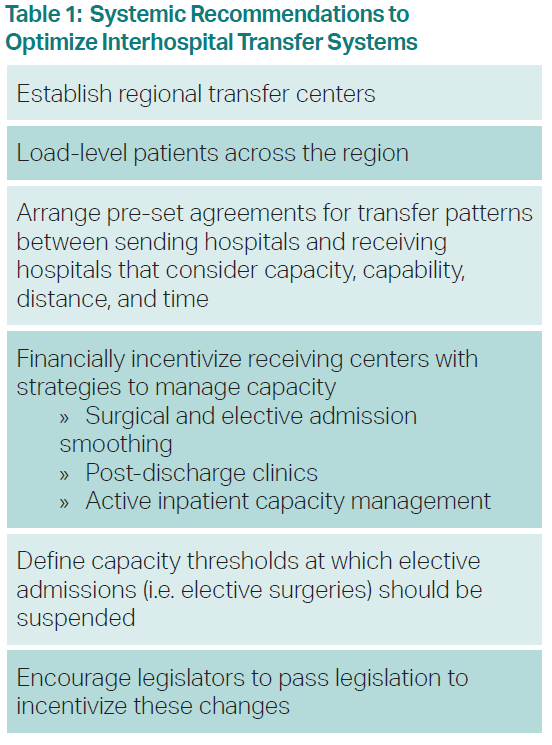
It is becoming clear that EMTALA is not sufficient to address the transfer crisis. In many transfer situations, both whether the patient has a time-sensitive EMC and whether the receiving facility has “capacity” are ill-defined or uncertain. Moreover, receiving centers are financially incentivized to prioritize elective admissions and surgeries at the expense of protecting capacity for transfers requiring stabilization.5 This perverse incentive structure, along with the vagueness of “capacity,” encourages facilities to evaluate transfers in a way that deviates from the intended purpose of EMTALA, which is to ensure that patients’ acute needs are not in competition with the financial interests of institutions or clinicians. Currently, clarification of how “capacity” is defined and what specific circumstances constitute an “EMC” exist only through violation investigations and penalties. There is a critical need for proactive system optimization to align incentives with patient needs and provide clarity around capacity thresholds (Table 1). Without legislative or regulatory guidance and funding intervention, the challenges of interhospital transfers will continue to cause acute patient care needs to be compromised by hospital operations incentives.
Click to enlarge.

Pages: 1 2 3 4 | Single Page

Topics: BoardingCrowdinginterhospital transfertransfer

Related

  • November 2025 News from the College

    November 4, 2025 - 0 Comment
  • Pediatric Patients in Acute Mental Health Crisis Face Long Waits

    August 29, 2025 - 0 Comment
  • Hospital at Home Is Here: An Opportunity EM Can’t Ignore

    August 25, 2025 - 0 Comment

Current Issue

ACEP Now: November 2025

Download PDF

Read More

One Response to “Ethical Issues in Interhospital Transfers of Emergency Department Patients”

  1. May 5, 2024

    Curtis Brown, MD. FACEP Reply

    A national physician on call data center where hospital on call lists are published and categorized by location would be of great value in locating the appropriate available hospital and provider.

Leave a Reply Cancel Reply

Your email address will not be published. Required fields are marked *


*
*


Wiley
  • Home
  • About Us
  • Contact Us
  • Privacy
  • Terms of Use
  • Advertise
  • Cookie Preferences
Copyright © 2025 by John Wiley & Sons, Inc. All rights reserved, including rights for text and data mining and training of artificial technologies or similar technologies. ISSN 2333-2603
