
Logo

Log In Sign Up |  An official publication of: American College of Emergency Physicians
Navigation
  • Home
  • Multimedia
    • Podcasts
    • Videos
  • Clinical
    • Airway Managment
    • Case Reports
    • Critical Care
    • Guidelines
    • Imaging & Ultrasound
    • Pain & Palliative Care
    • Pediatrics
    • Resuscitation
    • Trauma & Injury
  • Resource Centers
    • mTBI Resource Center
  • Career
    • Practice Management
      • Benchmarking
      • Reimbursement & Coding
      • Care Team
      • Legal
      • Operations
      • Quality & Safety
    • Awards
    • Certification
    • Compensation
    • Early Career
    • Education
    • Leadership
    • Profiles
    • Retirement
    • Work-Life Balance
  • Columns
    • ACEP4U
    • Airway
    • Benchmarking
    • Brief19
    • By the Numbers
    • Coding Wizard
    • EM Cases
    • End of the Rainbow
    • Equity Equation
    • FACEPs in the Crowd
    • Forensic Facts
    • From the College
    • Images in EM
    • Kids Korner
    • Medicolegal Mind
    • Opinion
      • Break Room
      • New Spin
      • Pro-Con
    • Pearls From EM Literature
    • Policy Rx
    • Practice Changers
    • Problem Solvers
    • Residency Spotlight
    • Resident Voice
    • Skeptics’ Guide to Emergency Medicine
    • Sound Advice
    • Special OPs
    • Toxicology Q&A
    • WorldTravelERs
  • Resources
    • ACEP.org
    • ACEP Knowledge Quiz
    • Issue Archives
    • CME Now
    • Annual Scientific Assembly
      • ACEP14
      • ACEP15
      • ACEP16
      • ACEP17
      • ACEP18
      • ACEP19
    • Annals of Emergency Medicine
    • JACEP Open
    • Emergency Medicine Foundation
  • About
    • Our Mission
    • Medical Editor in Chief
    • Editorial Advisory Board
    • Awards
    • Authors
    • Article Submission
    • Contact Us
    • Advertise
    • Subscribe
    • Privacy Policy
    • Copyright Information

Employ a Trauma-Informed Approach to Care

By Ralph Riviello, MD, FACEP; and Heather Rozzi, MD, FACEP | on December 7, 2024 | 0 Comment
Forensic Facts
  • Tweet
  • Click to email a link to a friend (Opens in new window) Email
Print-Friendly Version

History

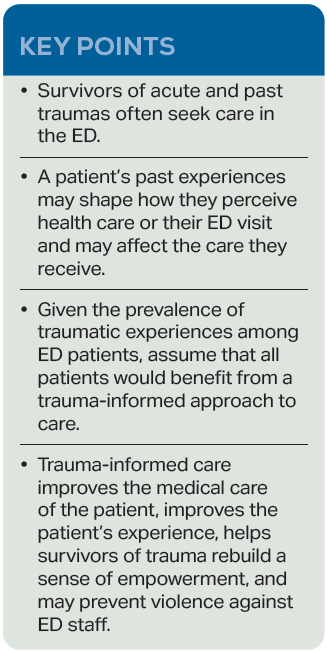
During the initial evaluation of the patient, the physician should establish the ED as a safe space for the patient. Simple actions such as knocking and asking permission to enter the room may provide reassurance to the patient that their preferences will be taken into consideration. Clinicians should confirm the pronunciation of the patient’s name, use their preferred pronouns, and use an interpreter, if necessary. Ask whether the patient wants others (friends or family members) in the room during the history and examination. The patient may not feel empowered to ask visitors to leave, so this should be addressed by the clinician. Conversely, the patient may feel safer with friends or family members present in the room or on speaker phone.

You Might Also Like
  • Is It Time to Sunset Rectal Examinations in the Trauma Bay?
  • Emergency Departments Often First Point of Care for Domestic Violence Trauma, Injury Cases
  • Beyond the form: Talking points on informed consent
Explore This Issue
ACEP Now: Vol 43 – No 12 – December 2024

Physical Examination

Clinicians should describe the steps of the physical examination so that the patient knows what to expect and should ask for consent to do the examination, especially of sensitive areas of the body. Stress to the patient that they can refuse any or all parts of the medical forensic examination. The patient should be offered as much privacy as possible during the examination. This may mean moving a patient from a hallway bed into an examination room or using adequate draping techniques. The clinician should also ask questions such as, “Is there a part of the examination that is worrisome to you? Is there anything we can do to make you more comfortable?”

Procedures
Click to enlarge.

Procedures, including necessary equipment, should be explained in as much detail as the patient would like. After obtaining consent, the clinician should provide as much pain relief as possible prior to the procedure. Ask the patient about preferences regarding position of comfort and whether they want a support person present. Give the patient as much control as possible. The speculum or pelvic exam can be triggering to a patient with a past history of sexual abuse or assault; therefore, patients may prefer to self-insert a speculum or to self-swab the genitals. If the patient needs a break during the procedure, this should be provided if possible.

Disposition

Shared decision making is key to empowering patients in their own medical care. If the patient is being discharged, ensure appropriate referral and community resources. Because many ED patients are experiencing stress, which may interfere with comprehension and retention of instructions, methods such as teach-back should be used. Patients should be asked what questions they have, and resources should be provided in case they have questions following disposition.

Pages: 1 2 3 | Single Page

Topics: ClinicalRapeSexual AssaultTrauma & Injurytrauma-informed care

Related

  • Emergency Physicians Step Up for Women

    October 15, 2025 - 4 Comments
  • Non-Invasive Positive Pressure Ventilation in the Emergency Department

    October 1, 2025 - 0 Comment
  • Emergency Department Management of Prehospital Tourniquets

    October 1, 2025 - 0 Comment

Current Issue

ACEP Now: November 2025

Download PDF

Read More

No Responses to “Employ a Trauma-Informed Approach to Care”

Leave a Reply Cancel Reply

Your email address will not be published. Required fields are marked *


*
*


Wiley
  • Home
  • About Us
  • Contact Us
  • Privacy
  • Terms of Use
  • Advertise
  • Cookie Preferences
Copyright © 2025 by John Wiley & Sons, Inc. All rights reserved, including rights for text and data mining and training of artificial technologies or similar technologies. ISSN 2333-2603
