Logo

Log In Sign Up |  An official publication of: American College of Emergency Physicians
Navigation
  • Home
  • Multimedia
    • Podcasts
    • Videos
  • Clinical
    • Airway Managment
    • Case Reports
    • Critical Care
    • Guidelines
    • Imaging & Ultrasound
    • Pain & Palliative Care
    • Pediatrics
    • Resuscitation
    • Trauma & Injury
  • Resource Centers
    • mTBI Resource Center
  • Career
    • Practice Management
      • Benchmarking
      • Reimbursement & Coding
      • Care Team
      • Legal
      • Operations
      • Quality & Safety
    • Awards
    • Certification
    • Compensation
    • Early Career
    • Education
    • Leadership
    • Profiles
    • Retirement
    • Work-Life Balance
  • Columns
    • ACEP4U
    • Airway
    • Benchmarking
    • Brief19
    • By the Numbers
    • Coding Wizard
    • EM Cases
    • End of the Rainbow
    • Equity Equation
    • FACEPs in the Crowd
    • Forensic Facts
    • From the College
    • Images in EM
    • Kids Korner
    • Medicolegal Mind
    • Opinion
      • Break Room
      • New Spin
      • Pro-Con
    • Pearls From EM Literature
    • Policy Rx
    • Practice Changers
    • Problem Solvers
    • Residency Spotlight
    • Resident Voice
    • Skeptics’ Guide to Emergency Medicine
    • Sound Advice
    • Special OPs
    • Toxicology Q&A
    • WorldTravelERs
  • Resources
    • ACEP.org
    • ACEP Knowledge Quiz
    • Issue Archives
    • CME Now
    • Annual Scientific Assembly
      • ACEP14
      • ACEP15
      • ACEP16
      • ACEP17
      • ACEP18
      • ACEP19
    • Annals of Emergency Medicine
    • JACEP Open
    • Emergency Medicine Foundation
  • About
    • Our Mission
    • Medical Editor in Chief
    • Editorial Advisory Board
    • Awards
    • Authors
    • Article Submission
    • Contact Us
    • Advertise
    • Subscribe
    • Privacy Policy
    • Copyright Information

Emergency Physician Shares Story and Lessons Learned from Wildfire Evacuation

By Susan Fitzgerald, MD | on June 12, 2018 | 0 Comment
Features
  • Tweet
  • Click to email a link to a friend (Opens in new window) Email
Print-Friendly Version
PHOTO: Jitesh Visadia

After what felt like an eternity, I found myself hurtling east down Guerneville Road toward the hospital. There was a large orange glow on the horizon, and the smell of smoke was growing stronger. I couldn’t help but notice the steady stream of cars driving west, away from the fire.

You Might Also Like
  • Notes From Emergency Physician Working When the Camp Fire Threatened Hospital
  • Lessons Learned from Court Case that Weakened Peer-Review Protection
  • New Hospital Disaster Resources Available
Explore This Issue
ACEP Now: Vol 37 – No 06 – June 2018

There weren’t many cars going in my direction, toward the fire.

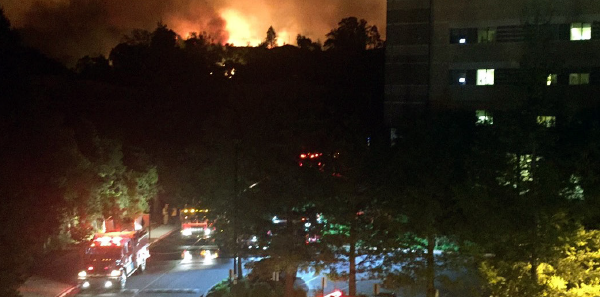
The Tubbs Fire rages behind KP Santa Rosa hospital.

The Tubbs Fire rages behind KP Santa Rosa hospital.
Photo: Wes McBride

Entering the Fire Zone

My normal route was blocked. The exit was blocked; there was a police car stationed there with lights flashing.

I showed my ID, and the officer let me through. I thought back to all the times I’d taught staff to keep their IDs with them. I always promise it will get folks through a roadblock, and it had. I later learned many of our hospital administrators were not so lucky. It didn’t matter what they showed or said, they were turned away at other entry points because they were in active fire zones.

I kept driving. A sea of flashing lights and emergency vehicles appeared before me only a half block from the hospital. I turned left into the parking lot, wound my way around the buildings, and parked in the garage.

The smoke was incredibly thick when I got out of the car, and a security guard was controlling access to the emergency department.

That’s when things get fuzzy. My brain didn’t register the people carrying their belongings walking the other way or the embers flying through the air. And although I walked right past the Journey’s End mobile home park on my left, only yards away from the hospital’s property line, my brain didn’t register anything unusual there either, despite the fact it was almost completely engulfed in flames.

Here’s what I do remember: the smoke in the emergency department and hospital hallways; the calm, focused intensity in the hospital command center; and the decision to evacuate the hospital when the fire department told us it was making “a last stand.” I remember the cadre of police officers who showed up when we needed to step up the evacuation even further and how we went floor to floor in teams to clear out the bedbound patients. My brain finally registered the fire as I passed a fourth-floor window and saw the flames at our hospital’s property edge.

Evacuation

We staged patients by the freight elevators and took them down one by one. Once downstairs, we lined them up in the hallway to await transport. We assigned one staff member, from MDs to RNs to environmental service workers, to every patient and documented each patient as they went through the lobby doors onto the ambulances and city buses waiting to take them to safety. The patients and staff were amazing; there was no panic and very little noise.

Pages: 1 2 3 4 | Single Page

Topics: Disaster Planning EffortsEvacuation

Related

  • LA County Fires Illustrate Strength of Emergency Medicine Community

    September 18, 2025 - 0 Comment
  • How ACEP Earns and Spends Grant Funds

    August 11, 2022 - 0 Comment
  • Notes From Emergency Physician Working When the Camp Fire Threatened Hospital

    March 12, 2019 - 2 Comments

Current Issue

ACEP Now: November 2025

Download PDF

Read More

No Responses to “Emergency Physician Shares Story and Lessons Learned from Wildfire Evacuation”

Leave a Reply Cancel Reply

Your email address will not be published. Required fields are marked *


*
*


Wiley
  • Home
  • About Us
  • Contact Us
  • Privacy
  • Terms of Use
  • Advertise
  • Cookie Preferences
Copyright © 2025 by John Wiley & Sons, Inc. All rights reserved, including rights for text and data mining and training of artificial technologies or similar technologies. ISSN 2333-2603
