Logo

Log In Sign Up |  An official publication of: American College of Emergency Physicians
Navigation
  • Home
  • Multimedia
    • Podcasts
    • Videos
  • Clinical
    • Airway Managment
    • Case Reports
    • Critical Care
    • Guidelines
    • Imaging & Ultrasound
    • Pain & Palliative Care
    • Pediatrics
    • Resuscitation
    • Trauma & Injury
  • Resource Centers
    • mTBI Resource Center
  • Career
    • Practice Management
      • Benchmarking
      • Reimbursement & Coding
      • Care Team
      • Legal
      • Operations
      • Quality & Safety
    • Awards
    • Certification
    • Compensation
    • Early Career
    • Education
    • Leadership
    • Profiles
    • Retirement
    • Work-Life Balance
  • Columns
    • ACEP4U
    • Airway
    • Benchmarking
    • Brief19
    • By the Numbers
    • Coding Wizard
    • EM Cases
    • End of the Rainbow
    • Equity Equation
    • FACEPs in the Crowd
    • Forensic Facts
    • From the College
    • Images in EM
    • Kids Korner
    • Medicolegal Mind
    • Opinion
      • Break Room
      • New Spin
      • Pro-Con
    • Pearls From EM Literature
    • Policy Rx
    • Practice Changers
    • Problem Solvers
    • Residency Spotlight
    • Resident Voice
    • Skeptics’ Guide to Emergency Medicine
    • Sound Advice
    • Special OPs
    • Toxicology Q&A
    • WorldTravelERs
  • Resources
    • ACEP.org
    • ACEP Knowledge Quiz
    • Issue Archives
    • CME Now
    • Annual Scientific Assembly
      • ACEP14
      • ACEP15
      • ACEP16
      • ACEP17
      • ACEP18
      • ACEP19
    • Annals of Emergency Medicine
    • JACEP Open
    • Emergency Medicine Foundation
  • About
    • Our Mission
    • Medical Editor in Chief
    • Editorial Advisory Board
    • Awards
    • Authors
    • Article Submission
    • Contact Us
    • Advertise
    • Subscribe
    • Privacy Policy
    • Copyright Information

Emergency Physician Dr. Renee Salas Treats Injured in Nepal Earthquake

By ACEP Now | on July 15, 2015 | 0 Comment
Features
  • Tweet
  • Click to email a link to a friend (Opens in new window) Email
Print-Friendly Version
Emergency Physician Dr. Renee Salas Treats Injured in Nepal Earthquake

KK: What happened to the guy who came in by horseback?

You Might Also Like
  • Emergency Physician Dr. Anne Klimke Taps Training to Treat Wounded in Amtrak Crash
  • Emergency Physician Dr. Bradford Walters on Being First Responder to Northwest Flight 255 Crash
  • Emergency Physician Lands in ED after Subarachnoid Hemorrhage During Bike Ride
Explore This Issue
ACEP Now: Vol 34 – No 07 – July 2015

RS: He was stable overnight. He was a bit hypoxic. One interesting point is that people’s oxygen saturation is routinely between 80 percent and 90 percent, but that’s normal. He was hypoxic relative to what I would expect for that altitude, so he was on oxygen overnight. There are no cars because there are pretty steep trails that go through this whole region. Transportation is either by foot, horse, or helicopter; a lot of goods are transported via yaks.
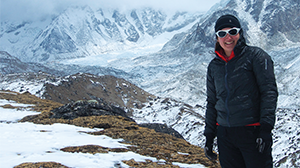
Dr. Salas at Everest Base Camp a week before the avalanche.

Dr. Salas at Everest Base Camp a week before the avalanche.

KK: Certainly some unique trans-portation challenges. If I had to choose between the yak and the horse, I think I’d have to go with the yak. It’s a smoother ride, from what I hear.

RS: I never did get the chance to ride on a yak. I’ll have to save that for my next trip to Nepal.

KK: How did you plan to care for all these people, and did you have enough resources to do it?

RS: We had a three-bed hospital: one bed where we would see active patients and complete evaluations and two beds that were considered inpatient beds, which essentially were two stretchers in a small room. An ancient ultrasound machine was the only imaging modality that we had. We had the ability to do IVs. Even then, we only had 20 bags of normal saline.

KK: Your imaging modality was only an old dinosaur ultrasound machine. Did you also do lung scans to looking for pneumothoraces?

RS: We did the EFAST [Extended Focused Assessment with Sonography for Trauma] on the first patients who came in that night. During the mass casualty itself, we used ultrasound to make sure it wasn’t a pneumothorax as long as I didn’t think a patient was having a tension pneumothorax and getting hypotensive from that or tamponade. Because there was such a high volume of patients, we really had to limit our time with each one.

KK: Tell me about the sickest or most challenging patient you took care of.

RS: The first one that comes to mind was a climbing Sherpa, I guess a Nepali, who had what appeared to be isolated head trauma. He was about a Glasgow Coma Scale of nine, and he was protecting his airway, but he was very combative. He actually came down from Everest Base Camp. I think the only reason we were very successful at what we did was because of the amazing work that they did at the Everest Base Camp. They were the first responders, pronouncing the deceased in their tents.

Pages: 1 2 3 4 | Single Page

Topics: Critical CareDisaster MedicineEarthquakeEmergency MedicineEmergency PhysicianNepalTrauma and Injury

Related

  • The First National Congress on Emergency Medical Care in Ukraine

    December 4, 2025 - 0 Comment
  • Why the Nonrebreather Should be Abandoned

    December 3, 2025 - 0 Comment
  • Event Medicine: Where Fun and Safety Sing in Perfect Harmony

    October 9, 2025 - 1 Comment

Current Issue

ACEP Now: November 2025

Download PDF

Read More

About the Author

ACEP Now

View this author's posts »

No Responses to “Emergency Physician Dr. Renee Salas Treats Injured in Nepal Earthquake”

Leave a Reply Cancel Reply

Your email address will not be published. Required fields are marked *


*
*


Wiley
  • Home
  • About Us
  • Contact Us
  • Privacy
  • Terms of Use
  • Advertise
  • Cookie Preferences
Copyright © 2025 by John Wiley & Sons, Inc. All rights reserved, including rights for text and data mining and training of artificial technologies or similar technologies. ISSN 2333-2603
