Logo

Log In Sign Up |  An official publication of: American College of Emergency Physicians
Navigation
  • Home
  • Multimedia
    • Podcasts
    • Videos
  • Clinical
    • Airway Managment
    • Case Reports
    • Critical Care
    • Guidelines
    • Imaging & Ultrasound
    • Pain & Palliative Care
    • Pediatrics
    • Resuscitation
    • Trauma & Injury
  • Resource Centers
    • mTBI Resource Center
  • Career
    • Practice Management
      • Benchmarking
      • Reimbursement & Coding
      • Care Team
      • Legal
      • Operations
      • Quality & Safety
    • Awards
    • Certification
    • Compensation
    • Early Career
    • Education
    • Leadership
    • Profiles
    • Retirement
    • Work-Life Balance
  • Columns
    • ACEP4U
    • Airway
    • Benchmarking
    • Brief19
    • By the Numbers
    • Coding Wizard
    • EM Cases
    • End of the Rainbow
    • Equity Equation
    • FACEPs in the Crowd
    • Forensic Facts
    • From the College
    • Images in EM
    • Kids Korner
    • Medicolegal Mind
    • Opinion
      • Break Room
      • New Spin
      • Pro-Con
    • Pearls From EM Literature
    • Policy Rx
    • Practice Changers
    • Problem Solvers
    • Residency Spotlight
    • Resident Voice
    • Skeptics’ Guide to Emergency Medicine
    • Sound Advice
    • Special OPs
    • Toxicology Q&A
    • WorldTravelERs
  • Resources
    • ACEP.org
    • ACEP Knowledge Quiz
    • Issue Archives
    • CME Now
    • Annual Scientific Assembly
      • ACEP14
      • ACEP15
      • ACEP16
      • ACEP17
      • ACEP18
      • ACEP19
    • Annals of Emergency Medicine
    • JACEP Open
    • Emergency Medicine Foundation
  • About
    • Our Mission
    • Medical Editor in Chief
    • Editorial Advisory Board
    • Awards
    • Authors
    • Article Submission
    • Contact Us
    • Advertise
    • Subscribe
    • Privacy Policy
    • Copyright Information

Emergency Ocular Ultrasonography to Measure Optic Nerve Sheath Diameter

By ooman Hossein-Nejad, MD; Maryam Bahreini, MD; and Fatemeh Rasooli, MD | on June 20, 2017 | 0 Comment
Features
  • Tweet
  • Click to email a link to a friend (Opens in new window) Email
Print-Friendly Version
Figures & Photo:Dr. Hossein-Nejad, Dr. Bahreini, and Dr. Rasooli

A 40-year-old woman presented to our emergency department complaining of left hemiparesis and headache. She was awake and oriented, and her vitals were unremarkable except for a blood pressure of 180/100 without a history of hypertension. Past history and medications were negative. No trauma was reported. The optic nerve sheath diameter (ONSD) was measured and showed increased diameter of 0.47 cm bilaterally, demonstrating increased intracranial pressure (see Figure 1). Her level of consciousness decreased dramatically within 30 minutes, and she developed a right-sided gaze. She was intubated and underwent a brain CT showing intracranial hemorrhage in the right basal ganglia with midline shift and intraventricular hemorrhage (see Figure 2). She received a phenytoin loading dose and was taken emergently to the operating room. Fortunately, she survived with an acceptable neurologic outcome.

You Might Also Like
  • High-Yield Ocular Ultrasound Applications in the ED, Part 2
  • Consider Optic Nerve Head Edema in Some ED Patients
  • How to Perform Ultrasound-Guided Forearm Nerve Blocks to Provide Non-Drug Pain Relief for Acute Injuries
Explore This Issue
ACEP Now: Vol 36 – No 06 – June 2017

ONSD can predict increased intracranial pressure effectively. The exact measurement can be achieved by frequent practice. Thus, this approach is being described as an operator-dependent procedure.
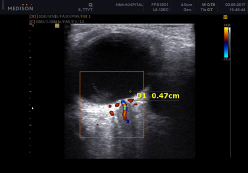
Figure 1: The optic nerve sheath diameter was measured at 0.47 cm, demonstrating an increased intracranial process in our patient.
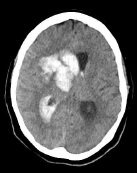
Figure 1: The optic nerve sheath diameter was measured at 0.47 cm, demonstrating an increased intracranial process in our patient.

Figure 2 (TOP RIGHT): Brain computed tomography showed intracranial hemorrhage of the right basal ganglia as well as an intraventricular hemorrhage and a significant midline shift.

Figure 2: Brain computed tomography showed intracranial hemorrhage of the right basal ganglia as well as an intraventricular hemorrhage and a significant midline shift.

Optic Nerve Sheath Diameter

There is no doubt that ultrasonography is a valuable way to evaluate ONSD to determine intracranial pressure, considering that the brain subarachnoid space is continuous with the optic nerve sheath and the pressure should be transmitted.1–4 However, the way to measure the diameter has yet to be determined. Optic nerve color Doppler ultrasonography may clarify this measure and change what was previously approved to evaluate the ONSD. Copetti et al noted that the former measures were not compatible with the real anatomy of the optic nerve and proposed a new measurement that seems to be more reliable.1 There are two points to be considered:

  1. According to the route of optic nerve approaching the globe, the oblique hypoechoic shadow running medially represents the exact measure of the optic nerve (see Figure 3).
  2. Regarding color Doppler ultrasonography of the central retinal artery, which runs within the dural optic nerve sheath to the globe, the new image compatible with the oblique hypoechoic shadow seems more characteristic of the optic nerve.
Figure 3 (MIDDLE LEFT): Ocular ultrasound with a 12 MHz linear probe in a normal subject shows a 35 mm optic nerve diameter, identified with color Doppler.

Figure 3: Ocular ultrasound with a 12 MHz linear probe in a normal subject shows a 35 mm optic nerve diameter, identified with color Doppler.

Pages: 1 2 3 | Single Page

Topics: ClinicalED Critical CareEmergency DepartmentEmergency MedicineEmergency PhysiciansEyeHeadacheImaging & UltrasoundIntracranial PressureNeurologyOcularOptic NervePatient CareUltrasonography

Related

  • Let Core Values Help Guide Patient Care

    November 5, 2025 - 0 Comment
  • What Can a Patient’s Eyes Tell Us About Concussions?

    October 23, 2025 - 0 Comment
  • Event Medicine: Where Fun and Safety Sing in Perfect Harmony

    October 9, 2025 - 1 Comment

Current Issue

ACEP Now: November 2025

Download PDF

Read More

No Responses to “Emergency Ocular Ultrasonography to Measure Optic Nerve Sheath Diameter”

Leave a Reply Cancel Reply

Your email address will not be published. Required fields are marked *


*
*


Wiley
  • Home
  • About Us
  • Contact Us
  • Privacy
  • Terms of Use
  • Advertise
  • Cookie Preferences
Copyright © 2025 by John Wiley & Sons, Inc. All rights reserved, including rights for text and data mining and training of artificial technologies or similar technologies. ISSN 2333-2603
