Logo

Log In Sign Up |  An official publication of: American College of Emergency Physicians
Navigation
  • Home
  • Multimedia
    • Podcasts
    • Videos
  • Clinical
    • Airway Managment
    • Case Reports
    • Critical Care
    • Guidelines
    • Imaging & Ultrasound
    • Pain & Palliative Care
    • Pediatrics
    • Resuscitation
    • Trauma & Injury
  • Resource Centers
    • mTBI Resource Center
  • Career
    • Practice Management
      • Benchmarking
      • Reimbursement & Coding
      • Care Team
      • Legal
      • Operations
      • Quality & Safety
    • Awards
    • Certification
    • Compensation
    • Early Career
    • Education
    • Leadership
    • Profiles
    • Retirement
    • Work-Life Balance
  • Columns
    • ACEP4U
    • Airway
    • Benchmarking
    • Brief19
    • By the Numbers
    • Coding Wizard
    • EM Cases
    • End of the Rainbow
    • Equity Equation
    • FACEPs in the Crowd
    • Forensic Facts
    • From the College
    • Images in EM
    • Kids Korner
    • Medicolegal Mind
    • Opinion
      • Break Room
      • New Spin
      • Pro-Con
    • Pearls From EM Literature
    • Policy Rx
    • Practice Changers
    • Problem Solvers
    • Residency Spotlight
    • Resident Voice
    • Skeptics’ Guide to Emergency Medicine
    • Sound Advice
    • Special OPs
    • Toxicology Q&A
    • WorldTravelERs
  • Resources
    • ACEP.org
    • ACEP Knowledge Quiz
    • Issue Archives
    • CME Now
    • Annual Scientific Assembly
      • ACEP14
      • ACEP15
      • ACEP16
      • ACEP17
      • ACEP18
      • ACEP19
    • Annals of Emergency Medicine
    • JACEP Open
    • Emergency Medicine Foundation
  • About
    • Our Mission
    • Medical Editor in Chief
    • Editorial Advisory Board
    • Awards
    • Authors
    • Article Submission
    • Contact Us
    • Advertise
    • Subscribe
    • Privacy Policy
    • Copyright Information

Emergency Medicine Techniques, Equipment List for Removing Fishhooks Lodged in Patients

By William Trinh, DO, Justin McNamee, DO, and Terry McGovern, DO, MPH | on June 14, 2016 | 0 Comment
Tricks of the Trade
  • Tweet
  • Click to email a link to a friend (Opens in new window) Email
Print-Friendly Version
Emergency Medicine Techniques, Equipment List for Removing Fishhooks Lodged in Patients

Barb sheath technique (see Figure 4). Normally, this is reserved for small hooks that are not embedded in the nose, in the ears, or near joints, as this is a more technically difficult technique that may cause further damage from blindly inserting an 18-gauge needle to disengage the barb. Firmly grasp the shaft end with the needle driver. Inject 0.5–1 mL of local anesthetic (without epinephrine) along the entry wound site of the fishhook. Insert an 18-gauge needle along the entry site, with the bevel facing toward the barb. Once the core of the needle has engaged the barb, slowly retract both the hook and the needle back out through the entry site.4

You Might Also Like
  • Techniques for Performing Paramedian Approach to Lumbar Puncture
  • Opinion: Tactical Emergency Medicine Providers Deserve Appropriate Protective Equipment
  • Some Emergency Medicine Techniques, Treatments from 1974 Hold Value
Explore This Issue
ACEP Now: Vol 35 – No 06 – June 2016

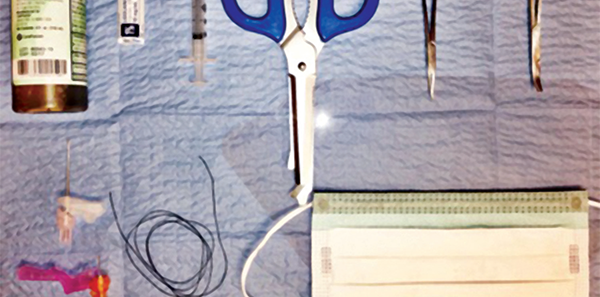
String yank technique (see Figure 5). This is likely the least painful technique for removing fishhooks. Although effective, this technique cannot be used on hooks embedded in ears, the nose, or joint cavities and is more suited for single hooks that are embedded into stable surfaces such as arms, the back, and the scalp region.6 Both the patient and the provider should wear eye protection. After cleaning up the area as previously described, loop a string around the bend of the hook. With your nondominant thumb or index finger, depress the shaft of the hook toward the embedded body part until it is parallel to the surface to disengage the hook. With a quick and firm jerk of the string, using your dominant hand, remove the hook. Local anesthetic is applied similarly to other techniques at the provider’s discretion. Many patients do not require an anesthetic, as experienced fishers often perform this procedure in the field.4

Case Conclusion

The fishhook is safely removed using the string yank technique. A dry dressing is applied, and the patient’s tetanus vaccine is updated. The fishhook was embedded superficially, therefore no prophylactic antibiotics are given. The patient will live to boast the big one next time.


Dr. Trinh

Dr. Trinh works at Saint Barnabas Hospital in Livingston, New Jersey.

Dr. Justin McNameeDr. McNamee is an attending physician at Emergency Medicine Professionals in Ormond Beach, Florida.

Dr. McGovernDr. McGovern is an emergency medicine resident at St. Joseph’s Regional Medical Center in Paterson, New Jersey.

References

  1. Doser C, Cooper WL, Edinger WM, et al. Fishhook injuries: a prospective evaluation. Am J Emerg Med. 1991;9(5):413-415.
  2. Swanson JL, Augustine JA. Penetrating intracranial trauma from a fishhook. Ann Emerg Med. 1992;21(5)568-571.
  3. Blaivas M, Lyon M, Brannam L, et al. Water bath evaluation technique for emergency ultrasound of painful superficial structures. Am J Emerg Med. 2004;22(7): 589-593.
  4. Reichman E. Fishhook removal. Emergency Medicine Procedures. New York, NY: McGraw-Hill Education/Medical; 2013.
  5. McClary D. Saltwater fishing tips, tackle and techniques. Accessed May 12, 2016.
  6. Buttaravoli P, Leffler SM. Fishhook Removal. Minor Emergencies. Philadelphia, PA: Elsevier/Saunders; 2012:543-546.

Pages: 1 2 3 4 | Single Page

Topics: ClinicalCritical CareEmergency DepartmentEmergency MedicineEmergency PhysiciansFishhookFishingProcedures and SkillsTrauma & Injury

Related

  • Why the Nonrebreather Should be Abandoned

    December 3, 2025 - 0 Comment
  • Event Medicine: Where Fun and Safety Sing in Perfect Harmony

    October 9, 2025 - 1 Comment
  • Non-Invasive Positive Pressure Ventilation in the Emergency Department

    October 1, 2025 - 0 Comment

Current Issue

ACEP Now: November 2025

Download PDF

Read More

No Responses to “Emergency Medicine Techniques, Equipment List for Removing Fishhooks Lodged in Patients”

Leave a Reply Cancel Reply

Your email address will not be published. Required fields are marked *


*
*


Wiley
  • Home
  • About Us
  • Contact Us
  • Privacy
  • Terms of Use
  • Advertise
  • Cookie Preferences
Copyright © 2025 by John Wiley & Sons, Inc. All rights reserved, including rights for text and data mining and training of artificial technologies or similar technologies. ISSN 2333-2603
