
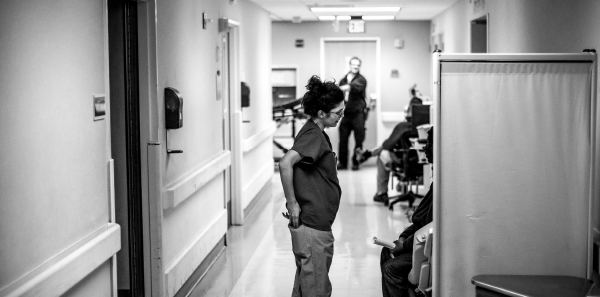
One of the reasons I chose emergency medicine is because I love the spontaneity our specialty offers. No shift is exactly the same. Anything can happen at any given time. Unfortunately, that spontaneity can put you in situations that you might never expect.
Explore This Issue
ACEP Now: Vol 38 – No 06 – June 2019I was working a shift in our rapid care area for low-acuity patients when I met a young man in his 20s who presented with the chief complaint of rash. His rash had started three days prior, and he had completed a course of amoxicillin for pharyngitis a week earlier. He denied fever, chills, recent travel, and exposure to known sick contacts. The rash started on his neck, spreading to his torso and extremities. He had no significant past medical or surgical history. He reported using amphetamines and cocaine recreationally. On exam, the patient was well-appearing. He had a diffuse erythematous palpable morbilliform rash involving his face, torso, and extremities, sparing his palms and soles.
His history and exam prompted me to think that he had a simple drug reaction secondary to the amoxicillin. Drug reaction with eosinophilia and systemic symptoms (DRESS) syndrome were also on my differential, but the patient was well appearing with no history concerning for systemic involvement. My initial gut reaction was to discharge him home with expectant management. Yet something about his story did not sit well with me.
I decided to consult dermatology to get recommendations on workup and management. After my consultation, their initial thought was that his presentation was likely due to a drug eruption. They recommended that I obtain a complete blood count, basic metabolic panel, liver function tests, HIV test, and urinalysis. Results were coming in, and my concern began to diminish. I was on the verge of printing his discharge paperwork when I got a call that changed everything.
“Doctor, your patient’s HIV test is positive,” said the lab tech over the phone. I was stunned; I assumed the test would be negative. An attending once told me to never order a study unless you have a plan for what to do with the result. That day, I did not have a plan for this HIV result. More specifically, I did not have an idea for how I was going to share the unexpected news with him.
I took the patient out of our crowded rapid care area to a private room. I sat him down in a chair and looked into his eyes and told him his HIV test was positive. The look on his face was something I will never forget. The moment after sharing the news felt like an eternity. I watched the stages of grief unfold before my eyes as the patient tried to wrap his mind around this diagnosis. I tried to console the patient and inform him that he could live a long life with proper HIV treatment. Yet I felt my words fell on deaf ears. The hardest part about medicine is being able to bear witness to suffering.
After spending some time trying to coordinate this patient’s follow-up, I walked back into the room to find it completely empty. He eloped. I can only imagine what was racing through his mind as he secretly walked out of the emergency department. I made frantic attempts to reach him by phone to no avail.
He left the emergency department with a result he was not expecting. I left the emergency department that day remembering to always expect the unexpected.




3 Responses to “Emergency Medicine Requires Us to Be Ready for Anything at Any Time”
June 27, 2019
NinaI totally agree with your sir. No two shifts are the same:)
Each time there are always full of unexpected suprises, it can be good or bad.
Keep up the good work!
July 5, 2019
BiancaThis was beautifully written. As a new practitioner, I can only pray that I will be able to do as you did; try my best to help after delivering devastating news.
July 6, 2019
Pik MukherjiA few questions reflecting on your case:
Did your pt. have HIV? My guess is yes, but your ED test is likely not the confirmatory gold standard. If done on a screening populace, depending on the prevalence in your area, the PPV could be as low as 50%.
But in your rash pt., the pretest is higher than in a screen. Rash may represent seroconversion early in HIV. But these pts. are often symptomatic. Not always, but a large majority will feel ill with acute HIV. Was the CBC normal? Relatively lymphopenic?
Perhaps stressing the need for the confirmatory test would have helped us keep this pt. in the follow up chain. It would have accurately conveyed that we did not yet make a final dx as well as allow time for the “warning shot” that bad news requires.
The test is not the truth.