
RM: You want to expand on that?
Explore This Issue
ACEP Now: Vol 34 – No 10 – October 2015LM: Well, first off, I don’t think there are many groups that meet all the criteria that Savoy just recited. I’m not quarreling with them at all. I just don’t think there are many groups like that in any specialty and certainly not in emergency medicine. Second, with the pace of change and the challenges that face all of us these days, I just respectfully question whether it’s a practical model for “running a railroad,” if you will. I think if you take that to its logical extreme, it means that each person has equal responsibility for everything that the organization does, legally, financially, etc. By and large in groups, even the ones that have one person, one vote, my experience has been that the work is never equal and the level of commitment to accountability and responsibility is never equal. There are pretty big differences even within groups that are largely or entirely democratic by even that strict definition.
RM: Great. Who hasn’t weighed in here? Dighton?
DP: I think we need to be definitive about what exactly we’re trying to define here because Savoy clearly enunciated what ACEP’s policy is and that’s what a democratic group is. What does “democracy” mean? We may be talking about two different definitions there. I think I would lean more toward, when you say what does “democracy” mean, what it means to individual physicians. When a doc is working in the emergency department, does he feel or she feel like that she’s being treated fair or equitably? Does she have a voice about what goes on in that department? I feel like, more often than not, that’s what they would define as “democracy” rather than “I have ownership and I’m responsible for everything that we do.” What I’m finding is—and I freely admit that I’m not sure that I’m the oldest person on the call, but some of us have been around a lot longer than others—that I’ve seen this change. I know that when we started out, we very much wanted to have our own shop. We wanted an independent practice within the hospital. I think Wes, and to some extent Lynn, has already said that this is becoming intensely difficult to do, just like we’ve seen many of our fellow independent practitioners outside the hospital coalesce together in large groups for very obvious reasons to them. I think that’s what’s happening to hospital-based groups as well. It’s becoming very difficult to
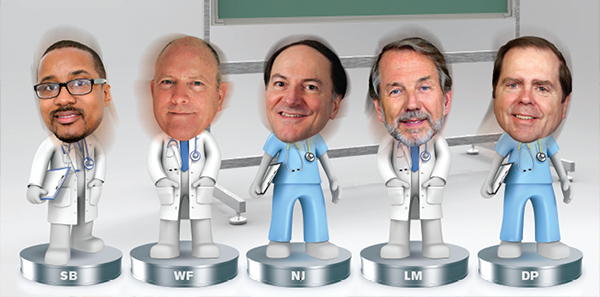
“Fairly” is situational. What’s fair in one group is not fair in another. I think as long as each individual member is treated fairly within their own group, that’s what should count. —Nicholas J. Jouriles, MD, FACEP
Clearly there is confusion, and many times that type of confusion is present because there are groups that are trying to confuse the term for their own purposes. It has been very, very clearly stated, by both AAEM and ACEP, what the tenants of a democratic group are about. —Savoy Brummer, MD, FACEP
The important question is whether or not the democratic practice model is clearly the best way to deliver care on behalf of populations or if it’s really a boutique kind of activity that can only happen in increasingly rare circumstances. —Wesley Fields, MD, FACEP
practice independently. The regulatory, bureaucratic requirements and hospital-based requirements are making it much more difficult to do that. Even if one was to agree that it was ideal, one hospital, one group, purely democratic practice, according to ACEP’s definition, I think it’s very, very difficult to accomplish that in today’s world. Much less, when you deal with systems of hospitals, then it becomes even more complicated. Democratic group, well, ACEP has it defined it. I guess I could argue with one or two words, but I think it’s more important to me what my doctors feel about it. My doctors feel that they’re being treated fairly both by my group and by the hospital. To some extent, I see that as part of my job to make sure that happens.



4 Responses to “Emergency Medicine Leaders Discuss Pros, Cons of Democratic Group Practices”
October 25, 2015
ED PhysicianTo Dr. Packards point.. I don’t think it is fair, logical, or even reasonable to conclude that what EMCARE is doing is “democratic”. I certainly think there are countless examples of completely unfair actions that EMCARE has taken against ED Physicians. I specifically have several, which I think if Dr. Packard new he would rectify. There in lies the problem.. EMCARE is so big that terrible atrocities are being done against ED Physicians and the people at the top don’t even know. In a democratic group, because it is smaller and the power is distributed these terrible actions are avoided. The profession of emergency medicine is being destroyed by this type of unaccountable behavior.
I hope Dr. Packard is interested in what is happening at a local level within EMCARE!!
October 25, 2015
John ShermanI think it unfortunate that the panel is mainly folk who are in the upper positions of apparently non-democratic groups. I get from the above discussions a paternalistic view: some people at the top know how to run the business better and that is the best way for it. It is then rationalized into the social darwinism framework of that is what is needed for groups/companies to survive. Rather Ayn Rand-ish. I also get the sense that a couple of the responses were being obviously obtuse with the sentiment that ‘some people want to do more of the administrative work and so it does not come out evenly’ – most ER doctors are smarter than that and know that administrative work is necessary and will proportion payment to those who are doing the “back office” work of the group. A good part of the chagrin from the “pit doctors” in a non-democratic group is over-valuing the administrative tasks compared to clinical work, to the point of the administrative level people in the organization getting considerable-fold higher incomes. That is the common “business-model” for corporations, but should it be that way for a group of professionals? I am a contractor for TeamHealth, and I would say that I have no particular say in anything the group does and know that a considerable portion of my revenue that I generate goes to a lot of administrative overhead that does not have transparent value.
I think the virtues of a democratic practice are good and could be strived for and incorporated into even “corporate model” groups of doctors.
October 26, 2015
Bill BassMany of us think that democracy is the fairest form of governance of any organization. Watch the video regarding democracy vs a republic ( https://www.youtube.com/watch?v=JdS6fyUIklIto ) to really understand democracy.
The complexities of medical practice with it’s insurance, government, and regulatory burdens make solo practice almost impossible. A group that manages billing, insurance, malpractice insurance, pension plan, health insurance, CME, and scheduling well, certainly deserves a fair profit. That profit should be openly available to all group members a to see and invest in if they so chose. If you can find a group this open, you should join it.
Bill Bass, M.D.
November 5, 2015
Dominic Bagnoli, MD - CEO, USACSAs the co-founder and current CEO of one of the largest democratic EM groups in the country, I am acutely interested in this discussion and the comments that have followed. Being a democratic practice has been the gold standard in our specialty for decades and that hasn’t changed but as the discussion clearly highlights, there isn’t a consensus opinion as to what constitutes a democratic practice and for many, democracy is in the eye of the beholder. Realizing that there are many different perspectives of democracy, it occurs to me that we are using the wrong standard to judge an ideal EM practice. From my perspective, the real issue is equity and ownership. Do the practicing physicians own the practice? Do they have a path to ownership? What exactly do they own? I believe being an owner is the real difference maker. Everyone takes better care of something they own. Have you ever washed your rental car? Additionally, democratic and physician-owned groups will need more support and resources than ever to succeed in the progressively complex healthcare environment. All groups will need capital for investments in processes, infrastructure and technology in order to deliver better, more efficient care. Hospitals will also require support and partnership with world-class business leadership. It will be increasingly difficult, if not impossible, for smaller EM groups to access either of those. We are building a large EM group committed to physician equity and shared ownership for all of our members. Having a democratic vote is important, but it is not a substitute for being an actual owner of the practice.