
KK: How many episodes do they commit to? Do they tell you, “We’re going to do it for a whole season, we’ll do two seasons, we’re going to do a pilot of three episodes”?
Explore This Issue
ACEP Now: Vol 34 – No 11 – November 2015RM: It’s fairly standard for a full-season order, which in network television is 22 episodes. We have our first order of 13 episodes.
KK: So how long does it take to get all those ready to go?
RM: If you can believe it, it’s a four-ring circus. We’re filming one, we’re editing another, prepping another, and writing another. A lot like emergency medicine, it’s one thing to push your patients through the system, but it’s quite another for them to leave that experience and say, “That was amazing!” That’s what we’re trying to do here.
KK: Glad you’re still able to squeeze in six shifts a month. I agree. You don’t want to close the door on your emergency medicine life, but you don’t have much time for a personal life these days, do you?
RM: No. Simple answer, no.
KK: I remember you going through the fund-raising process and trying to make sure the documentary could actually be completed and that your return on investment was what you could provide in raising awareness for emergency medicine. But I have to believe when you get noticed and your idea gets picked up for a series, without asking you the details, I hope they’re paying you properly for the work you’re doing.
RM: It is a game changer. The sad state of affairs, my friends and I joke, is that to get ahead on my medical school and educational debt, I had to sell a show to network television.
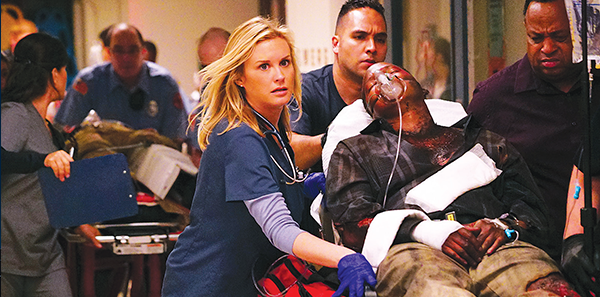
The academic quality of the show is pretty impressive. Each department has to be a student of medicine to get it right; we are unusually committed to authenticity. At one point, we cut basically raw footage of a chest tube trauma in a very high-stakes situation, and we just did an assembly cut, which means we did literally nothing to it, we just went clip for clip for clip of each step of that procedure. When we screened it internally with our docs here, they said, “I guess it’s accurate, but it doesn’t feel right.” Interestingly, when we added in a tension-laden editing process, and we added in music, “Hollywood-ized” that documentary footage in a tasteful way, suddenly it felt right, At the end of the day, that’s what we were after in this fictional series, and I think we’re doing that successfully.
Pages: 1 2 3 | Single Page



2 Responses to “Emergency Medicine Code Black Documentary Basis for CBS TV Primetime Series”
December 13, 2015
Michael MenowskyAn “accurate portrayal”, I think not! On an episode they had an ED attending performing an ovarian de-torsion? The premise being he trained in England as a surgeon before making the jump to EM. They quietly secured an OR and performed a surgery on a patient. Now I’m not sure about California, but I doubt this would or could happen?
The show lost all credibility after that!
January 6, 2016
Louise B AndrewI agree with you, Michael. An EP who performed surgery in an OR in any hospital in this country without privileges in surgery would (not be able to get in or have assistance but also) be fired, would lose his license for good, and then probably be prosecuted for assault and battery.
I watched the first episode, in which I believe Marsha Gay Hardin was trying to intubate an awake talking patient for CPR… my thought was “this feels like the very first episode of ER. Where is the medical editing?” I haven’t watched since.