
Previous Efforts
Health care-based nonpartisan voter registration has worked before. In 2008, the National Association of Community Health Centers ran a voter registration drive in health centers that resulted in more than 18,000 low- and middle-income citizens added to official rolls.11 Another program, conducted in 2012 at two Federally Qualified Health Centers in the Bronx, New York, demonstrated that successful nonpartisan voter registration initiatives can be run out of community health centers without requiring significant physician effort, disrupting clinic workflows, or compromising the patient-doctor relationship.11
Patients have been extremely receptive to nonpartisan voter registration services, with one study finding that 89 percent of individuals approached in a health center waiting room expressed openness to registering to vote.11 These models, specifically directed toward low-acuity patients, are readily adapted to hospital ED waiting rooms.
Another Initiative: VotER
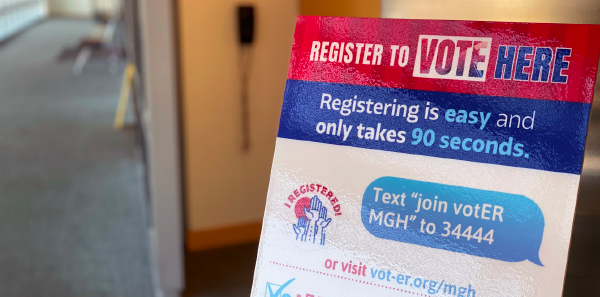
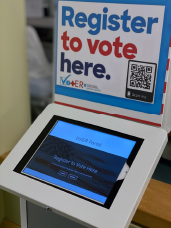
Accordingly, emergency departments across the United States have already begun implementing such voter registration efforts. VotER is one such effort that was founded at Massachusetts General Hospital in Boston and has since been adopted at more than a dozen emergency departments across the United States. The program uses iPad-based kiosks and posters and discharge paperwork with QR codes in low-acuity emergency department waiting areas to offer patients a convenient, nonpartisan, and optional opportunity to register to vote or check their registration status while waiting.
The platform does not interrupt clinical care or rely on doctors, physician assistants, or nurses providing care to interact with the voter registration process. Patients are guided through the voter registration application on their phone or the iPad-based kiosk in 90 seconds or less. Emergency departments can play a critical role in encouraging patients to register to vote without detracting from the delivery of care using platforms like VotER. Groups like VotER, Patient Voting, and Med Out The Vote are launching the first Civic Health Month in August 2020 to bring a renewed focus to helping patients get to the ballot box, particularly when COVID-19 has made voting in a safe and healthy way a public health issue.
Health care professionals must be concerned with our democracy’s health and mindful of who gets to participate in it. The demographic overlap of patients who lack access to stable care—and therefore use the emergency department at higher rates—and those who historically have low civic engagement affords a natural opportunity to pilot and develop voter registration efforts in the emergency department.
ED-based nonpartisan voter registration via nonintrusive platforms such as VotER is an innovation that can improve our civic system and the well-being of the communities we serve. With an eye toward national elections later this year, emergency departments have the potential to elevate all patient voices in our national dialogue of how to deliver effective, affordable health care in the United States.
Visit www.vot-ER.org to learn more.
Pages: 1 2 3 | Single Page



2 Responses to “Emergency Departments Can Help Get Patients Registered to Vote”
July 1, 2020
NeilI find the idea of voter registration in the ED a little unsettling. I do not think that emergency departments are the right venue for introducing voting registration. As an emergency department, we should be taking care of the sick as our primary challenge. We do this fairly well knowing that HIV testing, domestic abuse, substance abuse, human trafficking, etc falls through the cracks. At times we are struggling to form a safety net for medical health and basic needs. Should we also be a safety net for social health?
I hate to start a slippery slope argument, but I already try to avoid uncomfortable patient conversations whether they start off with: “Can you believe what Trump tweeted today…” versus “Biden had another senior moment…” With these conversations already I put on a smile, nod my head, and try to steer the patient back to determining when their crushing chest pain started.
As an emergency department, we are already been dealing with an incredible amount of social issues in which we struggle to get the resources for let alone voter registration. Lets focus on emergency medical needs, immediate social needs, and then worry about everything else when we get that right.
July 5, 2020
Brian LevyIt’s not our job. It’s also not ACEP’s role to promote this type of initiative.