
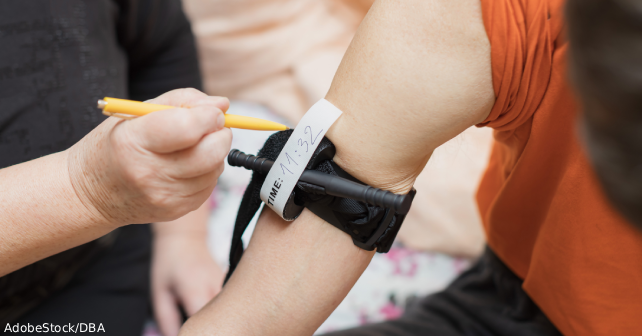
As shown in Figure 1, the timing of the tourniquet application determines the next steps. If it has been less than 90 minutes and surgery is available, an immediate surgical consult should be placed to minimize ischemic injury to the patient. If it has been longer than 120 minutes, the patient should be assessed for any contraindications to tourniquet removal—including decompensated shock, inability to directly monitor the patient for at least one hour after tourniquet removal, or a traumatic amputation with the tourniquet within several inches of the amputation stump. If there are no contraindications, the tourniquet should be removed in a critical care setting with monitoring, fluids, resuscitation meds, and surgical services available.3
Explore This Issue
ACEP Now: October 2025 (Digital)If less than 90 minutes and surgery is not available, the patient should be transferred to a trauma center within 120 minutes of the initial tourniquet placement. If this is also not possible, the patient should be assessed for risk for PTAS versus the risk for re-bleeding secondary to tourniquet removal, considering the contraindications listed above.3 If there are no contraindications, tourniquet removal may be attempted.
When removing the initial tourniquet, a new tourniquet should be available. The initial tourniquet should have its tension eased—if any life-threatening bleeding starts, it should be retightened, with the second tourniquet also applied within several inches of the wound, noting the time. If there is a non–life-threatening bleed, hemostatic gauze may be applied with manual pressure for three to five minutes and secured with pressure dressing.
If the blood rapidly soaks through the gauze, the original tourniquet should be tightened. If this bleed continues, the second tourniquet should be applied. If there is no bleeding, or bleeding is controlled, the patient should be closely observed for a minimum of one hour to ensure there is no rebleeding. In all these cases, the original tourniquet should be kept loose on the limb in case it is needed for any emergent rebleeding.3 In all cases, close wound monitoring is imperative.4
 Dr. Turner originally trained at the Medical University of South Carolina, and is an emergency medicine resident at Hershey Medical Center in Hershey, Pa.
References
- Smith AA, Ochoa JE, Wong S, et al. Prehospital tourniquet use in penetrating extremity trauma: decreased blood transfusions and limb complications. J Trauma Acute Care Surg. 2019;;86(1):43-51.
- Chang CD, Bosson N, Gausche-Hill M, et al. Assessing hemorrhage control and tourniquet skills in school-aged children. J Am Coll Emerg Physicians Open. 2025;6(3):100078.
- Levy MJ, Pasley J, Remick KN, et al. Removal of the prehospital tourniquet in the emergency department. J Emerg Med. 2021;60(1):98-102.
- Sabate-Ferris A, Pfister G, Boddaert G, et al. Prolonged tactical tourniquet application for extremity combat injuries during war against terrorism in the Sahelian strip. Eur JTrauma Emerg Surg. 2022;48(5):3847-3854.
- Butler F, Holcomb JB, Dorlac W, et al. Who needs a tourniquet? And who does not? Lessons learned from a review of tourniquet use in the Russo-Ukrainian war. J Trauma Acute Care Surg. 2024;97(2S):S45-54.
- Leurcharusmee P, Sawaddiruk P, Punjasawadwong Y, et al. The possible pathophysiological outcomes and mechanisms of tourniquet‐induced ischemia‐reperfusion injury during total knee arthroplasty. Oxid Med Cell Longev. 2018;2018(1):8087598.
Pages: 1 2 3 | Single Page



No Responses to “Emergency Department Management of Prehospital Tourniquets”