Logo

Log In Sign Up |  An official publication of: American College of Emergency Physicians
Navigation
  • Home
  • Multimedia
    • Podcasts
    • Videos
  • Clinical
    • Airway Managment
    • Case Reports
    • Critical Care
    • Guidelines
    • Imaging & Ultrasound
    • Pain & Palliative Care
    • Pediatrics
    • Resuscitation
    • Trauma & Injury
  • Resource Centers
    • mTBI Resource Center
  • Career
    • Practice Management
      • Benchmarking
      • Reimbursement & Coding
      • Care Team
      • Legal
      • Operations
      • Quality & Safety
    • Awards
    • Certification
    • Compensation
    • Early Career
    • Education
    • Leadership
    • Profiles
    • Retirement
    • Work-Life Balance
  • Columns
    • ACEP4U
    • Airway
    • Benchmarking
    • Brief19
    • By the Numbers
    • Coding Wizard
    • EM Cases
    • End of the Rainbow
    • Equity Equation
    • FACEPs in the Crowd
    • Forensic Facts
    • From the College
    • Images in EM
    • Kids Korner
    • Medicolegal Mind
    • Opinion
      • Break Room
      • New Spin
      • Pro-Con
    • Pearls From EM Literature
    • Policy Rx
    • Practice Changers
    • Problem Solvers
    • Residency Spotlight
    • Resident Voice
    • Skeptics’ Guide to Emergency Medicine
    • Sound Advice
    • Special OPs
    • Toxicology Q&A
    • WorldTravelERs
  • Resources
    • ACEP.org
    • ACEP Knowledge Quiz
    • Issue Archives
    • CME Now
    • Annual Scientific Assembly
      • ACEP14
      • ACEP15
      • ACEP16
      • ACEP17
      • ACEP18
      • ACEP19
    • Annals of Emergency Medicine
    • JACEP Open
    • Emergency Medicine Foundation
  • About
    • Our Mission
    • Medical Editor in Chief
    • Editorial Advisory Board
    • Awards
    • Authors
    • Article Submission
    • Contact Us
    • Advertise
    • Subscribe
    • Privacy Policy
    • Copyright Information

Emergency Department Management of Extensor Tendon Lacerations

By Terrance McGovern, DO, MPH, and Justin McNamee, DO | on December 15, 2015 | 0 Comment
CME CME Now Tricks of the Trade
  • Tweet
  • Click to email a link to a friend (Opens in new window) Email
Print-Friendly Version
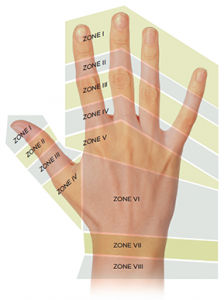
Figure 1. Extensor injury zones.3

You Might Also Like
  • Documentation Pearls for Coding Lacerations
  • Best Practices for Seizure Management In the Emergency Department
  • Standard of Care Review Panel: Ruptured Tendon
Explore This Issue
ACEP Now: Vol 34 – No 12 – December 2015

Figure 1. Extensor injury zones.3
Image Credit: ILLUSTRATION/PAUL JUESTRICH; PHOTOs shutterstock.com

The hand is an intricate structure that provides us with the dexterity needed for our everyday lives. Unfortunately, we see many patients in the emergency department who take this functionality for granted until they lose all or part of it. The attention spent on flexor tendon injuries is pervasive throughout the literature, whereas the more common extensor tendon injuries have not garnered as much attention.1 As emergency physicians, we have the opportunity to decrease the amount of impairment that patients sustain from these extensor tendon injuries by providing them with the appropriate treatment that they deserve.

Diagnosing an extensor tendon injury takes a thorough physical exam, with time spent by the provider to isolate each joint and test the range of motion against resistance. (See “Management of Extensor Tendon Injuries” for more on the exam.)2 The potential impairment that may occur without proper treatment is reason enough to have a low threshold to treat these patients for a tendon injury if there is any doubt in your mind. Even a small discrepancy in your exam may indicate a partial tendon laceration that can progress to a complete laceration if not treated appropriately. Kleinert and Verdan developed a classification system for extensor tendon lacerations that divides the dorsal part of the hand into eight different zones (see Figure 1).3 This classification system is used below as a reference point to provide emergency physicians guidance in treating their next extensor tendon injury.

Introducing CME NowACEP Now features one article each issue related to an ACEP eCME CME activity.

Log on to the ACEP eCME CME site to complete the activity for this article and earn free AMA PRA Category 1 Credit.

Extensor Tendon Injuries and Lacerations

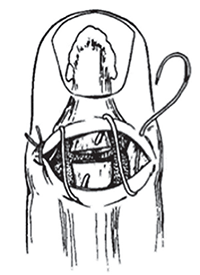
Zone I: This zone encompasses the distal interphalangeal (DIP) joint and the remaining part of the finger distal to the joint. Most commonly, these injuries are closed and require immobilization in hyperextension of the DIP for six to eight weeks and outpatient follow-up with the hand surgeon.4 Besides outpatient follow-up with a hand surgeon, patients are truly responsible for how well these injuries will heal because it’s been shown that compliance with the splint is the biggest factor affecting successful treatment.5
Reprinted with permission from J Emerg Med. 1986;4:217-225.

Figure 2. Roll stitch for extensor tendon laceration repair in zones I and II.7
Reprinted with permission from J Emerg Med. 1986;4:217-225.

Pages: 1 2 3 4 | Single Page

Topics: CMECritical CareEmergency DepartmentEmergency MedicineEmergency PhysicianExtensor Tendon LacerationsProcedures and SkillsTrauma and InjuryTreatment

Related

  • Why the Nonrebreather Should be Abandoned

    December 3, 2025 - 0 Comment
  • Non-Invasive Positive Pressure Ventilation in the Emergency Department

    October 1, 2025 - 0 Comment
  • Emergency Department Management of Prehospital Tourniquets

    October 1, 2025 - 0 Comment

Current Issue

ACEP Now: November 2025

Download PDF

Read More

No Responses to “Emergency Department Management of Extensor Tendon Lacerations”

Leave a Reply Cancel Reply

Your email address will not be published. Required fields are marked *


*
*


Wiley
  • Home
  • About Us
  • Contact Us
  • Privacy
  • Terms of Use
  • Advertise
  • Cookie Preferences
Copyright © 2025 by John Wiley & Sons, Inc. All rights reserved, including rights for text and data mining and training of artificial technologies or similar technologies. ISSN 2333-2603
