Logo

Log In Sign Up |  An official publication of: American College of Emergency Physicians
Navigation
  • Home
  • Multimedia
    • Podcasts
    • Videos
  • Clinical
    • Airway Managment
    • Case Reports
    • Critical Care
    • Guidelines
    • Imaging & Ultrasound
    • Pain & Palliative Care
    • Pediatrics
    • Resuscitation
    • Trauma & Injury
  • Resource Centers
    • mTBI Resource Center
  • Career
    • Practice Management
      • Benchmarking
      • Reimbursement & Coding
      • Care Team
      • Legal
      • Operations
      • Quality & Safety
    • Awards
    • Certification
    • Compensation
    • Early Career
    • Education
    • Leadership
    • Profiles
    • Retirement
    • Work-Life Balance
  • Columns
    • ACEP4U
    • Airway
    • Benchmarking
    • Brief19
    • By the Numbers
    • Coding Wizard
    • EM Cases
    • End of the Rainbow
    • Equity Equation
    • FACEPs in the Crowd
    • Forensic Facts
    • From the College
    • Images in EM
    • Kids Korner
    • Medicolegal Mind
    • Opinion
      • Break Room
      • New Spin
      • Pro-Con
    • Pearls From EM Literature
    • Policy Rx
    • Practice Changers
    • Problem Solvers
    • Residency Spotlight
    • Resident Voice
    • Skeptics’ Guide to Emergency Medicine
    • Sound Advice
    • Special OPs
    • Toxicology Q&A
    • WorldTravelERs
  • Resources
    • ACEP.org
    • ACEP Knowledge Quiz
    • Issue Archives
    • CME Now
    • Annual Scientific Assembly
      • ACEP14
      • ACEP15
      • ACEP16
      • ACEP17
      • ACEP18
      • ACEP19
    • Annals of Emergency Medicine
    • JACEP Open
    • Emergency Medicine Foundation
  • About
    • Our Mission
    • Medical Editor in Chief
    • Editorial Advisory Board
    • Awards
    • Authors
    • Article Submission
    • Contact Us
    • Advertise
    • Subscribe
    • Privacy Policy
    • Copyright Information

Dispelling 5 Ovarian Torsion Myths

By Brit Long, MD, FACEP; Alex Koyfman, MD, FACEP, FAAEM; and Michael Gottlieb, MD, FAAEM | on June 24, 2020 | 1 Comment
Features
  • Tweet
  • Click to email a link to a friend (Opens in new window) Email
Print-Friendly Version

Myth #5: CT of the Abdomen and Pelvis Has No Role in Evaluating Ovarian Torsion
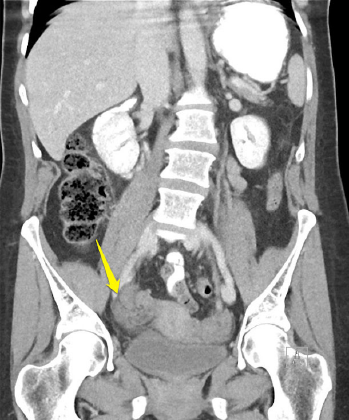
Figure 2 (RIGHT) CT depicting twisted follicle and enlarged ovary.

You Might Also Like
  • Research on Ovarian Size in Children Provides Guidance on Dealing with Torsion, Uncomplicated Cellulitis
  • Pediatric and Adolescent Ovarian Torsion
  • Ovarian Vein Thrombosis Diagnosis, Management Tips for Emergency Physicians
Explore This Issue
ACEP Now: Vol 39 – No 06 – June 2020

Figure 2 (RIGHT)
CT depicting twisted follicle and enlarged ovary.

Patients with undifferentiated abdominal pain often undergo CT, but can CT assist in ruling in or out ovarian torsion? CT with IV contrast will often display findings suggestive of torsion.5,16,33,39–42 Findings on CT with high specificity for ovarian torsion include a twisted vascular pedicle (see Figure 2), a thickened fallopian tube with target/beak-like appearance, absent or reduced ovarian enhancement with contrast, and an enlarged ovary with a follicular ovarian stroma and peripherally displaced follicles.16,33,39–42 Features that are commonly found but not specific include an enlarged ovary, an adnexal mass, adnexal mass mural thickening, free pelvic fluid, fat stranding surrounding the ovary, uterine deviation toward the torsed ovary, and ovarian displacement toward the uterus.16,33,39–42 CT with contrast demonstrates a high sensitivity for these secondary findings, approaching 100 percent.16,33,39–42 If one of these secondary findings is present, TVUS and OB/GYN consultation should be expedited. If these findings are not present and the ovary is normal in size, TVUS may not be needed, depending on the any changes in the clinical course. If the ovary is abnormal on CT, then obtain TVUS.

Finally, if suspicious of torsion based on your history and exam, an ob-gyn consultation should be initiated prior to imaging. If an ob-gyn is unavailable, a general surgery consultation is warranted. Torsion is a time-sensitive condition; early involvement of specialists is paramount.

Key Point: A normal CT of the abdomen and pelvis with contrast that has no secondary findings displays high sensitivity for excluding ovarian torsion. If secondary findings such as an enlarged ovary are present, then obtain TVUS.

Case Conclusion

The CT of the abdomen and pelvis reveals a normal appendix but an enlarged right ovary. A small amount of pelvic free fluid and fat stranding around the right ovary are observed. You consult the ob-gyn on call, who requests a TVUS. The TVUS reveals an enlarged ovary with decreased venous flow on Doppler. The ob-gyn evaluates the patient and takes her to the operating room, where detorsion is successful.


Dr. Long is an emergency physician in the San Antonio Uniformed Services Health Education Consortium at Fort Sam Houston, Texas. Dr. Koyfman (@EMHighAK) is assistant professor of emergency medicine at UT Southwestern Medical Center and an attending physician at Parkland Memorial Hospital in Dallas. Dr. Gottlieb is associate professor, ultrasound division director, and ultrasound fellowship director in the department of emergency medicine at Rush University Medical Center in Chicago.

Pages: 1 2 3 4 5 | Single Page

Topics: Computed TomographyImaging & UltrasoundOvarianOvarian TorsionPhysical ExamTransvaginal Ultrasound

Related

  • ACEP’s October 2025 Poll: How Often Do You Read Your Own X-Rays?

    September 30, 2025 - 0 Comment
  • Case Report: Rapid Diagnosis of Acute Aortic Dissection with POCUS

    June 11, 2025 - 1 Comment
  • How Well Does Ultrasound Detect Volvulus in Infants?

    September 5, 2024 - 0 Comment

Current Issue

ACEP Now: November 2025

Download PDF

Read More

One Response to “Dispelling 5 Ovarian Torsion Myths”

  1. July 5, 2020

    Jerry W. Jones, MD FACEP FAAEM Reply

    Excellent article. Very concise and right to the point.

Leave a Reply Cancel Reply

Your email address will not be published. Required fields are marked *


*
*


Wiley
  • Home
  • About Us
  • Contact Us
  • Privacy
  • Terms of Use
  • Advertise
  • Cookie Preferences
Copyright © 2025 by John Wiley & Sons, Inc. All rights reserved, including rights for text and data mining and training of artificial technologies or similar technologies. ISSN 2333-2603
