Logo

Log In Sign Up |  An official publication of: American College of Emergency Physicians
Navigation
  • Home
  • Multimedia
    • Podcasts
    • Videos
  • Clinical
    • Airway Managment
    • Case Reports
    • Critical Care
    • Guidelines
    • Imaging & Ultrasound
    • Pain & Palliative Care
    • Pediatrics
    • Resuscitation
    • Trauma & Injury
  • Resource Centers
    • mTBI Resource Center
  • Career
    • Practice Management
      • Benchmarking
      • Reimbursement & Coding
      • Care Team
      • Legal
      • Operations
      • Quality & Safety
    • Awards
    • Certification
    • Compensation
    • Early Career
    • Education
    • Leadership
    • Profiles
    • Retirement
    • Work-Life Balance
  • Columns
    • ACEP4U
    • Airway
    • Benchmarking
    • Brief19
    • By the Numbers
    • Coding Wizard
    • EM Cases
    • End of the Rainbow
    • Equity Equation
    • FACEPs in the Crowd
    • Forensic Facts
    • From the College
    • Images in EM
    • Kids Korner
    • Medicolegal Mind
    • Opinion
      • Break Room
      • New Spin
      • Pro-Con
    • Pearls From EM Literature
    • Policy Rx
    • Practice Changers
    • Problem Solvers
    • Residency Spotlight
    • Resident Voice
    • Skeptics’ Guide to Emergency Medicine
    • Sound Advice
    • Special OPs
    • Toxicology Q&A
    • WorldTravelERs
  • Resources
    • ACEP.org
    • ACEP Knowledge Quiz
    • Issue Archives
    • CME Now
    • Annual Scientific Assembly
      • ACEP14
      • ACEP15
      • ACEP16
      • ACEP17
      • ACEP18
      • ACEP19
    • Annals of Emergency Medicine
    • JACEP Open
    • Emergency Medicine Foundation
  • About
    • Our Mission
    • Medical Editor in Chief
    • Editorial Advisory Board
    • Awards
    • Authors
    • Article Submission
    • Contact Us
    • Advertise
    • Subscribe
    • Privacy Policy
    • Copyright Information

Disease Trajectory as an Emergency Medicine Tool

By Kate Aberger, MD, FACEP, Marny Fetzer, MD, Rebecca Goett, MD, Sangeeta Lamba, MD, MS HPEd, and Mark Rosenberg, DO, MBA | on December 10, 2015 | 0 Comment
Features
  • Tweet
  • Click to email a link to a friend (Opens in new window) Email
Print-Friendly Version
Cancer trajectory

You Might Also Like
  • Emergency Medicine’s Role in End-of-Life Care
  • Building the Future of Emergency Medicine and Palliative Care
  • Emergency Physicians Can Help Ensure Patients Receive Quality End-of-Life Care

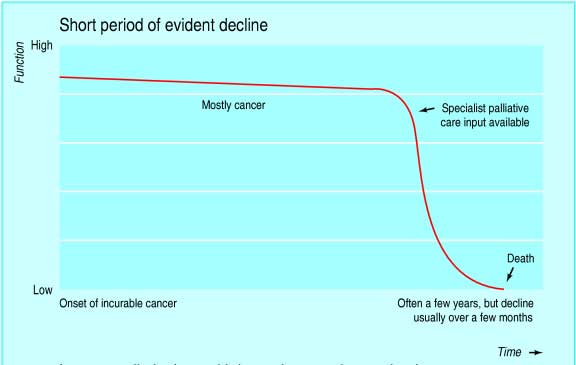
Figure 2: Cancer trajectory
Reprinted with permission from BMJ. 2005;330:1007–1011.

Cancer has a different trajectory than cardiopulmonary disease (see Figure 2). Cancer patients who were fairly healthy before an early-stage diagnosis often continue to do well through their treatments and hopefully progress to a cure. People can return to baseline if they only require symptomatic treatment for simple challenges like chemotherapy-induced dehydration or nausea and vomiting. However, if prolonged immunocompromise or significant metastatic spread occurs, patients eventually reach a physiologic tipping point. When this happens, decline is usually rapid, and patients will not revert back to their previous quality of life.3,4
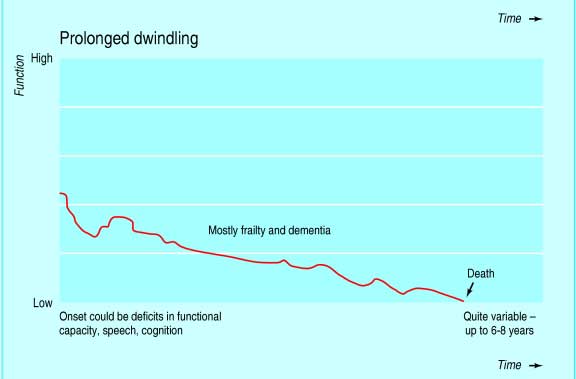
Figure 3: Neurologic failure trajectory

Figure 3: Neurologic failure trajectory
Reprinted with permission from BMJ. 2005;330:1007–1011.

Neurologic failure may be related to dementia or other irreversible and progressive neurologic conditions (see Figure 3). Stroke may also cause neurologic failure if either a massive stroke is survived or is superimposed on another progressive neurologic condition, leading to acceleration of a patient’s functional decline. These patients live with low levels of functional and physiologic reserve. Opportunistic infections (eg, urine, respiratory) or minor falls lead to disproportionate levels of morbidity and mortality. Neurologic failure most often progresses to the constellation of bedbound status, opportunistic infection, dysphasia, weight loss, and death. During decline, families and caregivers may become confused because patients have “good days and bad days.” Despite these minor fluctuations, established neurologic failure is terminal and not reversible. 2,3

Employing Illness Trajectories in the ED

It can be difficult to have conversations about palliative care options, especially in the fast-paced emergency department environment. Illness trajectories can be a good tool for explaining a patient’s long-term prognosis and starting a conversation about palliative care. Here’s a sample conversation between a caregiver and an emergency physician.
Family Member: Doctor, can you help me understand why my mom keeps winding up in the hospital? She has been admitted three times in the last few months. Rehabilitation doesn’t seem to be helping very much with her strength or dementia symptoms. I’m worried being in the hospital is hard on her, but I don’t know what else to do. Is this going to get better?
Physician: Unfortunately, there is no cure for dementia, and it will slowly get worse with time. It also makes her susceptible to repeat infections that can be severe. If being in the hospital is getting hard for your mom and you don’t think she would want this type of care, there are more options for her. Have you considered talking with palliative care?

Putting Trajectories Into Practice

Although it may seem difficult to move beyond the acute exacerbation during a long shift, emergency physicians can begin discussions of these trajectories and what they may mean for our patients and their caregivers. Sharing disease trajectory information empowers providers and the patients we treat to make the best decisions possible, whether moving forward with a procedure or a consultation for palliative care.1 (See sidebar for a sample conversation.)

Pages: 1 2 3 | Single Page

Topics: End-of-LifeEnd-of-Life CareIllness TrajectoriesPain and Palliative Care

Related

  • Using Extracorporeal Membrane Oxygenation as Life-Sustaining Therapy

    June 30, 2025 - 0 Comment
  • The Evidence for Empathy in the Emergency Department

    June 17, 2025 - 0 Comment
  • Sickle Cell Outcomes Better at Infusion Center Than Emergency Department

    August 17, 2021 - 0 Comment

Current Issue

ACEP Now: November 2025

Download PDF

Read More

No Responses to “Disease Trajectory as an Emergency Medicine Tool”

Leave a Reply Cancel Reply

Your email address will not be published. Required fields are marked *


*
*


Wiley
  • Home
  • About Us
  • Contact Us
  • Privacy
  • Terms of Use
  • Advertise
  • Cookie Preferences
Copyright © 2025 by John Wiley & Sons, Inc. All rights reserved, including rights for text and data mining and training of artificial technologies or similar technologies. ISSN 2333-2603
