Logo

Log In Sign Up |  An official publication of: American College of Emergency Physicians
Navigation
  • Home
  • Multimedia
    • Podcasts
    • Videos
  • Clinical
    • Airway Managment
    • Case Reports
    • Critical Care
    • Guidelines
    • Imaging & Ultrasound
    • Pain & Palliative Care
    • Pediatrics
    • Resuscitation
    • Trauma & Injury
  • Resource Centers
    • mTBI Resource Center
  • Career
    • Practice Management
      • Benchmarking
      • Reimbursement & Coding
      • Care Team
      • Legal
      • Operations
      • Quality & Safety
    • Awards
    • Certification
    • Compensation
    • Early Career
    • Education
    • Leadership
    • Profiles
    • Retirement
    • Work-Life Balance
  • Columns
    • ACEP4U
    • Airway
    • Benchmarking
    • Brief19
    • By the Numbers
    • Coding Wizard
    • EM Cases
    • End of the Rainbow
    • Equity Equation
    • FACEPs in the Crowd
    • Forensic Facts
    • From the College
    • Images in EM
    • Kids Korner
    • Medicolegal Mind
    • Opinion
      • Break Room
      • New Spin
      • Pro-Con
    • Pearls From EM Literature
    • Policy Rx
    • Practice Changers
    • Problem Solvers
    • Residency Spotlight
    • Resident Voice
    • Skeptics’ Guide to Emergency Medicine
    • Sound Advice
    • Special OPs
    • Toxicology Q&A
    • WorldTravelERs
  • Resources
    • ACEP.org
    • ACEP Knowledge Quiz
    • Issue Archives
    • CME Now
    • Annual Scientific Assembly
      • ACEP14
      • ACEP15
      • ACEP16
      • ACEP17
      • ACEP18
      • ACEP19
    • Annals of Emergency Medicine
    • JACEP Open
    • Emergency Medicine Foundation
  • About
    • Our Mission
    • Medical Editor in Chief
    • Editorial Advisory Board
    • Awards
    • Authors
    • Article Submission
    • Contact Us
    • Advertise
    • Subscribe
    • Privacy Policy
    • Copyright Information

Decreased Public Mental Health Spending Raises Concerns over Psychiatric Patient Boarding

By Jackie Kitchen, MD | on June 10, 2014 | 1 Comment
Features
  • Tweet
  • Click to email a link to a friend (Opens in new window) Email
Print-Friendly Version
Decreased Public Mental Health Spending Raises Concerns over Psychiatric Patient Boarding

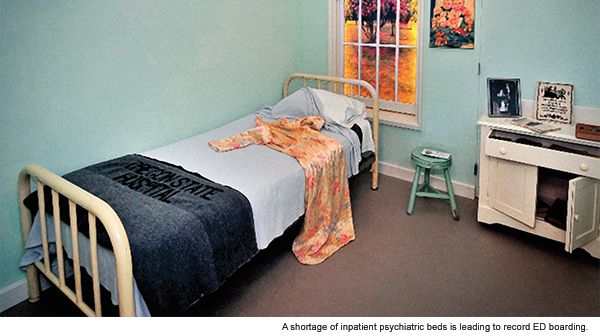
As emergency care providers, whether in rural Iowa or inner-city New York, we are all impacted by the shortage of inpatient psychiatric beds. Cost, quality of care, ED throughput, and patient safety are all negatively impacted by this crisis. Solutions,such as collaborating with community mental health services, educating ED staff about the management of the boarding mental health patient, and using telemedicine are all viable strategies that will protect a subset of ED patients who often cannot advocate for themselves.

You Might Also Like
  • Solutions Needed to Reduce Boarding of Mental Health Patients in Emergency Departments
  • Telepsychiatry, Emergency Psychiatric Services Can Reduce Mental Health Patient Boarding
  • Washington Chapter ACEP Brings Fight Against Psychiatric Boarding to the Courts
Explore This Issue
ACEP Now: Vol 33 – No 06 – June 2014

Dr. Kitchen is an emergency physician resident R2 at the University of Iowa Hospital and Clinics in Iowa City.

References

  1. Torrey EF, Entsminger K, Geller J, et al. The shortage of public hospital beds for mentally ill persons. Arlington, Va: Treatment Advocacy Center; 2008.
  2. ACEP. America’s emergency care environment: A state-by-state report card 2014.
  3. Nicks BA, Manthey DM. The impact of psychiatric patient boarding in emergency departments. Emerg Med Int. 2012;2012:360306.
  4. Hickey L, Hawton K, Fagg J, Weitzel H. Deliberate self-harm patients who leave the accident and emergency department without a psychiatric assessment: a neglected population at risk of suicide. J Psychosomatic Res. 2001:50(2):87-93
  5. Richardson DB. Increase in patient mortality at 10 days associated with emergency department overcrowding. Med J Aust. 2006:184(5):213-216.
  6. Sprivulis PC, Da Silva JA, Jacobs IG, et al. The association between hospital overcrowding and mortality among patients admitted via Western Australian emergency departments. Med J Aust. 2006:184(5):208-212.
  7. Glover RW, Miller J, Sadowski S. Proceedings on the state budget crisis and behavioral health treatment gap: The impact of public substance abuse and mental health treatment systems. Special Congressional Briefing; March 22, 2012.
  8. Alakeson V, Pande N, Ludwig M. A plan to reduce emergency room ‘boarding’ of psychiatric patients. Health Affairs. 2010; 29(9): 1637-1642.

Pages: 1 2 3 | Single Page

Topics: Cost of Health CareEmergency DepartmentEmergency MedicineEmergency PhysicianHealth InsuranceMental HealthPatient BoardingPatient SafetyPractice TrendsPsychology and Behavioral DisorderPublic HealthPublic Policy

Related

  • Opinion: Physicians Must Reduce Plastic Waste

    December 4, 2025 - 0 Comment
  • Q&A with ACEP President L. Anthony Cirillo

    November 5, 2025 - 0 Comment
  • Overcoming Language Barriers in the Emergency Department

    October 21, 2025 - 0 Comment

Current Issue

ACEP Now: November 2025

Download PDF

Read More

One Response to “Decreased Public Mental Health Spending Raises Concerns over Psychiatric Patient Boarding”

  1. July 6, 2014

    benzonit Reply

    As a full time practicing EM doc, I suggest another solution; we can’t always cry “more more more” and expect to be part of the solution.
    I see many of our inpatient psych beds occupied by drug and alcohol patients, voluntary and involuntary (court committed at, usually, family request.)
    What is point here, keep them sober? Staying sober in the hospital is like staying non-pregnant in the cloister; there ain’t none.
    I think we could sit down with court officers and help them understand this is a useless expenditure of public funds.
    We would then free up psych beds.
    Unfortunately for the hospital, we may just trade a paying bed (court committed and paid) for a non paying (public in need.)
    That’s a discussion for another day.

Leave a Reply Cancel Reply

Your email address will not be published. Required fields are marked *


*
*


Wiley
  • Home
  • About Us
  • Contact Us
  • Privacy
  • Terms of Use
  • Advertise
  • Cookie Preferences
Copyright © 2025 by John Wiley & Sons, Inc. All rights reserved, including rights for text and data mining and training of artificial technologies or similar technologies. ISSN 2333-2603
