
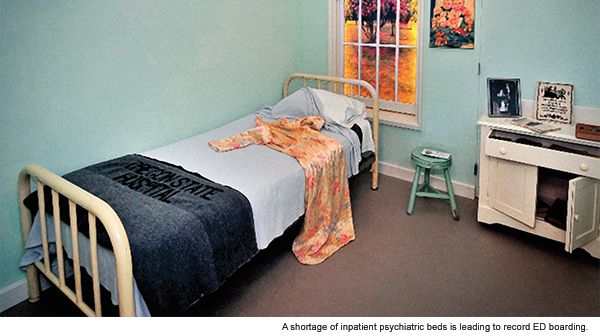
The financial impact of boarding these patients is profound. A recent study at Wake Forest University Health Sciences Center found admitted psychiatric patients are associated with a 40 percent decrease in average physician reimbursement as compared to nonpsychiatric patients. Furthermore, the increased length of stay for each of these patients was determined to prevent the ED from caring for an additional 2.2 patients, leading to an overall financial loss to the system of approximately $2,400 per boarded psychiatric patient.3
Explore This Issue
ACEP Now: Vol 33 – No 06 – June 2014The effects of budget cuts to public mental health care can be felt at the ground level in many emergency departments across the nation. Per the ACEP State-by-State Report Card, Iowa ranks 16th in the nation in number of psychiatric inpatient at 28 beds per 100,000 population. Although I work at the state’s only tertiary referral hospital, we lack sufficient psychiatric beds for our needs and are frequently forced to transfer patients to other facilities. We recently conducted a review of patient records for all psychiatric patients transferred out of the University of Iowa Hospitals and Clinics (UIHC) for 2010–2013. The average length of stay for psychiatric patients requiring transfer out of our ED more than doubled in that time (from 5.6 hours in 2010 to 13.8 hours in 2013). It is not unusual for patients to wait more than 24 hours in the ED while providers attempt to locate an available psychiatric bed.
The primary problem is inadequate funding. The recent economic downturn forced states to cut approximately $4.35 billion in public mental health spending in the period between 2009–2012, the largest reduction since deinstitutionalization in the 1960s.7 According to Steve Blanchard, the department administrator of UIHC Psychiatry, most hospitals run their inpatient psychiatric units at a deficit. Due to the chronic, disabling nature of mental illness, many patients seek care with coverage through government payers, which generally pay below cost. Duration of stay in an acute inpatient setting may be lengthened due to the inadequacy of outpatient community resources. In Iowa, the supply of inpatient psychiatric beds has continued to decline as inpatient facilities close due to lack of funding and retirement or exodus of Iowa psychiatrists to states with better reimbursement and more support staff. The problem of the inadequate supply of beds is exacerbated by the poor distribution of beds; many rural areas have no access to services. UIHC recently had a patient remain on one of the acute inpatient psychiatric units for 442 days because it was nearly impossible to locate a community-based option that could accept the patient, despite contacting more than 100 facilities.
In the absence of the promises for increased funding for mental health from state or federal sources, alternative solutions should be pursued.
While some of these problems may be specific to Iowa, they are symptomatic of the larger national crisis of lack of adequate mental health care. In the absence of promises for increased funding for mental health from state or federal sources, alternative solutions should be pursued. For example, telepsych, or the remote psychiatric evaluation, is one alternative being piloted at UIHC. Additionally, low-cost collaboration between EDs and community outpatient alternatives has been shown to decrease emergency department boarding.8 This collaboration could include using mental health clinicians to train ED staff in the management and care of patients with serious mental illnesses or having a social worker in the ED who can connect patients with community services at the time of discharge. The involvement of law enforcement may help. Federal grants of up to $250,000 over two years are available for the planning, implementation, or expansion of collaborative programs between criminal justice and mental health partners, including specialized training of law enforcement officers.
Pages: 1 2 3 | Single Page



One Response to “Decreased Public Mental Health Spending Raises Concerns over Psychiatric Patient Boarding”
July 6, 2014
benzonitAs a full time practicing EM doc, I suggest another solution; we can’t always cry “more more more” and expect to be part of the solution.
I see many of our inpatient psych beds occupied by drug and alcohol patients, voluntary and involuntary (court committed at, usually, family request.)
What is point here, keep them sober? Staying sober in the hospital is like staying non-pregnant in the cloister; there ain’t none.
I think we could sit down with court officers and help them understand this is a useless expenditure of public funds.
We would then free up psych beds.
Unfortunately for the hospital, we may just trade a paying bed (court committed and paid) for a non paying (public in need.)
That’s a discussion for another day.