
Logo

Log In Sign Up |  An official publication of: American College of Emergency Physicians
Navigation
  • Home
  • Multimedia
    • Podcasts
    • Videos
  • Clinical
    • Airway Managment
    • Case Reports
    • Critical Care
    • Guidelines
    • Imaging & Ultrasound
    • Pain & Palliative Care
    • Pediatrics
    • Resuscitation
    • Trauma & Injury
  • Resource Centers
    • mTBI Resource Center
  • Career
    • Practice Management
      • Benchmarking
      • Reimbursement & Coding
      • Care Team
      • Legal
      • Operations
      • Quality & Safety
    • Awards
    • Certification
    • Compensation
    • Early Career
    • Education
    • Leadership
    • Profiles
    • Retirement
    • Work-Life Balance
  • Columns
    • ACEP4U
    • Airway
    • Benchmarking
    • Brief19
    • By the Numbers
    • Coding Wizard
    • EM Cases
    • End of the Rainbow
    • Equity Equation
    • FACEPs in the Crowd
    • Forensic Facts
    • From the College
    • Images in EM
    • Kids Korner
    • Medicolegal Mind
    • Opinion
      • Break Room
      • New Spin
      • Pro-Con
    • Pearls From EM Literature
    • Policy Rx
    • Practice Changers
    • Problem Solvers
    • Residency Spotlight
    • Resident Voice
    • Skeptics’ Guide to Emergency Medicine
    • Sound Advice
    • Special OPs
    • Toxicology Q&A
    • WorldTravelERs
  • Resources
    • ACEP.org
    • ACEP Knowledge Quiz
    • Issue Archives
    • CME Now
    • Annual Scientific Assembly
      • ACEP14
      • ACEP15
      • ACEP16
      • ACEP17
      • ACEP18
      • ACEP19
    • Annals of Emergency Medicine
    • JACEP Open
    • Emergency Medicine Foundation
  • About
    • Our Mission
    • Medical Editor in Chief
    • Editorial Advisory Board
    • Awards
    • Authors
    • Article Submission
    • Contact Us
    • Advertise
    • Subscribe
    • Privacy Policy
    • Copyright Information

A Cost-effective Way to Evaluate Patients with Recurrent Renal Colic

By Michelle Lin, MD, MPH and Jeremiah D. Schuur, MD, MHS | on January 8, 2014 | 0 Comment
Opinion
  • Tweet
  • Click to email a link to a friend (Opens in new window) Email
Print-Friendly Version
A Better Approach to Managing Recurrent Renal Colic

Increasing use of CT is concerning due to radiation exposure, and patients with recurrent renal colic are at particularly high risk of repeat CTs, with a median dose of 7.9 mSv each (20 mSv is the maximum allowable for radiation workers annually, and 100 mSv is associated with carcinogenic effects).

You Might Also Like
  • The ER is a Cost-Effective Place to Receive Acute Care
  • Focused Renal Sonography
  • Should You Use Lidocaine Instead of Opioids to Treat Renal Colic?
Explore This Issue
ACEP Now: Vol 33 – No 01 – January 2014

The cost of these CTs adds up to real dollars. In 2012, Medicare reimbursement for non-contrast CT of the abdomen was $306, while hospital charges ranged from $35 to $2,724. In 2009, an estimated 497,000 CTs were performed for the evaluation of renal colic, totaling $152 million in medical costs (a conservative estimate based on Medicare payments).3
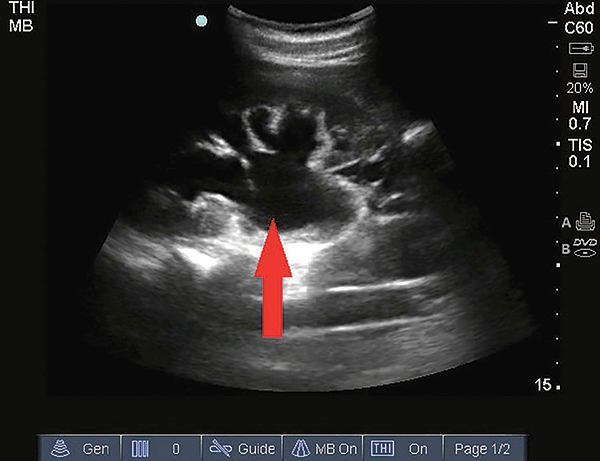
Hydronephrosis appears on ultrasound as a dilated hypoechoic (black) region in the collecting system of the kidney.

Hydronephrosis appears on ultrasound as a dilated hypoechoic (black) region in the collecting system of the kidney.

How can we safely evaluate patients with recurrent renal colic in a more cost-effective way than with repeat CTs?

Urinalysis and bedside renal ultrasound are an effective strategy to confirm recurrent renal colic. Microscopic hematuria is found in 84 percent of patients with kidney stones; however, due to its presence in other diseases, the specificity is 48 percent. Adding ultrasound enhances the yield of urinalysis alone.

Bedside ultrasound by an emergency physician is rapid, safe, and less expensive than CT. Ultrasound is 87 percent sensitive and 82 percent specific for the identification of hydronephrosis, which is present in 69 percent of patients with acute ureteral colic.4 While ultrasound is less sensitive for the detection of small stones, you don’t need to see the stone to make the diagnosis of renal colic. If you choose to perform ultrasound instead of CT, you aren’t alone—the American College of Radiology appropriateness criteria rates ultrasound as equivalent to CT of the abdomen for the evaluation of recurrent stones. If your group and emergency department are billing for ultrasounds, the cost of a renal ultrasound based on Medicare rates is $99, less than a third of the cost of CT.

With basic training, hydronephrosis is easy to identify using ultrasound. In one study, second-year emergency-medicine residents were able to identify hydronephrosis with 96 percent accuracy compared to registered sonographers after 45 minutes of renal ultrasound training (within a larger curriculum).5 Not all renal colic patients need IV fluids, but hydronephrosis is easier to detect after a 500 cc bolus. A prospective study of urinalysis and ultrasound in 227 patients resulted in discharge of half of patients found to have hydronephrosis and microscopic hematuria.6 Among those discharged, 81 percent ultimately had kidney stones, and none had adverse outcomes within three months.

The Bottom Line

The emergency physician’s role in the management of acute renal colic is symptom relief, evaluation for complications such as infection, and consideration of alternate diagnoses. The vast majority of stones pass spontaneously, and CT imaging in the emergency department rarely alters immediate management. One randomized study found that patients with suspected renal colic who undergo delayed outpatient imaging have equivalent outcomes to those who undergo emergency department imaging at four-week follow-up.7

Pages: 1 2 3 | Single Page

Topics: Cost of Health CareCost-Effective CareCritical CareEmergency MedicineEmergency PhysicianImaging and UltrasoundInternal MedicinePainPractice ManagementPractice TrendsProcedures and SkillsRenalUltrasound

Related

  • Why the Nonrebreather Should be Abandoned

    December 3, 2025 - 0 Comment
  • Florida Emergency Department Adds Medication-Dispensing Kiosk

    November 7, 2025 - 1 Comment
  • Q&A with ACEP President L. Anthony Cirillo

    November 5, 2025 - 0 Comment

Current Issue

ACEP Now: November 2025

Download PDF

Read More

About the Authors

Michelle Lin, MD, MPH

Michelle Lin, MD, MPH, is an attending emergency physician and a fellow in the Division of Health Policy Research and Translation in the Department of Emergency Medicine, Brigham and Women’s Hospital in Boston. She also serves as an instructor at Harvard Medical School.

View this author's posts »

Jeremiah D. Schuur, MD, MHS

Jeremiah D. Schuur, MD, MHS, is vice chair of quality and safety and chief of the Division of Health Policy Research and Translation in the Department of Emergency Medicine, Brigham & Women’s Hospital in Boston. He also serves as assistant professor at Harvard Medical School.

View this author's posts »

No Responses to “A Cost-effective Way to Evaluate Patients with Recurrent Renal Colic”

Leave a Reply Cancel Reply

Your email address will not be published. Required fields are marked *


*
*


Wiley
  • Home
  • About Us
  • Contact Us
  • Privacy
  • Terms of Use
  • Advertise
  • Cookie Preferences
Copyright © 2025 by John Wiley & Sons, Inc. All rights reserved, including rights for text and data mining and training of artificial technologies or similar technologies. ISSN 2333-2603
