Logo

Log In Sign Up |  An official publication of: American College of Emergency Physicians
Navigation
  • Home
  • Multimedia
    • Podcasts
    • Videos
  • Clinical
    • Airway Managment
    • Case Reports
    • Critical Care
    • Guidelines
    • Imaging & Ultrasound
    • Pain & Palliative Care
    • Pediatrics
    • Resuscitation
    • Trauma & Injury
  • Resource Centers
    • mTBI Resource Center
  • Career
    • Practice Management
      • Benchmarking
      • Reimbursement & Coding
      • Care Team
      • Legal
      • Operations
      • Quality & Safety
    • Awards
    • Certification
    • Compensation
    • Early Career
    • Education
    • Leadership
    • Profiles
    • Retirement
    • Work-Life Balance
  • Columns
    • ACEP4U
    • Airway
    • Benchmarking
    • Brief19
    • By the Numbers
    • Coding Wizard
    • EM Cases
    • End of the Rainbow
    • Equity Equation
    • FACEPs in the Crowd
    • Forensic Facts
    • From the College
    • Images in EM
    • Kids Korner
    • Medicolegal Mind
    • Opinion
      • Break Room
      • New Spin
      • Pro-Con
    • Pearls From EM Literature
    • Policy Rx
    • Practice Changers
    • Problem Solvers
    • Residency Spotlight
    • Resident Voice
    • Skeptics’ Guide to Emergency Medicine
    • Sound Advice
    • Special OPs
    • Toxicology Q&A
    • WorldTravelERs
  • Resources
    • ACEP.org
    • ACEP Knowledge Quiz
    • Issue Archives
    • CME Now
    • Annual Scientific Assembly
      • ACEP14
      • ACEP15
      • ACEP16
      • ACEP17
      • ACEP18
      • ACEP19
    • Annals of Emergency Medicine
    • JACEP Open
    • Emergency Medicine Foundation
  • About
    • Our Mission
    • Medical Editor in Chief
    • Editorial Advisory Board
    • Awards
    • Authors
    • Article Submission
    • Contact Us
    • Advertise
    • Subscribe
    • Privacy Policy
    • Copyright Information

Coping with COVID-19: The Puget Sound Experience

By Liam Yore, MD, FACEP | on April 1, 2020 | 0 Comment
Uncategorized
  • Tweet
  • Click to email a link to a friend (Opens in new window) Email
Print-Friendly Version
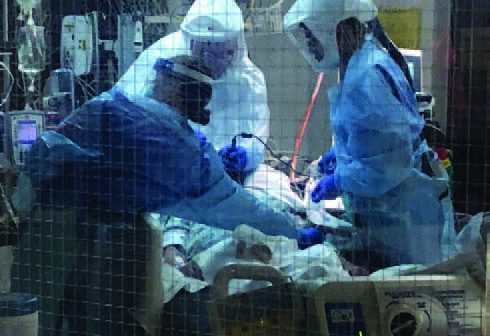
Physicians in PPE care for a patient with COVID-19.

Author’s Note: I am not an authorized representative of any hospital but am writing broadly from my knowledge of experiences at medical centers across the Puget Sound region, an epicenter of the recent coronavirus outbreak in the United States.

You Might Also Like
  • Diabetes, Lung, and Heart Disease Common in U.S. COVID-19 Patient
  • Loss of Taste and Smell Key COVID-19 Symptoms, App Study Finds
  • Health Workers Rush to Contain Fresh Ebola Outbreak in Guinea
Explore This Issue
ACEP Now: Vol 39 – No 04 – April 2020

Editors’ Note: This article was accepted on March 16, 2020, and was accurate at that time. Because information about SARS-nCoV-2 and COVID-19 is evolving rapidly, please verify these recommendations and information.

The first case of COVID-19 at Providence Regional Medical Center in Everett, Washington, was diagnosed Jan. 20, 2020, in an intensive care unit patient who had recently traveled from Wuhan Province in China. We had heard about the epidemic breaking out of China, yet it came as a sobering shock to my colleagues and me when we realized the illness was at our local facility.

The real diagnostic challenge began about a week into the epidemic, when we started seeing patients with features of COVID-19 at various facilities across Puget Sound. We had large numbers of patients who had possibly been exposed, many of whom were showing symptoms that could be compatible with the disease.

Since that first case, we’ve seen a lot of patients with clinical features consistent with other descriptions that have been given—patients with cough, sore throat, and fever. Most patients had typical presentations, though some older adults did not mount a fever response. Many patients have had leukopenia, and some have had high transaminases. Some people had only mild symptoms, but we couldn’t definitively diagnose because no testing was available at that time. We had to assume that such patients might have COVID-19, so we sent them home for self-quarantine.

Triage and Treatment

We quickly learned to focus on the patients who appeared very ill. We’ve found that the clinical presentation was quite different from typical cold symptoms or common flu. Patients might present with a little labored breathing and mild hypoxia. However, the chest X-ray often looked substantially worse than the patient appeared. One could see a classic viral pattern of bilateral patchy ground-glass infiltrates.

We learned to recognize that as a highly alarming sign. In our experience, once patients develop that, the progression to severe respiratory complications is likely. For sick patients coming into the emergency department, this can often happen quickly, within hours. We’ve seen some patients who went from slight hypoxia on arrival to needing intubation eight hours later, displaying a severe viral pneumonia or even an acute respiratory distress syndrome pattern. We’ve been surprised by how dangerous this virus is, how it can make certain people very ill very quickly. That is in line with the Chinese experience, but it has still been disconcerting to see up close.

Pages: 1 2 3 4 | Single Page

Topics: coronavirusCOVID-19Puget Sound

Related

  • ACEP Member Uses ED, Military Training To Set Standards at FEMA

    August 11, 2025 - 0 Comment
  • Dr. Joe Sachs and “The Pitt” Redefine Public Health Education Through Storytelling

    July 3, 2025 - 0 Comment
  • Dr. Joe Sachs and “The Pitt” Are Redefining Public Health Education Through Storytelling

    June 11, 2025 - 0 Comment

Current Issue

ACEP Now: November 2025

Download PDF

Read More

No Responses to “Coping with COVID-19: The Puget Sound Experience”

Leave a Reply Cancel Reply

Your email address will not be published. Required fields are marked *


*
*


Wiley
  • Home
  • About Us
  • Contact Us
  • Privacy
  • Terms of Use
  • Advertise
  • Cookie Preferences
Copyright © 2025 by John Wiley & Sons, Inc. All rights reserved, including rights for text and data mining and training of artificial technologies or similar technologies. ISSN 2333-2603
