Logo

Log In Sign Up |  An official publication of: American College of Emergency Physicians
Navigation
  • Home
  • Multimedia
    • Podcasts
    • Videos
  • Clinical
    • Airway Managment
    • Case Reports
    • Critical Care
    • Guidelines
    • Imaging & Ultrasound
    • Pain & Palliative Care
    • Pediatrics
    • Resuscitation
    • Trauma & Injury
  • Resource Centers
    • mTBI Resource Center
  • Career
    • Practice Management
      • Benchmarking
      • Reimbursement & Coding
      • Care Team
      • Legal
      • Operations
      • Quality & Safety
    • Awards
    • Certification
    • Compensation
    • Early Career
    • Education
    • Leadership
    • Profiles
    • Retirement
    • Work-Life Balance
  • Columns
    • ACEP4U
    • Airway
    • Benchmarking
    • Brief19
    • By the Numbers
    • Coding Wizard
    • EM Cases
    • End of the Rainbow
    • Equity Equation
    • FACEPs in the Crowd
    • Forensic Facts
    • From the College
    • Images in EM
    • Kids Korner
    • Medicolegal Mind
    • Opinion
      • Break Room
      • New Spin
      • Pro-Con
    • Pearls From EM Literature
    • Policy Rx
    • Practice Changers
    • Problem Solvers
    • Residency Spotlight
    • Resident Voice
    • Skeptics’ Guide to Emergency Medicine
    • Sound Advice
    • Special OPs
    • Toxicology Q&A
    • WorldTravelERs
  • Resources
    • ACEP.org
    • ACEP Knowledge Quiz
    • Issue Archives
    • CME Now
    • Annual Scientific Assembly
      • ACEP14
      • ACEP15
      • ACEP16
      • ACEP17
      • ACEP18
      • ACEP19
    • Annals of Emergency Medicine
    • JACEP Open
    • Emergency Medicine Foundation
  • About
    • Our Mission
    • Medical Editor in Chief
    • Editorial Advisory Board
    • Awards
    • Authors
    • Article Submission
    • Contact Us
    • Advertise
    • Subscribe
    • Privacy Policy
    • Copyright Information

Combating COVID in Latino Communities

By Renée Bacher | on June 15, 2021 | 0 Comment
Features
  • Tweet
  • Click to email a link to a friend (Opens in new window) Email
Print-Friendly Version
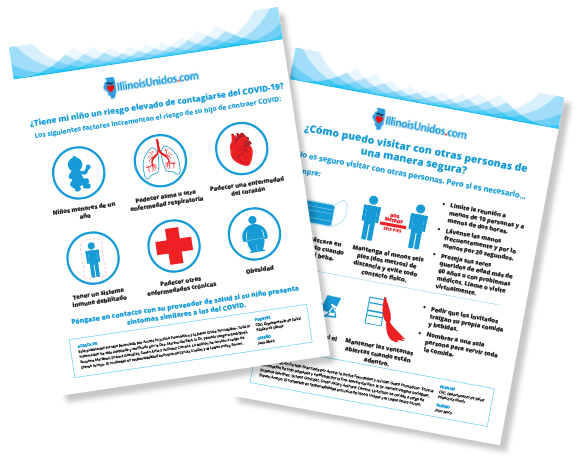
 Illinois Unidos provides COVID-19 information sheets in Spanish and English on its website, IllinoisUnidos.com. Illinois Unidos

You Might Also Like
  • Correction
  • Floating Doctors Volunteers Bring Patient Care to Remote Communities in Panama
  • COVID-19 Vaccine Hesitancy Info and Tips
Explore This Issue
ACEP Now: Vol 40 – No 06 – June 2021

Illinois Unidos provides COVID-19 information sheets in Spanish and English on its website, IllinoisUnidos.com.
Illinois Unidos

At that point, the City of Chicago and the State of Illinois were mostly providing overall rates of COVID-19 illness, with a recognition that the Black population in the state was being disproportionately affected. In Latino communities, however, there was also a high rate of illness and mortality, but it was not yet being discussed. The community’s fear, she said, was that there was undercounting and underreporting related to the way the state and the city were looking at the data. 

“We have some data-savvy people that are community members who started looking at COVID-19 rates by ZIP code, and there was a recognition that there were predominantly Latino ZIP codes that had high rates of infection and high rates of mortality,” she said. She thought the first meeting of Illinois Unidos would be like a think tank to discuss what to do next. But it grew into weekly meetings to discuss ongoing issues like how to garner media attention, gather resources, and have conversations with Latino government officials in the state and City of Chicago. 

“From that, we’ve learned we all have different expertise, and different leadership roles have arisen throughout the time of the pandemic,” she said. 

The coalition has focused not only on getting bilingual and bicultural information on COVID-19 into the Latino community but also providing testing and personal protective equipment and advocating for resources to take care of COVID-19 survivors and their families, some of whom are of mixed status and include undocumented people who don’t typically qualify for resources.

Beyond COVID-19, Dr. Del Rios Rivera said the Latino community confronts problems of structural racism similar to those faced by Black and Native American communities, including redlining, food/pharmacy/health and hospital deserts, and people being left out of worker protections due to discrimination. “The additional piece with the Latino community, though, is the language component,” she said, “and the fact that many are not citizens, so they are treated worse because there’s no protections in place for people that don’t have the U.S. citizen badge.” 

The silver lining, she said, is that the pandemic shined a light on existing problems and issues with infrastructure that needed to be fixed anyway. She is hoping the same model can be used not just for another possible pandemic but also to point to hot spots in all communities to improve conditions like heart disease, asthma, and diabetes. “I know that sometimes the community reaches out to us for expertise, but I actually find that I’ve learned a lot in this process,” Dr. Del Rios Rivera said. “I am certainly not an expert in community affairs, so a lot of this has been listening so you can be a voice to speak alongside other people rather than imposing your thoughts and beliefs on the community.”

Pages: 1 2 3 4 | Single Page

Topics: COVID-19Health DisparitiesRace Disparities

Related

  • Overcoming Language Barriers in the Emergency Department

    October 21, 2025 - 0 Comment
  • Emergency Physicians Step Up for Women

    October 15, 2025 - 4 Comments
  • Navigating the Health Care System in Vietnam with CKD/ESRD

    September 23, 2025 - 0 Comment

Current Issue

ACEP Now: November 2025

Download PDF

Read More

No Responses to “Combating COVID in Latino Communities”

Leave a Reply Cancel Reply

Your email address will not be published. Required fields are marked *


*
*


Wiley
  • Home
  • About Us
  • Contact Us
  • Privacy
  • Terms of Use
  • Advertise
  • Cookie Preferences
Copyright © 2025 by John Wiley & Sons, Inc. All rights reserved, including rights for text and data mining and training of artificial technologies or similar technologies. ISSN 2333-2603
