
Logo

Log In Sign Up |  An official publication of: American College of Emergency Physicians
Navigation
  • Home
  • Multimedia
    • Podcasts
    • Videos
  • Clinical
    • Airway Managment
    • Case Reports
    • Critical Care
    • Guidelines
    • Imaging & Ultrasound
    • Pain & Palliative Care
    • Pediatrics
    • Resuscitation
    • Trauma & Injury
  • Resource Centers
    • mTBI Resource Center
  • Career
    • Practice Management
      • Benchmarking
      • Reimbursement & Coding
      • Care Team
      • Legal
      • Operations
      • Quality & Safety
    • Awards
    • Certification
    • Compensation
    • Early Career
    • Education
    • Leadership
    • Profiles
    • Retirement
    • Work-Life Balance
  • Columns
    • ACEP4U
    • Airway
    • Benchmarking
    • Brief19
    • By the Numbers
    • Coding Wizard
    • EM Cases
    • End of the Rainbow
    • Equity Equation
    • FACEPs in the Crowd
    • Forensic Facts
    • From the College
    • Images in EM
    • Kids Korner
    • Medicolegal Mind
    • Opinion
      • Break Room
      • New Spin
      • Pro-Con
    • Pearls From EM Literature
    • Policy Rx
    • Practice Changers
    • Problem Solvers
    • Residency Spotlight
    • Resident Voice
    • Skeptics’ Guide to Emergency Medicine
    • Sound Advice
    • Special OPs
    • Toxicology Q&A
    • WorldTravelERs
  • Resources
    • ACEP.org
    • ACEP Knowledge Quiz
    • Issue Archives
    • CME Now
    • Annual Scientific Assembly
      • ACEP14
      • ACEP15
      • ACEP16
      • ACEP17
      • ACEP18
      • ACEP19
    • Annals of Emergency Medicine
    • JACEP Open
    • Emergency Medicine Foundation
  • About
    • Our Mission
    • Medical Editor in Chief
    • Editorial Advisory Board
    • Awards
    • Authors
    • Article Submission
    • Contact Us
    • Advertise
    • Subscribe
    • Privacy Policy
    • Copyright Information

Choosing Right Medication Critical to Combat Extended-Spectrum Beta-Lactamase Infections

By David A. Talan, MD, FACEP, FAAEM, FIDSA | on November 21, 2016 | 0 Comment
CME CME Now Features
  • Tweet
  • Click to email a link to a friend (Opens in new window) Email
Print-Friendly Version
ILLUSTRATION: PAUL JUESTRICH, PHOTOS: shutterstock.com

Have you wondered when you’d start to routinely confront superbugs resistant to multiple antibiotics in your emergency department and not just in grocery line tabloids? Unfortunately, the time has come, and without awareness, some of our patients will have bad outcomes because of undertreatment.

You Might Also Like
  • California Bill Would Require Reporting of ‘Superbug’ Infections, Deaths
  • Researchers Find First U.S. Bacteria With Worrisome Superbug Genes
  • Clinical Guideline Review: Acute Uncomplicated Cystitis
Explore This Issue
ACEP Now: Vol 35 – No 11 – November 2016

CME Now

The Wrong Drugs for a Superbug

In the September 2016 edition of the Centers for Disease Control and Prevention (CDC) journal Emerging Infectious Diseases, my colleagues and I report on a 2013–2014 study of US emergency department patients presenting with acute pyelonephritis.1 A multiple-antibiotic-resistant E. coli that produces extended-spectrum beta-lactamases, referred to as ESBL, was the cause of as many as 8 percent of uncomplicated pyelonephritis cases and 17 percent of complicated pyelonephritis cases in some locations (see Figures 1 and 2). The study was done by EMERGEncy ID NET, an emergency department–based sentinel research network for emerging infections funded by the CDC since 1995, and involved 10 geographically diverse large university-affiliated US departments.
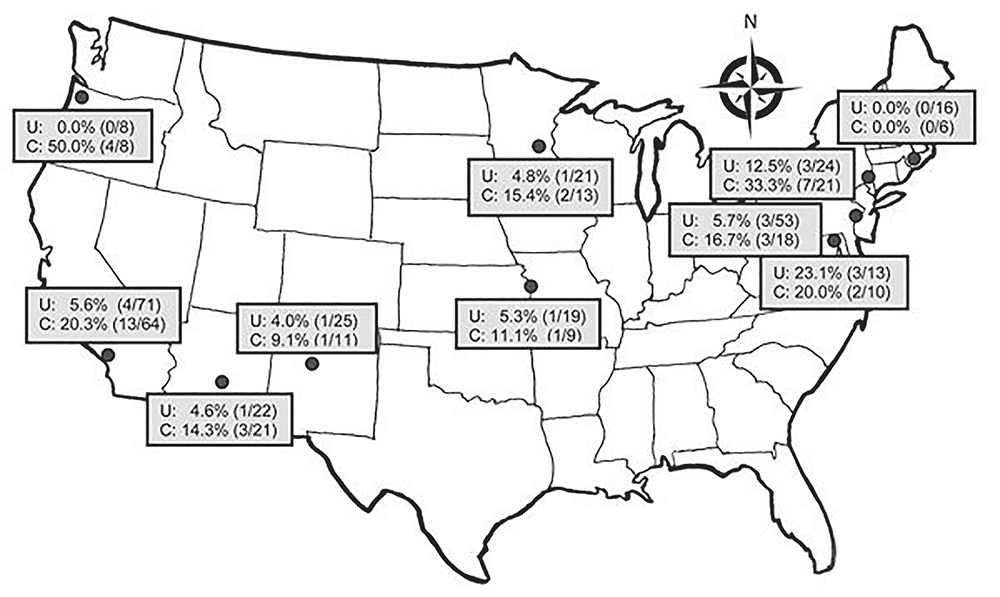
Prevalence of fluoroquinolone-resistant Escherichia coli infection among emergency department patients with uncomplicated (U) and complicated (C) pyelonephritis by study site, United States, July 2013–December 2014. In vitro resistance to ciprofloxacin and/or levofloxacin is shown as % (number of patients with a resistant isolate/total number of patients tested).

(click for larger image)
Figure 1. Prevalence of fluoroquinolone-resistant Escherichia coli infection among emergency department patients with uncomplicated (U) and complicated (C) pyelonephritis by study site, United States, July 2013–December 2014. In vitro resistance to ciprofloxacin and/or levofloxacin is shown as % (number of patients with a resistant isolate/total
number of patients tested).
Source: CDC.
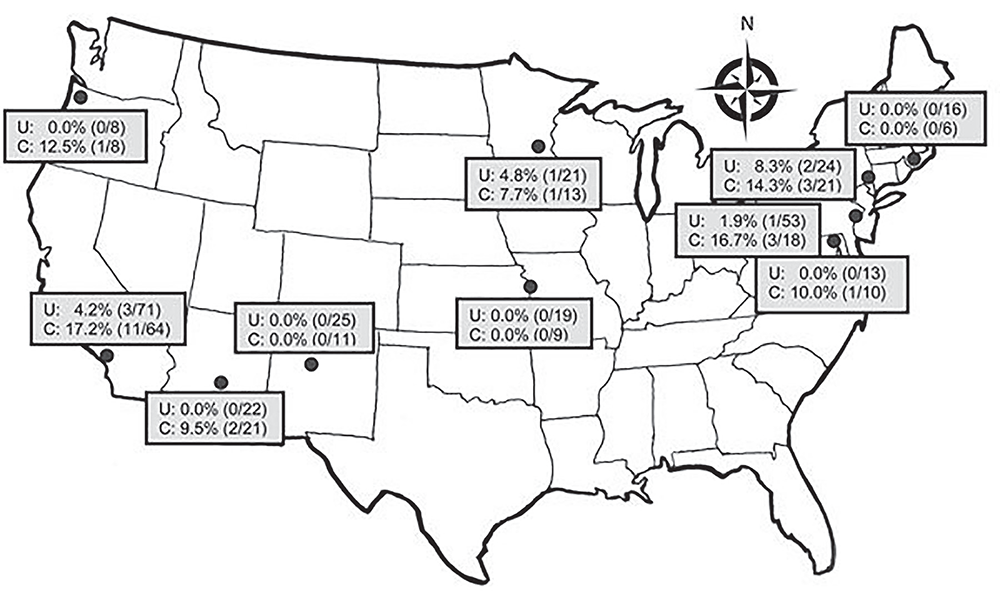
Prevalence of fluoroquinolone-resistant and ESBL-producing Escherichia coli infections among patients with uncomplicated and complicated pyelonephritis by study site, United States, July 2013–December 2014. Each dot indicates a study site; the line to show the general trend between fluoroquinolone resistance and ESBL-producing E. coli was generated by using simple linear regression.

(click for larger image)
Figure 2. Prevalence of fluoroquinolone-resistant and ESBL-producing Escherichia coli infections among patients with uncomplicated and complicated pyelonephritis by study site, United States, July 2013–December 2014. Each dot indicates a study site; the line to show the general trend between fluoroquinolone resistance and ESBL-producing E. coli was generated by using simple linear regression.
Source: CDC.

Importantly, we found that about three-quarters of patients with acute pyelonephritis due to ESBLs were empirically treated with antibiotics lacking in vitro activity—in other words, they were treated with the wrong drugs. This is a big problem. Treatment antibiotic in vitro activity discordance is associated with bad outcomes.

The FRQ/ESBL Connection

While you may not have noticed the emergence of ESBLs, you probably have seen more and more of your culture results showing E. coli resistant to our go-to pyelonephritis antibiotics, fluoroquinolones (eg, ciprofloxacin and levofloxacin). Compared to when we studied this about a decade ago, overall rates of fluoroquinolone-resistant infections (FQR) increased from 4 percent to 12 percent. However, in some locations and among some patients with resistance risk factors and high-risk infections (ie, complicated infections, males, structural/functional urological conditions, antibiotic use, health care exposure, international travel within 90 days, or prior FQR or ESBL infection), FQR rates exceeded thresholds set by Infectious Diseases Society of America (IDSA) guidelines for which a different treatment strategy is recommended—FQR rates were above 10 percent and even 20 percent in some circumstances.2

Pages: 1 2 3 | Single Page

Topics: AntibioticClinicalE. coliEmergency DepartmentEmergency MedicineEmergency PhysicianESBLExtended-Spectrum Beta-Lactamase InfectionFluoroquinolone ResistantInfectious DiseaseOutcomePublic HealthsuperbugTreatment

Related

  • Opinion: Physicians Must Reduce Plastic Waste

    December 4, 2025 - 0 Comment
  • Non-Invasive Positive Pressure Ventilation in the Emergency Department

    October 1, 2025 - 0 Comment
  • Emergency Department Management of Prehospital Tourniquets

    October 1, 2025 - 0 Comment

Current Issue

ACEP Now: November 2025

Download PDF

Read More

No Responses to “Choosing Right Medication Critical to Combat Extended-Spectrum Beta-Lactamase Infections”

Leave a Reply Cancel Reply

Your email address will not be published. Required fields are marked *


*
*


Wiley
  • Home
  • About Us
  • Contact Us
  • Privacy
  • Terms of Use
  • Advertise
  • Cookie Preferences
Copyright © 2025 by John Wiley & Sons, Inc. All rights reserved, including rights for text and data mining and training of artificial technologies or similar technologies. ISSN 2333-2603
