

Elder mistreatment:
Explore This Issue
ACEP Now: Vol 43 – No 07 – July 2024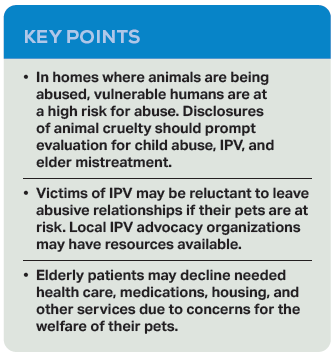 A similar connection exists between violence against animals and mistreatment of the elderly or other vulnerable adults. The elderly are often strongly attached to their pets, who provide companionship, stress relief, and an incentive for exercise and social interaction. This bond places the elderly person at risk for exploitation. A survey of adult protective services (APS) workers showed that more than 35 percent of clients reported that their pets had been threatened, injured, killed, or denied care by a caregiver.6 A perpetrator may use threats against an elderly person’s pets to obtain money, housing, or other items from the elderly person. Pets may also be a reason elderly people neglect themselves. Elderly patients may choose to decline health care, services, or safe housing based on concern for their pet’s welfare. Elders may prioritize their pet’s food and veterinary care over their own. Declining animal welfare may also be a warning sign of self-neglect or an early indicator of dementia.
CASE RESOLUTIONS
Case 1:
You ask the child to tell you about his puppy’s injury. He explains that he has a Labrador puppy at his biological mother’s house. The puppy urinated on the floor, the mother’s boyfriend threw the puppy down the basement stairs, and the puppy has been limping. When asked about how his own bruise happened, the child is tearful and states that his mother’s boyfriend also struck him but threatened to kill the puppy if he told anyone.
You contact Child Protective Services. The child is discharged into the care of his father. The local humane officer is contacted, and the puppy is voluntarily surrendered and adopted by the child’s father and stepmother.
Case 2:
The victim advocate from the community’s IPV organization comes to the ED to speak with the patient. She informs the patient that the local human society has a safe pet program that provides housing, food, and veterinary care for victims of IPV until pet-friendly housing can be arranged. The patient elects to be discharged to the women’s shelter, and her dogs are transported to the humane society.
 Dr. Riviello is chair and professor of emergency medicine at the University of Texas Health Science Center at San Antonio.
 Dr. Rozzi is an emergency physician, medical director of the Forensic Examiner Team at WellSpan York Hospital in York, Pennsylvania, and secretary of ACEP’s Forensic Section.
Pages: 1 2 3 | Single Page



No Responses to “Child Abuse Cases in the Emergency Department”