
Logo

Log In Sign Up |  An official publication of: American College of Emergency Physicians
Navigation
  • Home
  • Multimedia
    • Podcasts
    • Videos
  • Clinical
    • Airway Managment
    • Case Reports
    • Critical Care
    • Guidelines
    • Imaging & Ultrasound
    • Pain & Palliative Care
    • Pediatrics
    • Resuscitation
    • Trauma & Injury
  • Resource Centers
    • mTBI Resource Center
  • Career
    • Practice Management
      • Benchmarking
      • Reimbursement & Coding
      • Care Team
      • Legal
      • Operations
      • Quality & Safety
    • Awards
    • Certification
    • Compensation
    • Early Career
    • Education
    • Leadership
    • Profiles
    • Retirement
    • Work-Life Balance
  • Columns
    • ACEP4U
    • Airway
    • Benchmarking
    • Brief19
    • By the Numbers
    • Coding Wizard
    • EM Cases
    • End of the Rainbow
    • Equity Equation
    • FACEPs in the Crowd
    • Forensic Facts
    • From the College
    • Images in EM
    • Kids Korner
    • Medicolegal Mind
    • Opinion
      • Break Room
      • New Spin
      • Pro-Con
    • Pearls From EM Literature
    • Policy Rx
    • Practice Changers
    • Problem Solvers
    • Residency Spotlight
    • Resident Voice
    • Skeptics’ Guide to Emergency Medicine
    • Sound Advice
    • Special OPs
    • Toxicology Q&A
    • WorldTravelERs
  • Resources
    • ACEP.org
    • ACEP Knowledge Quiz
    • Issue Archives
    • CME Now
    • Annual Scientific Assembly
      • ACEP14
      • ACEP15
      • ACEP16
      • ACEP17
      • ACEP18
      • ACEP19
    • Annals of Emergency Medicine
    • JACEP Open
    • Emergency Medicine Foundation
  • About
    • Our Mission
    • Medical Editor in Chief
    • Editorial Advisory Board
    • Awards
    • Authors
    • Article Submission
    • Contact Us
    • Advertise
    • Subscribe
    • Privacy Policy
    • Copyright Information

Case Report: When Syncope Gets Hairy

By Anthony J. Halupa, DO, FACEP | on June 17, 2025 | 0 Comment
Case Report
  • Tweet
  • Click to email a link to a friend (Opens in new window) Email
Print-Friendly Version

Hair-Grooming Syncope

When evaluating these patients with low-risk syncope, how often have you asked: “Were you getting your hair groomed when you passed out?”

You Might Also Like
  • Best Practices for Emergency Department Syncope Risk Assessment
  • How to Perform Ultrasound-Guided Distal Sciatic Nerve Block in the Popliteal Fossa
  • How to Perform Ultrasound-Guided Forearm Nerve Blocks to Provide Non-Drug Pain Relief for Acute Injuries
Explore This Issue
ACEP Now: June 2025 (Digital)

Hair-grooming syncope is a rare subtype of neurocardiogenic syncope that is precipitated by different acts of hair care or grooming. Evans, et al., conducted a retrospective study in which they reviewed a database of pediatric patients being evaluated for syncope in the outpatient pediatric cardiology clinic. Hair grooming triggered episodes in seven percent of the cohort—78% of whom were girls. Hair combing was the most common trigger in girls, whereas hair cutting predominated in boys.

Cardiac testing workup demonstrated normal ECGs in 109 of 111 with two patients having minor noncontributory arrhythmias; and 105 of 111 had normal ECG with six patients having minor noncontributory structural abnormalities.2 The authors speculate that the mechanism of hair grooming syncope is related to pain from hair pulling or scalp stimulation of the trigeminal nerve, which precipitates a neurocardiogenic reflex. Although the authors do not specify which branch(es) of the trigeminal nerve are affected, all branches of the trigeminal nerve innervate sensitive areas of the scalp as shown in Image 1.
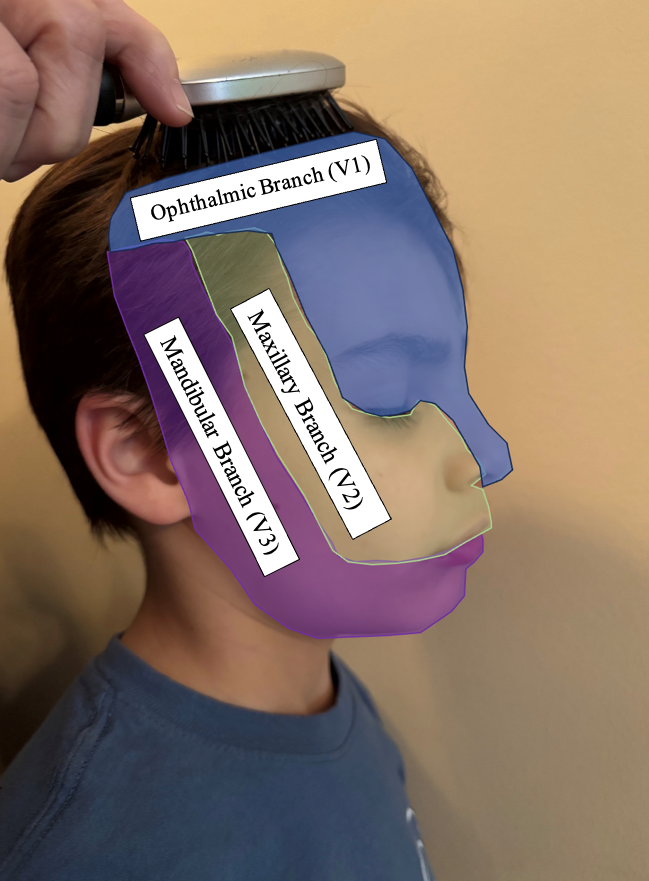
Image 1. All branches of the trigeminal nerve innervate sensitive areas of the scalp. (Click to enlarge.)

Emergency physicians must decide who can be safely discharged with outpatient follow-up (low-risk) and who requires admission for monitoring (high-risk. The next time you see a patient in the emergency department who experienced a syncopal episode when getting their hair combed or cut, you can now potentially “brush” it off as hair grooming syncope.

Teaching Points:

  • An ECG should be obtained on all patients who present to the emergency department after a syncopal episode.
  • Syncope during hair grooming practices is thought to be a type of neurocardiogenic syncope that occurs because of stimulation of the scalp nerve fibers and/or branches of the trigeminal nerve.
  • Although the differential diagnosis for syncope is broad, most causes of syncope are benign, so obtaining a thorough history and performing a physical exam to help identify high-risk syncope are paramount in determining additional workup and disposition.

Dr. Halupa is an emergency physician at the Geisinger St. Luke’s Hospital in Orwigsburg, Pa. 


References

  1. De Lorenzo RA. (2018). Syncope. In Walls R, Hockberger R., Gausche-Hill M, et al. (Eds.), Rosen’s Emergency Medicine: Concepts and Clinical Practice (pp. 115-122). Elsevier.
  2. Evans WE, Acherman R, Kip K, Restrepo H. Hair-grooming syncope in children. Clinical Pediatrics. 2009; 48(8): 834-836.

Pages: 1 2 3 | Single Page

Topics: cardiologyClinicalECGhair-grooming syncopeNeurologyPediatricssituational syncopesyncopevasovagal syncope

Related

  • FACEPs in the Crowd: Dr. John Ludlow

    November 5, 2025 - 0 Comment
  • Non-Invasive Positive Pressure Ventilation in the Emergency Department

    October 1, 2025 - 0 Comment
  • Emergency Department Management of Prehospital Tourniquets

    October 1, 2025 - 0 Comment

Current Issue

ACEP Now: November 2025

Download PDF

Read More

No Responses to “Case Report: When Syncope Gets Hairy”

Leave a Reply Cancel Reply

Your email address will not be published. Required fields are marked *


*
*


Wiley
  • Home
  • About Us
  • Contact Us
  • Privacy
  • Terms of Use
  • Advertise
  • Cookie Preferences
Copyright © 2025 by John Wiley & Sons, Inc. All rights reserved, including rights for text and data mining and training of artificial technologies or similar technologies. ISSN 2333-2603
