

Case
A 24-year-old female presents to the emergency department (ED) claiming to be sexually assaulted by her friend-with-benefits sexual partner. She wants to file a police report and have a sexual assault nurse examiner (SANE) exam performed. Medical screening examination is performed and she does not have injuries or complaints that need to be addressed. While waiting for the SANE nurse to arrive, the police arrive and take her complaint. Afterward she is visibly upset, angry, and crying. The officer informed her that this was not sexual assault, and that neither a formal complaint nor charges will be filed. You learn that she agreed to consensual sex with him, provided he wore a condom. During the intercourse, he removed the condom and ended up ejaculating in her vagina. She disagrees with the officer and is extremely worried about becoming pregnant and catching a sexually transmitted infection. What do you do?
Explore This Issue
ACEP Now: Vol 43 – No 01 – January 2024Discussion
“Stealthing” is the practice of removing one’s condom during sex without the knowledge and consent of one’s partner.1-4 A study from Australia found that 32 percent of women and 19 percent of men, seeking care at a sexual health clinic, had been a stealthing victim.5 This is a form of reproductive coercion, which is defined as threats or acts of violence against a partner’s reproductive health or reproductive decision-making.
Why Do Men Do This?
Stealthing is a way abusers exercise power and control over a partner who is vulnerable and unaware. One study found that men with greater hostility toward women (odds ratio, 1.47) and more severe sexual aggression history (odds ratio, 1.06) had significantly higher odds of engaging in nonconsensual condom removal behavior.6 They think it is funny or they want to embarrass their partner. They often feel the sex is better or more pleasurable for themselves or their partner without the condom. Some men actually promise to use a condom, but never put one on. This is facilitated by the partner’s trust or sexual positioning, making the partner unable to see if it was put on. Males who engaged in nonconsensual condom removal were significantly more likely to have had a sexually transmitted infection diagnosis (29.5 percent versus 15.1 percent) or have had a partner who experienced an unplanned pregnancy (46.7 percent versus 25.8 percent).6
Is Stealthing Rape?
The answer is, “not in most jurisdictions.” Most sexual assault and rape statutes do not include stealthing as part of their definition. California is currently the only state that has a stealthing law (California AB-453).7,8 That law makes it a civil offense, not a criminal one. No other state has enacted stealthing legislation. Worldwide, only a few countries actually recognize it as a criminal offense. One could argue that asking a partner to wear a condom for sexual intercourse is considered conditional consent.9 Simply, “I am giving consent, provided a certain condition is met.” In other words, “I consent to intercourse provided you wear a condom.” Therefore, if the partner does not wear or removes the condom, they have not lived up to the condition of the consent, therefore, there is no consent. So, in the purest sense of the argument, no consent is rape or sexual assault. Unfortunately, many state laws have not added conditional consent to their rape statutes. That is why most jurisdictions will not charge or prosecute these cases as sexual assault or rape. The only recourse for the survivor is to seek damages in civil court. Often this can be based on psychological trauma, sexual assault, pain, suffering, mental anguish, etc. There is no data on how many of these cases have been successfully adjudicated.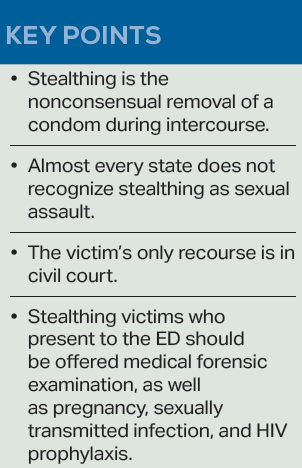
Pages: 1 2 3 | Single Page



No Responses to “Case Report: Intimate Partner Sexual Assault?”