
Discussion
Critical limb ischemia (CLI) is the most advanced stage of peripheral artery disease (PAD) and is associated with significant morbidity and mortality.7,8 A 2019 report estimates the U.S. prevalence of CLI to be 1.3 percent in patients above the age of 40 (2 million people), while PAD affects more than 200 million people worldwide.8,9
Explore This Issue
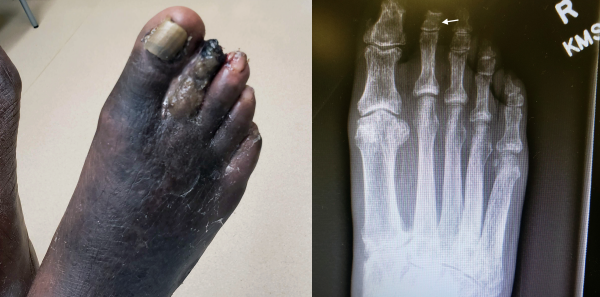
ACEP Now: Vol 40 – No 01 – January 2021The “5 P’s” of CLI are pain, pulselessness, pallor, paresthesia, and paralysis. These features are found in 48 to 90 percent of the acute presentations of limb ischemia.10,11 Rarely, progression to severe ischemia leads to ulceration of the digits of the foot (8.5 percent of cases) and frank gangrene (5.2 percent of cases).7,11
Smoking and diabetes are the most significant risk factors of CLI, but others include African American race, male sex, being more than 40 years old, hypertension, dyslipidemia, elevated C-reactive protein, hypercoagulable states, hyperhomocysteinemia, chronic renal insufficiency, and history of cardiovascular disease.7,9,10 The one-year mortality in CLI patients with gangrene is 33.2 percent, which jumps to 68.5 percent over four years.12
The COVID-19 pandemic has resulted in fear of seeking health care, which can contribute to preventable morbidity and mortality.
This case describes a significant delay in seeking medical care due to fear of COVID-19, resulting in worsening osteomyelitis and gangrene and ultimately requiring multiple surgical interventions and prolonged antibiotic therapy. Although our patient had risk factors for PAD, the development of severe and life-threatening CLI potentially could have been mitigated with early intervention.
Many local and national organizations are working to educate the public about seeking appropriate medical care.13–17 Continued patient education at the local and national level is necessary to ensure timely and appropriate medical treatment.



Mr. Asarpota is a medical student; Dr. Wyss is chief resident, emergency medicine; and Dr. Marco is professor of emergency medicine at the Wright State University Boonshoft School of Medicine in Dayton, Ohio.
References
- Masroor S. Collateral damage of COVID-19 pandemic: delayed medical care. J Card Surg. 2020;35(6):1345-1347.
- Messac L, Knopov A, Horton M. Delayed care-seeking for non-COVID illnesses in Rhode Island. R I Med J. 2020;103(4):10-11.
- Lange SJ, Ritchey MD, Goodman AB, et al. Potential indirect effects of the COVID-19 pandemic on use of emergency departments for acute life-threatening conditions — United States, January–May 2020. MMWR Morb Mortal Wkly Rep. 2020;69(25):795-800.
- Czeisler MÉ, Marynak K, Clarke KEN, et al. Delay or avoidance of medical care because of COVID-19–related concerns—United States, June 2020. MMWR Morb Mortal Wkly Rep. 2020;69(36):1250-1257.
- Public poll: emergency care concerns amidst COVID-19. ACEP website. Accessed May 29, 2020.
- National tracking poll #2004100 April 29–30, 2020. Morning Consult website. Accessed May 22, 2020.
- Fabiani I, Calogero E, Pugliese NR, et al. Critical limb ischemia: a practical up-to-date review. Angiology. 2018;69(6):465-474.
- Duff S, Mafilios MS, Bhounsule P, et al. The burden of critical limb ischemia: a review of recent literature. Vasc Health Risk Manag. 2019;15:187-208.
- Fowkes FGR, Rudan D, Rudan I, et al. Comparison of global estimates of prevalence and risk factors for peripheral artery disease in 2000 and 2010: a systematic review and analysis. Lancet. 2013;382(9901):1329-1340.
- Norgren L, Hiatt WR, Dormandy JA, et all. Inter-society consensus for the management of peripheral arterial disease (TASC II). J Vasc Surg. 2007;45 Suppl S:S5-S67.
- Zarins CK. A comparison of recombinant urokinase with vascular surgery for acute arterial occlusion of the legs. N Engl J Med. 1998;339(8):564; author reply 564-565.
- Mustapha JA, Katzen BT, Neville RF, et al. Determinants of long-term outcomes and costs in the management of critical limb ischemia: a population-based cohort study. J Am Heart Assoc. 2018;7(16): e009724.
- Wong LE, Hawkins JE, Langness S, et al. Where are all the patients? Addressing Covid-19 fear to encourage sick patients to seek emergency care. NEJM Catal. 2020. doi: 10.1056/CAT.20.0193.
- COVID-19: know when to go. ACEP website. Accessed May 29, 2020.
- Hsieh P. Do not delay urgent medical care due to the COVID-19 coronavirus pandemic. Forbes website. Accessed May 29, 2020.
- Washington State Department of Health. Heart attack and stroke don’t stop for COVID-19. Medium website. Accessed May 29, 2020.
- American Heart Association urges patients to quickly call 911 for chest pain or heart symptoms. American Heart Association website. Accessed May 29, 2020.
Pages: 1 2 3 | Single Page



One Response to “Case Report: Fear of COVID-19 Leads to Gangrene”
February 14, 2021
Thomas B, MDI saw a similar case recently. Our patient was diagnosed with Covid-19 and he dutifully remained in quarantine as instructed while his foot became necrotic and progressed to sepsis. He was critically ill when we flew him out from our critical access hospital.