
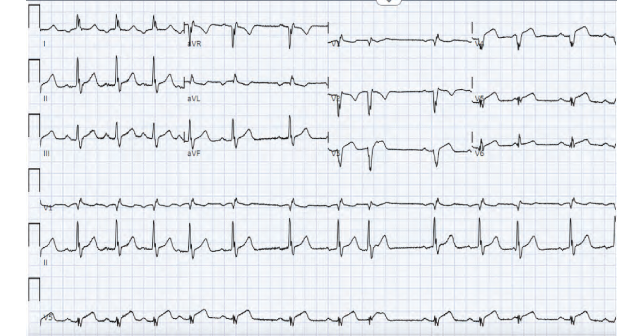
Dextrocardia with STEMI is a rare clinical presentation that presents with both diagnostic and technical challenges. A literature search through PubMed yielded fewer than 80 case reports of this presentation. Further, patients with dextrocardia may have atypical presentations of STEMIs. Dextrocardia can have features of right axis deviation, positive QRS complexes (upright P and T waves) in aVR, negative P and T waves and QRS complexes in lead I, and absent R wave progression in the precordial leads with dominant S waves.4 In cases of dextrocardia, precordial leads should be placed in a mirror image on the right side of the chest, as is done for a right-sided EKG, with the additional reversal of the right and left limb leads.4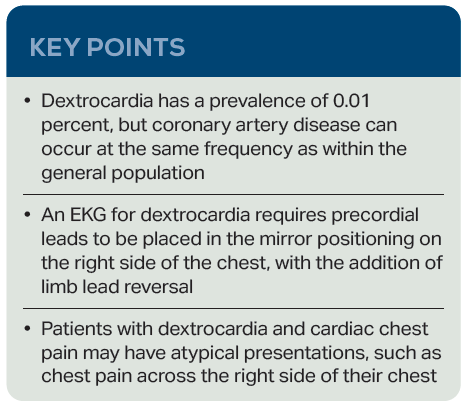
Explore This Issue
ACEP Now: Vol 43 – No 04 – April 2024Symptoms of acute coronary syndrome classically present on the left chest wall, however, our patient’s pain was all localized to the right side of the chest, which has been described with other cases of dextrocardia.5 The patient’s initial left-sided EKG did not demonstrate concerning ST segment changes. However, the patient had known dextrocardia based on documented medical history and was confirmed with a recent chest x-ray. Upon the prompt reversal of EKG leads for dextrocardia, the patient was found to have an obvious STEMI in the precordial leads. The patient was then emergently taken for cardiac catheterization. It is important to discern cardiac anomalies, such as dextrocardia, early in a patient’s clinical presentation, as it can significantly impact the timely interpretation of EKGs and the appropriate management of the patient’s care.
 Dr. Ahdi is a senior emergency medicine resident at Corewell Health William Beaumont University Hospital.
 Dr. Barish has been a clinical emergency physician for 37 years and the system professor at William BEAUMONT Oakland University medical school.
References
- Maldjian PD, Saric M. Approach to dextrocardia in adults: review. AJR Am J Roentgenol. 2007;188(6 Suppl):S39-S38.
- Totaro P, Coletti G, Lettieri C, Pepi P, Minzioni G. Coronary artery bypass grafts in a patient with isolated cardiac dextroversion. Ital Heart J. 2001;2(5):394-396.
- Hynes KM, Gau GT, Titus JL. Coronary heart disease in situs inversus totalis. The American Journal of Cardiology. 1973;31(5):666-669.
- Nickson C, Buttner R. Dextrocardia. life in the fast lane. July 19, 2021. Accessed December 1, 2023. Available at: https://litfl.com/dextrocardia-ecg-library.
- Kong B, Wang N, Dou L, Cao D. Coronary angioplasty in an adult with dextrocardia and single coronary artery with the right coronary artery originating from the left anterior descending artery. Coronary Artery Disease. 2019;30(5):390-392.
- Burns E, Buttner R. Right Ventricular Infarction. Life in the Fast Lane. February 8, 2021. Accessed December 1, 2023. Available at: https://litfl.com/right-ventricular-infarction-ecg-library.
Pages: 1 2 3 | Single Page



No Responses to “Case Report: A Rare Congenital Heart Anomaly”