
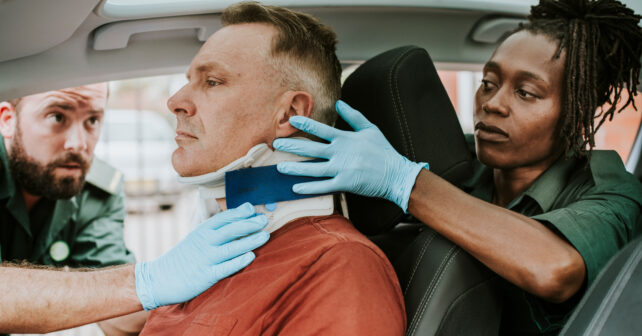
Case: A 71-year-old man is the restrained driver in a 25-mph front-end motor-vehicle crash (MVC). He self-extricates but experiences midline posterior neck pain and bilateral hand paresthesias. EMS applies manual in-line stabilization, moves him with minimal manipulation to the cot (to avoid prolonged backboard use), administers oxygen for an SpO₂ of 89 percent, and notes a systolic BP dropping to 92 mm Hg. He arrives hemodynamically borderline, cervical collar in place, Glasgow Coma Scale (GCS) score of 15, with persistent hand tingling.
Background: Out-of-hospital care for suspected spinal cord injury (SCI) involves two main priorities: preventing secondary cord injury while avoiding iatrogenic harm. Traditionally, EMS focused on rigid “immobilization” (using a long backboard and rigid cervical collar) due to concerns that movement after injury could cause delayed neurological deterioration. Over the past two decades, emergency care has shifted toward selective spinal motion restriction (SMR) and the earlier removal of collars when suitable, reflecting a better understanding of risks, test accuracy, and the harms associated with prolonged immobilization.
In the ED, validated decision tools such as the NEXUS criteria and the Canadian C-Spine Rule assist in identifying very-low-risk patients who do not require imaging. When imaging is necessary, modern multidetector CT scans have been shown to outperform plain radiography in detecting clinically significant cervical spine injuries (CSIs). A large cohort from the Western Trauma Association (10,276 patients) demonstrated that CT has approximately 98.5 percent sensitivity and nearly 100 percent negative predictive value for such injuries. They also report that misses are rare and typically occur in patients with focal neurologic deficits, who then require MRI. [1]
Out-of-hospital protocols are increasingly focused on reducing time spent on a backboard and avoiding prolonged collar use due to pressure injuries and other complications. The Eastern Association for the Surgery of Trauma (EAST) systematic review supports collar removal after a negative high-quality CT in obtunded adults, emphasizing the downstream harm caused by extended immobilization without additional benefit.[2]
Pediatrics and geriatrics remain special populations. NEXUS demonstrated high sensitivity in children, although confidence intervals are wider in the very young. Clinicians should maintain a low threshold for imaging in older adults, who are vulnerable to serious CSI from low-energy mechanisms.[3]
Clinical Question: In trauma patients suspected of SCI, what evidence supports the idea that movement after injury leads to delayed neurological worsening? Additionally, what are the benefits and harms of out-of-hospital spinal immobilization and spinal motion restriction?
Reference: Millin MG, Innes JC, King GD, et al. Prehospital Trauma Compendium: Prehospital Management of Spinal Cord Injuries – A NAEMSP Comprehensive Review and Analysis of the Literature. Prehosp Emerg Care. 2025 Aug 7:1-13. doi: 10.1080/10903127.2025.2541258. Epub ahead of print. PMID: 40736221.
- Population: Humans (and some animals) with potential spinal cord injuries, focusing on four key questions: the pathophysiology of delayed neurologic injury, harms of immobilization, the effectiveness of immobilization/SMR in limiting movement, and their relationship to delayed neurological injury.
- Exclusions:Manikin/simulation-only studies, abstracts without full publication, editorials, other reviews/meta-analyses, guidelines, book chapters, and non-English full manuscripts.
- Intervention: Out-of-hospital spinal immobilization and SMR
- Comparison: No immobilization vs immobilization or alternative immobilization strategies.
- Outcome:
- Primary Outcome: Assessing how effectively immobilization/SMR limits movement and its connection to delayed neurological injury.
- Secondary Outcomes:Harms of immobilization/SMR include airway or respiratory compromise, increased intracranial pressure, pressure ulcers, delays in care, more imaging, and pain. It also examines the links between hypoperfusion/hypoxia and poorer neurological outcomes.
- Type of Study: Comprehensive review with no meta-analysis
Authors’ Conclusions: “There are no data in the published literature to support spinal immobilization and spinal motion restriction as standard of care. Efforts aimed to reduce the use of cervical collar should be considered, and the use of backboards and full body vacuum splint should be limited to the point in time of active patient extrication.”
Results: The review analyzed 115 manuscripts covering out-of-hospital and hospital settings, adult and pediatric groups, and various regions and time periods. The authors did not combine demographic data from different studies because of the diverse study designs and research questions.
Key Result: No conclusive evidence that routine immobilization or SMR prevents delayed neurologic injury, and harms are frequently observed.
- Primary Outcome: The results on limiting movement using biomechanical surrogates are mixed. No randomized trials have demonstrated that collars or boards prevent secondary spinal cord injury. The most well-known observational comparison (immobilized versus non-immobilized) showed that immobilization was linked to greater neurologic disability. A before-and-after system study, which switched from routine backboards to SMR, found no increase in delayed deficits.
- Secondary Outcomes: Harms frequently occurred, including negative airway/respiratory effects, increased intracranial pressure (ICP), skin breakdown, delays in care, more imaging, and pain.
Talk Nerdy:
- Risk of Bias: Although the report provides details on selection and abstraction processes, it lacks a formal risk-of-bias (RoB) assessment tool, which is usually expected in systematic reviews. The authors could have utilized Risk of Bias in Non-Randomized Studies of Interventions (ROBINS-I), a tool designed to evaluate bias in non-randomized studies that compare the benefits and harms of different interventions.[4] Without a structured RoB assessment, confidence in causal conclusions remains limited.
- Screening: A single reviewer screened the title and abstract, which could increase the risk of missing eligible studies. Ideally, two independent reviewers should screen titles and abstracts and review full texts separately, resolving disagreements through discussion or with a third reviewer. This approach enhances the validity, transparency, and reproducibility of the systematic review.
- Surrogate Outcomes: Several papers focus on movement reduction as a surrogate for patient-important outcomes like neurologic deficits. However, surrogate-oriented outcomes do not consistently translate into patient-oriented outcomes.
SGEM Bottom Line: For suspected SCI in 2025, reduce time on boards, avoid reflexive collars, and prioritize out-of-hospital oxygenation and blood pressure management, reserving SMR for carefully chosen patients.
Case Resolution: In the ED, the patient remains GCS 15 with persistent paresthesia but normal motor strength. A high-quality C-spine CT is obtained, and no instability or fracture is seen. His collar is removed after a negative CT, but he proceeds to an MRI to rule out ligamentous/cord injury because of persistent neurological deficits. He receives oxygen and ventilation support and hemodynamic optimization, avoiding hypotension while neurosurgery is consulted.
Remember to be skeptical of anything you learn, even if you heard it on the Skeptics’ Guide to Emergency Medicine.
Thank you to Clay Odell, who is a paramedic firefighter with Newport, N.H. Fire-EMS, for his help with this review.
 Dr. Milne is a staff physician at the Strathroy Middlesex General Hospital in Strathroy, Ontario, Canada, and is an Associate Professor in the Department of Medicine (Division of Emergency Medicine) and Department of Family Medicine at the Schulich School of Medicine and Dentistry.
References
1. Inaba K, Byerly S, Bush LD, et al. WTA C-Spine Study Group. Cervical spinal clearance: A prospective Western Trauma Association Multi-institutional Trial. J Trauma Acute Care Surg. 2016;81(6):1122-1130. doi: 10.1097/TA.0000000000001194. PMID: 27438681; PMCID: PMC5121083.
2. Patel MB, Humble SS, Cullinane DC, et al. Cervical spine collar clearance in the obtunded adult blunt trauma patient: A systematic review and practice management guideline from the Eastern Association for the Surgery of Trauma. J Trauma Acute Care Surg. 2015;78(2):430–441.
3. Pines JM, Bellolio F. Cervical Spine Fractures. In: Evidence-Based Emergency Care: Diagnostic Testing and Clinical Decision Rules.3rd ed. Wiley; 2023. Chapter 7.
4. Sterne JA, et al. ROBINS-I: A tool for assessing risk of bias in non-randomised studies of interventions. BMJ. 2016;12;355:i4919. doi: 10.1136/bmj.i4919. PMID: 27733354; PMCID: PMC5062054.



One Response to “C-U Later C-Collar?”
February 9, 2026
Brian MillerTrue, C-collars don’t work, but what DOES work? This question comes from a practicing EMS physician with complete C8 quadriplegia.