
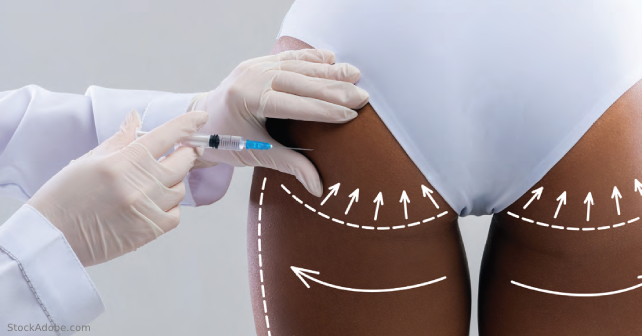
It is difficult to say exactly how many of the 163 patients at JHS suffered a PFE without autopsy reports. However, only one case—a patient who decompensated during her procedure and suffered a stroke but ultimately survived to hospital discharge—was presumed to be attributable to PFE.
Explore This Issue
ACEP Now: Vol 43 – No 05 – May 2024Instead, the overwhelming majority of post-AFT patients at JHS presented secondary to bleeding, pain, and syncope. Emergency physicians are very familiar with the workup and treatment of these conditions , however EPs must not underestimate the severity of these concerns in a purportedly “minimally invasive” procedure. For example, in our system, 37 percent of patients presenting after gluteal AFT procedures required transfusion, an average of 1.7 units per patient. Nearly half of all post-AFT patients presenting to our emergency departments required admission and six percent required ICU admission. Other complications seen in our cohort included sepsis, hemorrhagic shock, electrolyte derangements, bowel perforation, hematomas, abscess formation, and cardiac arrest.
Communities like South Florida are scrambling to regulate gluteal AFT procedures, but in the meantime, the care of patients like Ms. Baptiste, Ms. Larson, and Ms. Powell will continue to fall to emergency physicians. Pain and bleeding need to be taken seriously in these patients, and for those who present in critical condition, fat embolism must be considered. Familiarity with post-op restrictions for gluteal AFT patients will also improve their care in the emergency department. Until these procedures are regulated in a way that makes them safe for patients, emergency physicians must be ready and equipped to care for them
 Dr. Lee is a PGY2 emergency medicine resident at Jackson Memorial Hospital with an interest in critical care disparities and public policy.
 Dr. Pyle is an attending physician and ultrasound director at Jackson Memorial Hospital with an interest in medical education, ultrasound and critical care.
References
- Garcia SE. Butt Lifts Are Booming. Healing Is No Joke. The New York Times. Published May 11, 2022. Accessed March 6, 2024.
- The BBL effect: How the Brazilian butt lift went mainstream. Vox. Accessed February 19, 2024.
- The Price of Perfection: The dangers of Brazilian butt lifts. Al Jazeera. Accessed March 6, 2024.
- Cosmetic Surgery National Data Bank: 2002 Statistics. The American Society for Aesthetic Plastic Surgery.
- Aesthetic Plastic Surgery National Databank Statistics 2020–2021. Aesthet Surg J. 2022;42(Supplement_1):1-18.
- Pazmiño P, Garcia O Jr. Brazilian Butt Lift–Associated Mortality: The South Florida Experience. Aesthet Surg J. Published online August 11, 2022:sjac224.
- Garcia O, Pazmiño P. BBL Mortality in South Florida: An Update From Ground Zero. Aesthet Surg J. 2022;43(3):NP223-NP224.
- Che D hui, Xiao Z bo. Gluteal Augmentation with Fat Grafting: Literature Review. Aesthetic Plast Surg. 2021;45(4):1633-1641.
- Mofid MM, Teitelbaum S, Suissa D, et al. Report on Mortality from Gluteal Fat Grafting: Recommendations from the ASERF Task Force. Aesthet Surg J.2017;37(7):796-806.
- Cárdenas-Camarena L, Bayter JE, Aguirre-Serrano H, Cuenca-Pardo J. Deaths Caused by Gluteal Lipoinjection: What Are We Doing Wrong? Plast Reconstr Surg. 2015;136(1):58-66.
Pages: 1 2 3 4 | Single Page



One Response to “Brazilian Butt Lift Procedure Can Result in Emergency Department Visits”
May 19, 2024
Michael E. Mullins, MD, FACEPAnother potential complication is local anesthetic systemic toxicity (LAST) since both the liposuction and gluteal fat injection use local anesthetics (usually lidocaine or bupivacaine). In particular, this could occur with substitution of bupivacaine for lidocaine.
LAST may explain some of the cardiac arrests within this cohort. Hallmarks of LAST include cardiovascular instability and wide QRS interval in the electrocardiogram.
In cases of LAST, the preferred treatment is intravenous lipid emulsion — widely known by the brand name “Intralipid”, but “Clinolipid” (Baxter Healthcare, Deerfield IL) has replaced the former brand in the US.
When treating LAST, the American Society of Regional Anesthesia recommends a bolus of 1.5 mL/kg of 20% lipid (~100 mL in a 70 kg patient) followed by a short infusion of 0.25 to 0.5 mL/kg/min over 20 minutes. Avoid using a bolus > 100 mL or an infusion of > 250 mL.
https://www.asra.com/news-publications/asra-updates/blog-landing/guidelines/2020/11/01/checklist-for-treatment-of-local-anesthetic-systemic-toxicity