Logo

Log In Sign Up |  An official publication of: American College of Emergency Physicians
Navigation
  • Home
  • Multimedia
    • Podcasts
    • Videos
  • Clinical
    • Airway Managment
    • Case Reports
    • Critical Care
    • Guidelines
    • Imaging & Ultrasound
    • Pain & Palliative Care
    • Pediatrics
    • Resuscitation
    • Trauma & Injury
  • Resource Centers
    • mTBI Resource Center
  • Career
    • Practice Management
      • Benchmarking
      • Reimbursement & Coding
      • Care Team
      • Legal
      • Operations
      • Quality & Safety
    • Awards
    • Certification
    • Compensation
    • Early Career
    • Education
    • Leadership
    • Profiles
    • Retirement
    • Work-Life Balance
  • Columns
    • ACEP4U
    • Airway
    • Benchmarking
    • Brief19
    • By the Numbers
    • Coding Wizard
    • EM Cases
    • End of the Rainbow
    • Equity Equation
    • FACEPs in the Crowd
    • Forensic Facts
    • From the College
    • Images in EM
    • Kids Korner
    • Medicolegal Mind
    • Opinion
      • Break Room
      • New Spin
      • Pro-Con
    • Pearls From EM Literature
    • Policy Rx
    • Practice Changers
    • Problem Solvers
    • Residency Spotlight
    • Resident Voice
    • Skeptics’ Guide to Emergency Medicine
    • Sound Advice
    • Special OPs
    • Toxicology Q&A
    • WorldTravelERs
  • Resources
    • ACEP.org
    • ACEP Knowledge Quiz
    • Issue Archives
    • CME Now
    • Annual Scientific Assembly
      • ACEP14
      • ACEP15
      • ACEP16
      • ACEP17
      • ACEP18
      • ACEP19
    • Annals of Emergency Medicine
    • JACEP Open
    • Emergency Medicine Foundation
  • About
    • Our Mission
    • Medical Editor in Chief
    • Editorial Advisory Board
    • Awards
    • Authors
    • Article Submission
    • Contact Us
    • Advertise
    • Subscribe
    • Privacy Policy
    • Copyright Information

Bougienage Good Alternative for Treating Retained Esophageal Coins

By Terrance McGovern, DO, MPH, Justin McNamee, DO, and Julie Sanicola-Johnson, DO | on May 14, 2015 | 0 Comment
Tricks of the Trade
  • Tweet
  • Click to email a link to a friend (Opens in new window) Email
Print-Friendly Version

Children, for whatever reason, have a predilection for swallowing coins. Perhaps it’s the taste or that they’re using their stomach as a piggy bank. When these young patients present to the emergency department with a coin lodged in their esophagus, what options do we have? We could call gastroenterology or try to take it out ourselves. One option with few complications is bougienage, where we manually advance the coin into the stomach classically using a Hurst dilator and allow it to pass naturally.

You Might Also Like
  • How To Build a Substitute for a Hurst Dilator for Use in Bougienage
  • How To Place A Blakemore Tube in an ED Patient with Upper GI Bleeding from Esophageal Varices
  • Journal of ACEP Retrospective Provides Glimpse into Evolution of Emergency Medicine
Explore This Issue
ACEP Now: Vol 34 – No 05 – May 2015
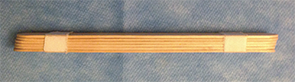
Figure 1. Tongue depressors taped together to act as a bite block

Figure 1. Tongue depressors taped together to act as a bite block

Background

In 2012, there were approximately 93,000 cases of foreign-body ingestions, nearly 4,000 of which were coins.1 While the feared button-battery ingestion can cause esophageal necrosis in as little as two hours, impacted coins can also cause perforation, obstruction, or fistulas if left untreated.2,3

The American Society for Gastrointestinal Endoscopy (ASGE) currently recommends an observation period of 24 hours for asymptomatic patients to see if the coin will pass into the stomach without any intervention.4 Up to 56 percent of coins lodged in the distal esophagus and 27 percent in the proximal esophagus will pass into the stomach without any complications.5 Once in the stomach, most coins will transverse the gastrointestinal
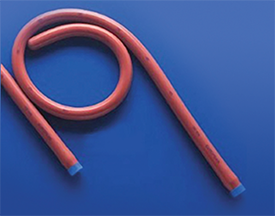
Figure 2. Hurst dilator

Figure 2. Hurst dilator

tract spontaneously.5,6 If the coin is retained within the stomach for more than three to four weeks, the patient will likely need endoscopic removal. The same is true for any coin that remains stationary for one week past the duodenum; it will need surgical removal.

For coins that do not spontaneously pass into the stomach, endoscopy has shown to be very successful (100 percent), with a small but measurable rate of complications, which are predominantly airway related (2.5 percent).7 An additional method of removal is using the Foley catheter technique. There are variations to the actual procedure, but typically it involves placing a Foley catheter (either orally or nasally) past the foreign body, inflating the Foley balloon, and extracting the foreign body. As you may imagine, the most concerning aspect to this technique is the thought of dragging the foreign body right past the glottis, which is just lying there open and waiting for that coin to drop in as though you are playing the penny slots in Vegas. While the concern is valid, the complication rate is relatively low (0–2 percent), and the success rate is favorable (88–94 percent).7–12

Pages: 1 2 3 4 | Single Page

Topics: BougienageCritical CareEmergency PhysicianPediatricsPractice ManagementProcedures and Skills

Related

  • Why the Nonrebreather Should be Abandoned

    December 3, 2025 - 0 Comment
  • Florida Emergency Department Adds Medication-Dispensing Kiosk

    November 7, 2025 - 1 Comment
  • Q&A with ACEP President L. Anthony Cirillo

    November 5, 2025 - 0 Comment

Current Issue

ACEP Now: November 2025

Download PDF

Read More

No Responses to “Bougienage Good Alternative for Treating Retained Esophageal Coins”

Leave a Reply Cancel Reply

Your email address will not be published. Required fields are marked *


*
*


Wiley
  • Home
  • About Us
  • Contact Us
  • Privacy
  • Terms of Use
  • Advertise
  • Cookie Preferences
Copyright © 2025 by John Wiley & Sons, Inc. All rights reserved, including rights for text and data mining and training of artificial technologies or similar technologies. ISSN 2333-2603
