
Logo

Log In Sign Up |  An official publication of: American College of Emergency Physicians
Navigation
  • Home
  • Multimedia
    • Podcasts
    • Videos
  • Clinical
    • Airway Managment
    • Case Reports
    • Critical Care
    • Guidelines
    • Imaging & Ultrasound
    • Pain & Palliative Care
    • Pediatrics
    • Resuscitation
    • Trauma & Injury
  • Resource Centers
    • mTBI Resource Center
  • Career
    • Practice Management
      • Benchmarking
      • Reimbursement & Coding
      • Care Team
      • Legal
      • Operations
      • Quality & Safety
    • Awards
    • Certification
    • Compensation
    • Early Career
    • Education
    • Leadership
    • Profiles
    • Retirement
    • Work-Life Balance
  • Columns
    • ACEP4U
    • Airway
    • Benchmarking
    • Brief19
    • By the Numbers
    • Coding Wizard
    • EM Cases
    • End of the Rainbow
    • Equity Equation
    • FACEPs in the Crowd
    • Forensic Facts
    • From the College
    • Images in EM
    • Kids Korner
    • Medicolegal Mind
    • Opinion
      • Break Room
      • New Spin
      • Pro-Con
    • Pearls From EM Literature
    • Policy Rx
    • Practice Changers
    • Problem Solvers
    • Residency Spotlight
    • Resident Voice
    • Skeptics’ Guide to Emergency Medicine
    • Sound Advice
    • Special OPs
    • Toxicology Q&A
    • WorldTravelERs
  • Resources
    • ACEP.org
    • ACEP Knowledge Quiz
    • Issue Archives
    • CME Now
    • Annual Scientific Assembly
      • ACEP14
      • ACEP15
      • ACEP16
      • ACEP17
      • ACEP18
      • ACEP19
    • Annals of Emergency Medicine
    • JACEP Open
    • Emergency Medicine Foundation
  • About
    • Our Mission
    • Medical Editor in Chief
    • Editorial Advisory Board
    • Awards
    • Authors
    • Article Submission
    • Contact Us
    • Advertise
    • Subscribe
    • Privacy Policy
    • Copyright Information

Biphasic Allergic Reactions: Observation, Treatment Guidelines

By Ken Milne, MD | on December 17, 2014 | 2 Comments
Skeptics' Guide to EM
  • Tweet
  • Click to email a link to a friend (Opens in new window) Email
Print-Friendly Version
Biphasic Allergic Reactions: Observation, Treatment Guidelines

Case

A 44-year old woman with a peanut allergy accidently eats a cookie containing peanuts while attending her office holiday party. She arrives to the emergency department covered in hives, hypotensive, short of breath, and vomiting. She is diagnosed with anaphylaxis and treated successfully with epinephrine, nebulized beta-agonists, and H1 and H2 receptor antagonists as per the Guidelines for the Diagnosis and Management of Food Allergy in the United States.1

You Might Also Like
  • Understanding Diagnostic Criteria for Anaphylaxis, Anaphylactic Shock, Kounis Syndrome Critical to Initiating Lifesaving Treatment
  • Recent studies suggest that the prevalence of food allergy has increased over the past 2 decades
  • Anaphylaxis Update
Explore This Issue
ACEP Now: Vol 33 – No 12 – December 2014

Question

How long do you observe such patients, and what is the incidence of clinically important biphasic allergic reactions?

Background

Anaphylaxis is one of the most serious medical problems that can present to the emergency department. There are guidelines available to help clinicians assess and manage these life-threatening conditions.2

There is a fear in emergency medicine that patients can have a biphasic reaction. That is when the symptoms of anaphylaxis reoccur after being successfully treated.

Previous research has suggested the rate of biphasic reactions can be as high as 20 percent. This has led some experts to suggest observing patients with anaphylaxis for up to 24 hours.3 However, the literature shows that biphasic reactions can happen in a few minutes or even days later.

It is not practical to admit patients for up to one week of observation. So how long should you observe someone with an anaphylactic reaction, and what are the chances of a clinically important biphasic reaction?

Relevant Article: Grunau BE, Li J, Yi TW, et al. Incidence of clinically important biphasic reactions in emergency department patients with allergic reactions or anaphylaxis. Ann Emerg Med. 2014;63:736-44.

Population: Adults (age >17 years) presenting to two urban EDs with allergic reactions

Intervention: Retrospective chart review

Control: N/A

Outcome: Primary (biphasic reaction) and secondary (mortality)

Excluded: <17 years old, primary diagnosis was asthma with allergy as secondary diagnosis, patient left ED prior to treatment, or patient had preexisting condition of angioedema

Authors Conclusions: “Among ED patients with allergic reactions or anaphylaxis, clinically important biphasic reactions and fatalities are rare. Our data suggest that prolonged routine monitoring of patients whose symptoms have resolved is likely unnecessary for patient safety.”

Key Results

There were a total of 428,634 ED visits over five years, with 2,323 (0.6 percent) considered allergic reactions and 496 (0.1 percent) classified as anaphylactic. Of these 2,819 patients, 185 had at least one subsequent visit for allergic symptoms (bounce back).
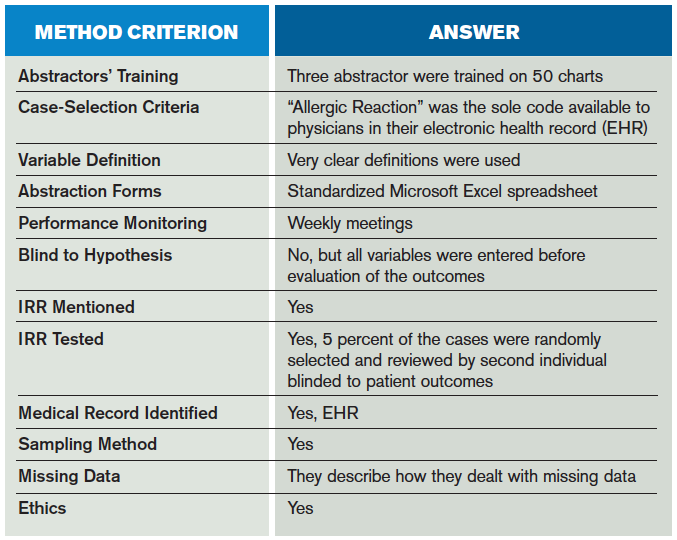
(click for larger image) Table 1.

(click for larger image)
Table 1.

Pages: 1 2 3 | Single Page

Topics: Airway ManagementAllergyAnaphylaxisBiphasic Allergic ReactionCritical CareEmergency MedicineEmergency Physician

Related

  • Why the Nonrebreather Should be Abandoned

    December 3, 2025 - 0 Comment
  • Non-Invasive Positive Pressure Ventilation in the Emergency Department

    October 1, 2025 - 0 Comment
  • Emergency Department Management of Prehospital Tourniquets

    October 1, 2025 - 0 Comment

Current Issue

ACEP Now: November 2025

Download PDF

Read More

About the Author

Ken Milne, MD

Ken Milne, MD, is chief of emergency medicine and chief of staff at South Huron Hospital, Ontario, Canada. He is on the Best Evidence in Emergency Medicine faculty and is creator of the knowledge translation project the Skeptics Guide to Emergency Medicine.

View this author's posts »

2 Responses to “Biphasic Allergic Reactions: Observation, Treatment Guidelines”

  1. January 26, 2015

    biphasic allergic reactions… | DAILYEM Reply

    […] via this recent ACEP Now article by Dr. Milne […]

  2. December 9, 2015

    Ellen Reply

    Hi Ken Milne, MD,
    Thank you for sharing your knowledge on how to observe Biphasic Allergic Reactions and also for giving treatment guidelines for it.

    This is really a great and helpful article.

Leave a Reply Cancel Reply

Your email address will not be published. Required fields are marked *


*
*


Wiley
  • Home
  • About Us
  • Contact Us
  • Privacy
  • Terms of Use
  • Advertise
  • Cookie Preferences
Copyright © 2025 by John Wiley & Sons, Inc. All rights reserved, including rights for text and data mining and training of artificial technologies or similar technologies. ISSN 2333-2603
