
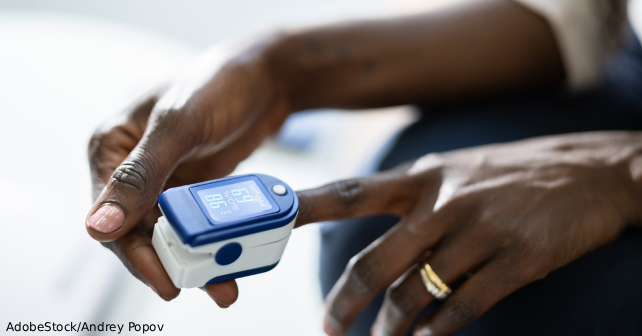
A 27-year-old woman presents with blue lips and fingers. She denies trauma, fever, chest pain, shortness of breath, or any systemic symptoms. She recently was treated for a urinary tract infection. On physical examination, she appears well with normal speech and mental status. Vital signs are: temperature 37.1 C; blood pressure 106/82; heart rate 78; respiratory rate 14, and peripheral oxygen saturation (SpO2) 81 percent. Lungs are clear to auscultation. Cardiac exam shows regular rate and rhythm with no murmur or gallop. All digits, including fingers and toes, appear cyanotic, with good sensation and range of motion.
Explore This Issue
ACEP Now: January 2026Discussion
Pulse oximetry is a widely used point-of-care measurement of arterial oxygen saturation. The pulse oximeter transilluminates the skin using visible and infrared wavelengths and compares the absorption of wavelengths of oxygenated and deoxygenated hemoglobin.1
Common causes of low pulse oximetry measurements include hypoxemia and inadequate waveform detection from hypoperfusion, anemia, skin pigmentation, nail polish, or artifact (motion artifact, tachycardia, excessive ambient light, incorrect probe placement).2,3,4,5
Other less common causes of inaccurate pulse oximetry measurements include variant hemoglobins, or dyshemoglobinemias, such as methemoglobinemia or carboxyhemoglobin.6,7 Methemoglobin and carboxyhemoglobin can falsely bias conventional pulse oximetry readings, although they are not typically detected by conventional pulse oximetry8,9 . Methemoglobin typically results in a falsely low SpO2, while carboxyhemoglobin typically results in a falsely high measured SpO2.10,11
Case Discussion
The etiology of the measured low SpO2 should be elucidated. True hypoxemia should be considered but is unlikely in this case of normal lung physiology. Other causes of low measured SpO2 should be considered, including hypoperfusion, Raynaud’s phenomenon, anemia, skin pigmentation, nail polish, variant hemoglobinopathies, methemoglobinemia, or carboxyhemoglobin. Hypoperfusion, anemia, skin pigmentation, and nail polish can be eliminated by physical examination and laboratory testing. Variant hemoglobinopathies cannot be ruled out in the emergency department setting. Methemoglobinemia and carboxyhemoglobin should be considered. Carboxyhemoglobin is less likely in this case without known exposure and with low pulse oximetry; it may be tested for using arterial blood gas measurement. Methemoglobinemia should be considered in this case as a likely cause of measured low SpO2.
Methemoglobinemia can be caused by a variety of medications, including benzocaine, prilocaine, lidocaine, tetracaine, metoclopramide, sulfonamides, nitric oxide, nitroglycerine, nitroprusside, nitrates, nitrites, ibuprofen, phenazopyridine, acetaminophen, and others.12 Phenazopyridine is the active ingredient in pyridium (AZO), an over-the-counter urinary tract pain relief medication.13
 Dr. Catherine A. Marco is professor of emergency medicine at Penn State Health-Milton S. Hershey Medical Center and associate editor of ACEP Now.
Pages: 1 2 | Single Page



No Responses to “Beyond Hypoxia: Other Causes of Low Pulse Oximetry”