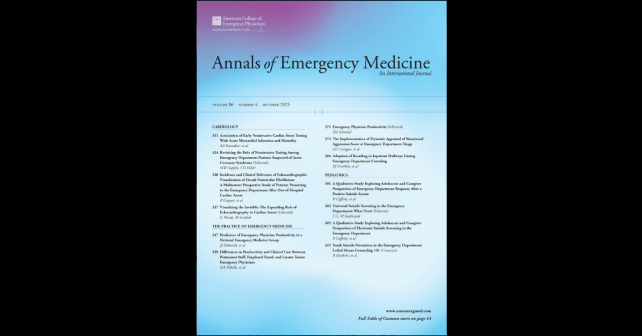
This year’s top article selections from Annals Editor in Chief Dr. Yealy cover areas encountered in the daily routines of emergency physicians and explore clinical topics critical for patient care. Commenting on one article about boarding, Dr. Yealy noted, “We’ve talked about inpatient hallway boarding for years. Yet, it always seems like something that can’t be done, even when inpatients are boarding in hallway stretchers and chairs in the ED.” Turning his attention to the selected article about the risk of persistent opioid use, Dr. Yealy described it as “a fascinating preliminary look on a key topic — important given the attention and lore about longer term opioid misuse.” Read more about these and other articles in Annal’s top picks for the year.
Explore This Issue
ACEP Now: December 2025 (Digital)Adoption of Boarding in Inpatient Hallways During Emergency Department Crowding
Discussed for 20 years as one tool to manage hospital capacity demands, sharing hallway patient boarding with inpatient units helps instead of exclusively using ED-hallway positioning while awaiting a room. To assess current inpatient shared hallway boarding practices, these authors surveyed hospital capacity leaders in 34 states and 91 sites. The responses suggest inpatient hallway use is still markedly dwarfed by ED hallway use despite much opportunity. Inpatient hallways are not the answer to bed delays, but using only ED hallways at peak demand times remains common for many reasons, real and perceived, despite clear harms. Finding alternative approaches to ED hallway boarding will require new strategies and engagement with both hospital teams and regulatory leaders.1
The ED can be a powerful site to detect illnesses and health risks beyond focusing on presenting acute concerns. This opportunity must be balanced with resources, needs, and missions. HIV screening is often offered to ED patients, but this results in limited use. These authors assessed the impact of three triage based “opt-out” HIV screening approaches in nearly 40,000 ED patients, in contrast to traditional “opt-in” methods. Of all who could be tested, 44 percentdid not opt out, enhancing screening numbers. The new approaches were associated with very small increases in some time-based care intervals and leaving before treatment completion. These observations show that ED HIV screening can add to testing capacity with a small operational burden.This may be a model for other screening.2
The role of prescriptive opioid use triggering an opioid use disorder is a target of attention, data, and lore. ED patients often receive an opioid as part of care, but the role of this in later misuse is unclear. One conflating factor when examining initial-to-later opioid use is previous opioid exposure or misuse. To better understand how often and why new ongoing prescriptive opioid use exists, the authors followed 699 opioid-naïve patients who had been seen for a painful complaint and were exposed to an opioid during or after discharge from two urban EDs. They observed that 2 percent of this cohort had more than one opioid prescription in the six months after the visit, with amount of early pain (two weeks after visit) being the strongest associated factor, not initial euphoria. These data underscore the realities of ED opioid analgesia and later ongoing use in those without existing opioid use; the frequency of longer use is small and linked to a common feature—continued pain after the initial ED visit.3
Choosing a career in the ED exposes physicians, advanced practitioners , nurses, and others to workplace risks, including infections acquired from those being served. The COVID-19 pandemic ushered in a high intensity period where that threat was real and linked to harm. Infectious risk mitigation may happen with protective actions and by changes in patient care that could include forgoing specific therapeutic steps. The authors explored what happened with ED cardiac arrest care during high pandemic periods across 20 sites, seeing this as an event where transmission could be high and basic interventions deemed riskier could be avoided. However, the investigators observed no changes in basic care steps or outcomes in these patients. This observation showed that despite concerns, ED professionals did their jobs when needed the most,despite being amidst a new and threatening scenario.4
ECG Patterns of Occlusion Myocardial Infarction: A Narrative Review
Emergency physicians and others involved in acute care traditionally focus on identifying ST segment elevation as the high priority subset of patients with myocardial ischemia. This review identifies other forms of occlusive myocardial infarction detectable on ECG that can benefit from the same early recognition and reperfusion actions that are now well entrenched with ST elevation myocardial ischemia. These features should be recognized and alter practice to improve patient outcomes.5
References
- Franklin BJ, Shen SH, Parekh VI, et al. Adoption of Boarding in Inpatient Hallways During Emergency Department Crowding. Ann Emerg Med.2025; 86(4):384-390.
- Jones AT, Haukoos J, Hopkins E, et al. Effect of Routine Opt-Out HIV Screening on Emergency Department Operational Metrics: Results From the Pragmatic Randomized HIV TESTED Trial. Ann Emerg Med. 2025; 86(3): 240-251.
- Abril L, Gilbert L, Pacheco F, et al. A Prospective Cohort Study to Determine Which Opioid-Naïve Emergency Department Patients Are at Risk of Persistent Opioid Use. Ann Emerg Med. 2025; 86(2):179-186.
- Torres JR, Paxton JH, Santos-Leon E, et al. Cardiac Arrest Management in United States Emergency Departments During the First Year of the COVID-19 Pandemic, 2020. Ann Emerg Med. 2025; 86(1):47-56.
- Ricci F, Martini C, Scordo DM, et al. ECG Patterns of Occlusion Myocardial Infarction: A Narrative Review. Ann Emerg Med. 2025; 86(4): 330-340.


No Responses to “Annals of Emergency Medicine’s Top Articles in 2025”
