
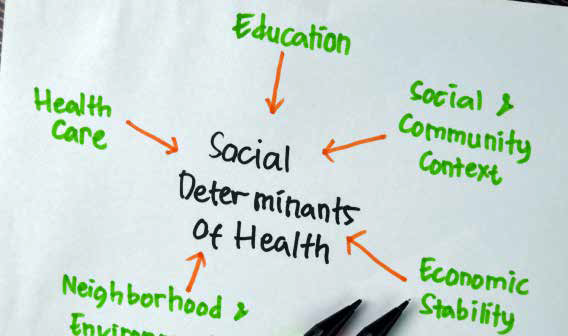
We as emergency physicians are aware of the importance that social needs have on health, yet the health care system itself lags behind. There remains a huge imbalance between national funding for health care and health improvement. Of the nearly four trillion dollars spent on health, 95 percent goes directly to medical care services, while just five percent is put aside for population health improvement. This represents a large area for opportunity to connect social services to health care, which could simultaneously improve patient health and reduce the burden on our health care system.
Explore This Issue
ACEP Now: Vol 41 – No 06 – June 2022References
- Fisher EM, Akiya K, Wells A, Li Y, Peck C, Pagán JA. Aligning social and health care services: The case of Community Care Connections. Prev Med. 2021 Feb;143:106350.
[/sidebar]
While the first step in creating change is to identify the problem, much more is needed to make a meaningful difference. Much scholarly work has been done identifying social needs among patients in the ED and elsewhere, and multiple pilot programs have been created to identify and address some of these needs in select populations. Be that as it may, numerous gaps remain, especially among ED populations, as described in the 2021 Society for Academic Medicine Consensus Conference which served to identify further research priorities within this arena.
Outside of the academic arena, changes can also be made to address these needs. The implementation of the Affordable Care Act in 2010, which incentivized many health care organizations to prioritize ‘value-based care’ and patient outcomes, may have provided some of the impetus for organizational changes. Currently, federal Medicaid rules do not allow for non-medical (i.e., social) expenditures, though this is not the case at the state level, and in January of 2021, the Center for Medicaid and Medicare Services (CMS) issued guidance educating states on how they may use allocations to “support states with designing programs, benefits, and services that can more effectively improve population health, reduce disability, and lower overall health care costs in the Medicaid and CHIP programs by addressing [social determinants of health].”
Of course, for a truly public-health centered approach, one must ensure solutions are evidence-based. The data from pilot studies to date are mixed, with some projects showing improvements in ED utilization and decreased inpatient hospitalizations, while others fail to show significant benefit. Indeed, the article reviewed in a recent Health Policy Journal Club column had similarly mixed results. Does this mean that efforts within health care to address social needs are untenable? I argue no. But rather, we must continue to study the problem and potential solutions (with an eye towards patient-centered outcomes) and encourage policy makers to ease the barriers to change. This will necessarily involve bringing our patients and our communities to the table, as the most important stakeholders in these efforts and as the reason we joined the profession in the first place. As Dr. Halloran mentions in her column, only five percent of health care dollars go towards population health improvement—an area ripe for growth if we are to improve the health and well-being of the patients we serve.
Pages: 1 2 3 | Single Page



No Responses to “Addressing Social Needs In and Out of the Emergency Department”