Logo

Log In Sign Up |  An official publication of: American College of Emergency Physicians
Navigation
  • Home
  • Multimedia
    • Podcasts
    • Videos
  • Clinical
    • Airway Managment
    • Case Reports
    • Critical Care
    • Guidelines
    • Imaging & Ultrasound
    • Pain & Palliative Care
    • Pediatrics
    • Resuscitation
    • Trauma & Injury
  • Resource Centers
    • mTBI Resource Center
  • Career
    • Practice Management
      • Benchmarking
      • Reimbursement & Coding
      • Care Team
      • Legal
      • Operations
      • Quality & Safety
    • Awards
    • Certification
    • Compensation
    • Early Career
    • Education
    • Leadership
    • Profiles
    • Retirement
    • Work-Life Balance
  • Columns
    • ACEP4U
    • Airway
    • Benchmarking
    • Brief19
    • By the Numbers
    • Coding Wizard
    • EM Cases
    • End of the Rainbow
    • Equity Equation
    • FACEPs in the Crowd
    • Forensic Facts
    • From the College
    • Images in EM
    • Kids Korner
    • Medicolegal Mind
    • Opinion
      • Break Room
      • New Spin
      • Pro-Con
    • Pearls From EM Literature
    • Policy Rx
    • Practice Changers
    • Problem Solvers
    • Residency Spotlight
    • Resident Voice
    • Skeptics’ Guide to Emergency Medicine
    • Sound Advice
    • Special OPs
    • Toxicology Q&A
    • WorldTravelERs
  • Resources
    • ACEP.org
    • ACEP Knowledge Quiz
    • Issue Archives
    • CME Now
    • Annual Scientific Assembly
      • ACEP14
      • ACEP15
      • ACEP16
      • ACEP17
      • ACEP18
      • ACEP19
    • Annals of Emergency Medicine
    • JACEP Open
    • Emergency Medicine Foundation
  • About
    • Our Mission
    • Medical Editor in Chief
    • Editorial Advisory Board
    • Awards
    • Authors
    • Article Submission
    • Contact Us
    • Advertise
    • Subscribe
    • Privacy Policy
    • Copyright Information

Acute Pericarditis: A Diagnosis of Exclusion

By Anton Helman, MD, CCFP(EM), FCFP | on July 5, 2022 | 0 Comment
EM Cases
  • Tweet
  • Click to email a link to a friend (Opens in new window) Email
Print-Friendly Version
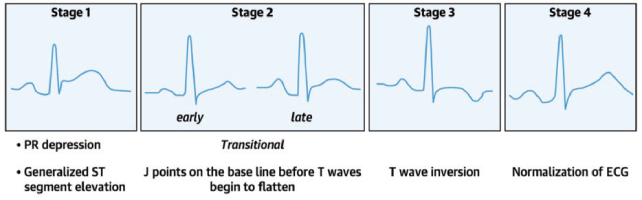
  • PR deviation strongly favors pericarditis
  • Evolution of ST and T changes strongly favors pericarditis
  • STE: T-wave amplitude ratio >0.25 has a 100 percent positive predictive value and negative predictive value for pericarditis
  • Pericarditis STE is typically more evenly distributed and sometimes more prominent in the inferior leads, whereas early repolarization STE is more prominent in anterior leads.

Troponin, in one study, was elevated in one third of cases of pericarditis, and is often associated with STE on ECG and pericardial effusion.9 Inflammatory markers (WBC, ESR, and CRP) are elevated in up to 80 percent of cases, but these markers are not sensitive or specific for the diagnosis of acute pericarditis.10 Patients with elevated CRP are at higher risk for recurrence and should be treated in a timely and aggressive manner.11

You Might Also Like
  • How Commonly Do Kids With Acute Appendicitis Present With Diarrhea?
  • One-hour Acute Myocardial Infarction Rule-Out Not Ready for Prime Time
  • Acute Chest Syndrome in Pediatric Sickle-Cell Disease: Antibiotic Guidelines Matter
Explore This Issue
ACEP Now: Vol 41 – No 07 – July 2022

Prevention of recurrence is perhaps the most important aspect of ED treatment of acute uncomplicated pericarditis because recurrence leads to long-term morbidity. Colchicine is the mainstay of ED treatment of acute pericarditis and has been shown in multiple randomized control trials to decrease recurrence and long-term morbidity.12–15 A common cause of recurrent pericarditis is inadequate treatment of the first episode. Up to 30 percent of patients with idiopathic acute pericarditis who are not treated with colchicine will develop either recurrent or incessant disease. Outpatient management of presumed viral/idiopathic uncomplicated pericarditis should include the following:

  • Restrict strenuous physical activity (as exercise may trigger recurrence of symptoms)
  • Ibuprofen 600–800 mg three times daily or indomethacin 50 mg three times daily
  • Colchicine 0.6 mg daily for <70 kg, twice daily for ≥70 kg
  • Proton pump inhibitors for those at high risk of upper gastrointestinal bleeding

Duration of uncomplicated pericarditis treatment is usually one to two weeks and is based on resolution of symptoms and normalization of CRP, typically followed by a taper of medications. Corticosteroids should be considered only as a second-line option after nonsteroidal anti-inflammatory drugs (NSAIDs) in patients with absolute contraindications to or failure of NSAIDS because of the risk of chronicity of disease and drug dependence with steroids.

Next time you are faced with a patient with chest pain in the ED, first, rule out other more deadly causes of chest pain first (understanding that there are no clinical features specific to pericarditis), carefully scrutinize the ECG (realizing that no finding is 100 percent specific for pericarditis), and if you arrive at a diagnosis of uncomplicated viral or idiopathic acute pericarditis, be sure to start the patient on colchicine and NSAIDs and also ensure tight follow-up to monitor the clinical course and consideration of serial CRP measurements.

Pages: 1 2 3 4 5 | Single Page

Topics: Acute PericarditisAortic Dissectioncardiac ischemiaCritical CareElectrocardiogramMyocardial InfarctionPulmonary Embolism

Related

  • Why the Nonrebreather Should be Abandoned

    December 3, 2025 - 0 Comment
  • Non-Invasive Positive Pressure Ventilation in the Emergency Department

    October 1, 2025 - 0 Comment
  • Emergency Department Management of Prehospital Tourniquets

    October 1, 2025 - 0 Comment

Current Issue

ACEP Now: November 2025

Download PDF

Read More

No Responses to “Acute Pericarditis: A Diagnosis of Exclusion”

Leave a Reply Cancel Reply

Your email address will not be published. Required fields are marked *


*
*


Wiley
  • Home
  • About Us
  • Contact Us
  • Privacy
  • Terms of Use
  • Advertise
  • Cookie Preferences
Copyright © 2025 by John Wiley & Sons, Inc. All rights reserved, including rights for text and data mining and training of artificial technologies or similar technologies. ISSN 2333-2603
