

—
Explore This Issue
ACEP Now: Vol 41 – No 01 – January 2022“I was useful and helping the good guys”
Yang Wang, MD
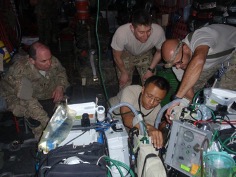
I was at Camp Bastion in 2012 from May to October as the Tactical Critical Care Evacuation Team (TCCET) physician. We flew more than 170 missions across Afghanistan, transporting patients from Role 2 to Role 3 hospitals.
Flying U.S. and coalition soldiers always felt good. I was useful and helping the good guys. But, more than half our patients were Afghan adults and children with amputations, open abdomens, burns, and devastating head injuries. Awake patients wore flat affects, no eye contact, and no acknowledgements. The rest were vented, swollen, broken. For every U.S. and coalition soldier I handed off, I knew they’d find world-class rehabilitative and psychological services at home. But what about my Afghan patients? Yes, we patched them up. But where would they find those same services?
Managing critical patients was thrilling and professionally rewarding. Mixing drips and push-dose pressors, setting up a-lines, IV pumps, and ventilators were skills I never learned in civilian residency, and it all made me a better physician today. I worked with the most diligent and grounded co-workers I’ve ever met.
Yet, remembering those Afghan patients, I’m relieved we have exited.
—
“You Really Lean On Your Training”
Roderick Fontenette, MD, FACEP
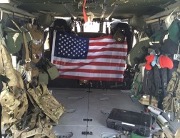
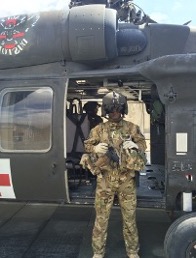
While deployed in 2014 in Afghanistan as part of the Tactical Critical Care Evacuation Team (TCCET) I was deployed far forward to care for members wounded at the point of injury and begin moving them toward a higher level of care. As an emergency physician deployed to resource-limited environments, you really lean on your training and focus on hemorrhage control and damage control resuscitation. On this deployment, we worked in the back of a UH-60 Black Hawk helicopter. The skills acquired in residency are instrumental when helping manage critically injured patients.
—
The NATO Effort to Fight COVID-19 in Afghanistan
Rory Stuart, MD, FACEP
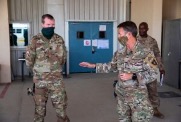
Midway through our Bagram deployment in early 2020, COVID-19 exploded across the globe. U.S./NATO physicians and war planners were tasked with developing a viral response plan.
We began with a series of mitigation strategies: quarantine requirement for all inbound personnel, moving high-risk individuals out, social distancing, masking, closing gyms, and suspending nonessential travel. Critical care resources were collapsed into the Role 3s in Bagram and Kandahar.
Emergency physicians would decide which individuals would be tested, quarantined, admitted, or sent to isolation. In emergency medicine, we are trained to do more with less in the service of patients who often have few good options. Our deployed emergency medicine team took this ethos and tackled the biggest military medicine and logistical problem of the last century. In recognition of our contribution to the mission, Gen. Austin Miller personally awarded our team the Bronze Star prior to our departure.

Pages: 1 2 3 4 | Single Page

No Responses to “ACEP Government Services Chapter Docs Reflect on Time in Afghanistan”