Logo

Log In Sign Up |  An official publication of: American College of Emergency Physicians
Navigation
  • Home
  • Multimedia
    • Podcasts
    • Videos
  • Clinical
    • Airway Managment
    • Case Reports
    • Critical Care
    • Guidelines
    • Imaging & Ultrasound
    • Pain & Palliative Care
    • Pediatrics
    • Resuscitation
    • Trauma & Injury
  • Resource Centers
    • mTBI Resource Center
  • Career
    • Practice Management
      • Benchmarking
      • Reimbursement & Coding
      • Care Team
      • Legal
      • Operations
      • Quality & Safety
    • Awards
    • Certification
    • Compensation
    • Early Career
    • Education
    • Leadership
    • Profiles
    • Retirement
    • Work-Life Balance
  • Columns
    • ACEP4U
    • Airway
    • Benchmarking
    • Brief19
    • By the Numbers
    • Coding Wizard
    • EM Cases
    • End of the Rainbow
    • Equity Equation
    • FACEPs in the Crowd
    • Forensic Facts
    • From the College
    • Images in EM
    • Kids Korner
    • Medicolegal Mind
    • Opinion
      • Break Room
      • New Spin
      • Pro-Con
    • Pearls From EM Literature
    • Policy Rx
    • Practice Changers
    • Problem Solvers
    • Residency Spotlight
    • Resident Voice
    • Skeptics’ Guide to Emergency Medicine
    • Sound Advice
    • Special OPs
    • Toxicology Q&A
    • WorldTravelERs
  • Resources
    • ACEP.org
    • ACEP Knowledge Quiz
    • Issue Archives
    • CME Now
    • Annual Scientific Assembly
      • ACEP14
      • ACEP15
      • ACEP16
      • ACEP17
      • ACEP18
      • ACEP19
    • Annals of Emergency Medicine
    • JACEP Open
    • Emergency Medicine Foundation
  • About
    • Our Mission
    • Medical Editor in Chief
    • Editorial Advisory Board
    • Awards
    • Authors
    • Article Submission
    • Contact Us
    • Advertise
    • Subscribe
    • Privacy Policy
    • Copyright Information

ACEP Government Services Chapter Docs Reflect on Time in Afghanistan

By ACEP Now | on January 12, 2022 | 0 Comment
Features
  • Tweet
  • Click to email a link to a friend (Opens in new window) Email
Print-Friendly Version
On Aug. 28, 2021, Dr. Kat Landa (center) and her fellow officers of the Shock Trauma Platoon waited to fly out of the Hamid Karzai International Airport in Kabul. Read more from Dr. Landa below.

“We left things in a better state than when we got there”

Mark Antonacci, MD, FACEP

You Might Also Like
  • Reflections on Afghanistan
  • ACEP Sues Federal Government Over Health Insurer Billing Practices
  • ACEP Chapter Roundup: Highlights, Updates, and More From 2021
Explore This Issue
ACEP Now: Vol 41 – No 01 – January 2022

I deployed several times during my time on active duty, but my most memorable deployment was in 2010 as part of an Embedded Training Team based out of Forward Operating Base Lindsey in Kandahar Province. My team worked with the Afghan Army doctors, nurses, medics, and ancillary staff on a daily basis in their facility. It was (and likely still is) the Wild West of Afghanistan. Processing the events of the U.S. withdrawal over the last few months has been difficult. I just try to focus on the fact that we left things in a better state than when we got there. We were able to make life a little easier for many (especially the women and children) who otherwise would not have had access to any medical care. The individuals we trained were able to provide a standard of care to the local population well above the existing civilian medical system. I can only hope some of that care we provided has persisted despite the current Taliban regime.

—

“We Saved Them for a Good Life”

Torree McGowan, MD, FACEP

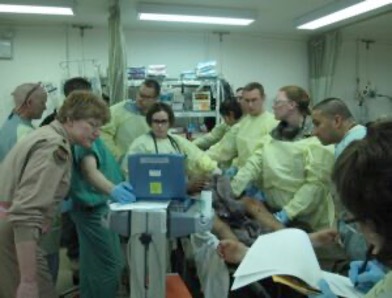
One of the most impactful things that happened to me when I was deployed in 2009 was having Operation Proper Exit come through my hospital. These men and women had been wounded in previous tours and were coming back through the country to see where they had been cared for. Most of them remembered getting hit and then would wake up at Brooke Army or Walter Reed and have a huge chunk of their life missing. Proper Exit let them come back and begin to process their trauma. Every one of them—most of whom were multiple amputees, had significant burns, and had survived other severe trauma—said we saved them for a good life. That kept me fighting to save them, no matter how badly they were injured.
—

“I was where I was needed…”

Leo Tanaka, MD, FACEP

On Sept. 11, 2011, the 10-year anniversary of 9/11, I was flying throughout Afghanistan on missions to pick up critically injured patients from forward operating locations (sometimes from unsecured airfields) and take them to a Role 3 higher level of care. I was proud of my work but sad about the devastation I saw. As medical director of a U.S. Air Force Pararescue unit that deployed so “that others may live,” I was where I was needed and where I could make the greatest impact. The mission remains, and there is still work to be done.

Pages: 1 2 3 4 | Single Page

Topics: ACEP Government Services Chapter

Current Issue

ACEP Now: November 2025

Download PDF

Read More

About the Author

ACEP Now

View this author's posts »

No Responses to “ACEP Government Services Chapter Docs Reflect on Time in Afghanistan”

Leave a Reply Cancel Reply

Your email address will not be published. Required fields are marked *


*
*


Wiley
  • Home
  • About Us
  • Contact Us
  • Privacy
  • Terms of Use
  • Advertise
  • Cookie Preferences
Copyright © 2025 by John Wiley & Sons, Inc. All rights reserved, including rights for text and data mining and training of artificial technologies or similar technologies. ISSN 2333-2603