
The team successfully achieved its primary objective of sharing a TBI evidence-based resuscitation protocol developed in the United States and adapting it for use in Vietnam. This effort exemplified the transfer of knowledge between a high-income country (HIC) and a low-middle-income country (LMIC) in a flexible, collaborative, and resource-sensitive manner. The health care professionals in Vietnam displayed remarkable resilience and adaptability. Witnessing their commitment to delivering quality care, even under challenging circumstances, was both humbling and inspiring. In a show of pragmatic solidarity between countries, the teams utilized the train-the-trainer and lecture presentation models in the audience’s native language,
Explore This Issue
ACEP Now: Vol 43 – No 07 – July 2024
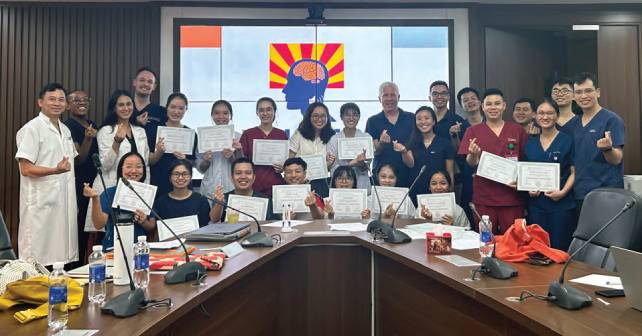
Students learn valuable lessons in EPIC-TBI. (Click to enlarge.)
facilitated by collaboration with native experts, rather than delivering content in a foreign language and relying on real-time interpreters. Moreover, working relationships between the UT Health Houston McGovern Medical School, Department of Emergency Medicine, and Hanoi Medical University, lay the foundation for future collaborative efforts.
The ultimate success of this international endeavor—defined as the integration of the adapted EPIC-TBI algorithm into best practice guidelines within Vietnam’s trauma systems—hinges on the ability of an international, multicultural team to champion the initiative and to expand training and adaptation at institutional, local, and national levels. While significant undertakings like establishing a high-quality EMS system, a trauma
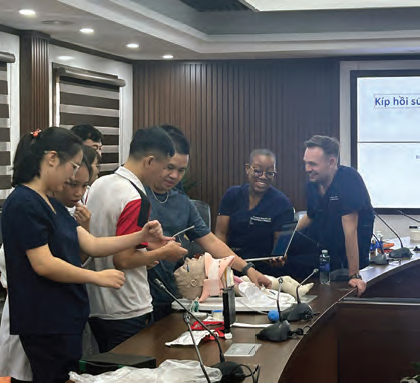
Collaborating together. (Click to enlarge.)
system, and a shared electronic medical record system will impact the speed and efficiency of this integration in Vietnam, the Houston-based team believes they have created a replicable model for international medical information exchange. The next step is to evaluate the effectiveness of Vietnam’s modified EPIC-TBI protocol and training through a pilot project, once again collaborating as an international team of investigators, educators, and clinicians.
 Dr. Bobrow is a professor of emergency medicine at McGovern Medical School at UTHealth Houston and Co-PI of the EPIC-TBI Trial.
 Dr. Walia is an assistant professor and global health director of emergency medicine at McGovern Medical School at UTHealth Houston.
 Dr. Tran is an assistant professor of emergency medicine and management, policy, and community health at UTHealth Houston, specializing in clinical population health and advocacy.
 Dr. Hoang is an associate professor of emergency and critical care medicine at Hanoi Medical University, Hanoi, Vietnam.
References
- Contents (by MWL Topic Area). National Transportation Safety Board; 2020. Accessed April 4, 2024. https://www.ntsb.gov/Advocacy/mwl/Documents/2019-20/2019-20-MWL-SafetyRecs.pdf
- World Health Organization (WHO). Global status report on road safety 2018: Summary. https://apps.who.int/iris/bitstream/handle/10665/277370/WHONMHNVI-18.20-eng.pdf. December 24, 2018. Accessed June 17, 2024.
- Spaite DW, Bobrow BJ, Keim SM, et al. Association of statewide implementation of the prehospital traumatic brain injury treatment guidelines with patient survival following traumatic brain injury: the Excellence in Prehospital Injury Care (EPIC) Study. JAMA Surg. 2019;154(7):e191152.
Pages: 1 2 3 | Single Page



No Responses to “A Train-the-Trainer Model Implements Traumatic Brain Injury Protocol in Vietnam”