
Logo

Log In Sign Up |  An official publication of: American College of Emergency Physicians
Navigation
  • Home
  • Multimedia
    • Podcasts
    • Videos
  • Clinical
    • Airway Managment
    • Case Reports
    • Critical Care
    • Guidelines
    • Imaging & Ultrasound
    • Pain & Palliative Care
    • Pediatrics
    • Resuscitation
    • Trauma & Injury
  • Resource Centers
    • mTBI Resource Center
  • Career
    • Practice Management
      • Benchmarking
      • Reimbursement & Coding
      • Care Team
      • Legal
      • Operations
      • Quality & Safety
    • Awards
    • Certification
    • Compensation
    • Early Career
    • Education
    • Leadership
    • Profiles
    • Retirement
    • Work-Life Balance
  • Columns
    • ACEP4U
    • Airway
    • Benchmarking
    • Brief19
    • By the Numbers
    • Coding Wizard
    • EM Cases
    • End of the Rainbow
    • Equity Equation
    • FACEPs in the Crowd
    • Forensic Facts
    • From the College
    • Images in EM
    • Kids Korner
    • Medicolegal Mind
    • Opinion
      • Break Room
      • New Spin
      • Pro-Con
    • Pearls From EM Literature
    • Policy Rx
    • Practice Changers
    • Problem Solvers
    • Residency Spotlight
    • Resident Voice
    • Skeptics’ Guide to Emergency Medicine
    • Sound Advice
    • Special OPs
    • Toxicology Q&A
    • WorldTravelERs
  • Resources
    • ACEP.org
    • ACEP Knowledge Quiz
    • Issue Archives
    • CME Now
    • Annual Scientific Assembly
      • ACEP14
      • ACEP15
      • ACEP16
      • ACEP17
      • ACEP18
      • ACEP19
    • Annals of Emergency Medicine
    • JACEP Open
    • Emergency Medicine Foundation
  • About
    • Our Mission
    • Medical Editor in Chief
    • Editorial Advisory Board
    • Awards
    • Authors
    • Article Submission
    • Contact Us
    • Advertise
    • Subscribe
    • Privacy Policy
    • Copyright Information

A Practical Guide to Diagnosing Delirium and Acute Cognitive Change in the ED

By Sonja Foo, MBBS | on December 23, 2025 | 0 Comment
Features
  • Tweet
  • Click to email a link to a friend (Opens in new window) Email
Print-Friendly Version

Terms such as “confusion,” “altered mental status,” or “not acting right,” are frequently used and invariably make their way into emergency department (ED) documentation. The terms are often used interchangeably, casually, and without much thought. But here’s the issue: none are diagnoses; they’re symptoms. Using these terms haphazardly as diagnostic surrogates can delay care, obscure critical illness, and leave dangerous gaps in reasoning and documentation.

You Might Also Like
  • Delirium in the Elderly: A Diagnosis Often Missed
  • ACEP Rejects “Excited Delirium”
  • Cancer Patients Diagnosed with Delirium in the Emergency Department Have Higher Risk of Death
Explore This Issue
ACEP Now: January 2026

If we are to start improving outcomes for our aging patients with cognitive impairment, we need to start by using the right vocabulary. Delirium is not just another way of saying “confused.” It’s a well-defined clinical syndrome characterized by acute onset, a fluctuating course, impaired attention, and disturbed awareness that arises from an underlying physiological insult.1 Delirium is identifiable, screenable, and often reversible.

By contrast, encephalopathy is a pathobiological process, referring to diffuse brain dysfunction caused by metabolic, toxic, infectious, or other systemic disturbances.1 Encephalopathy has a broad pathogenesis, and delirium is what the culmination of that pathogenesis might look like clinically. Recognizing this distinction isn’t purely academic — it’s actionable. Once we name it delirium (not just confusion), we can screen for it, work it up, and treat it.

Delirium in the ED
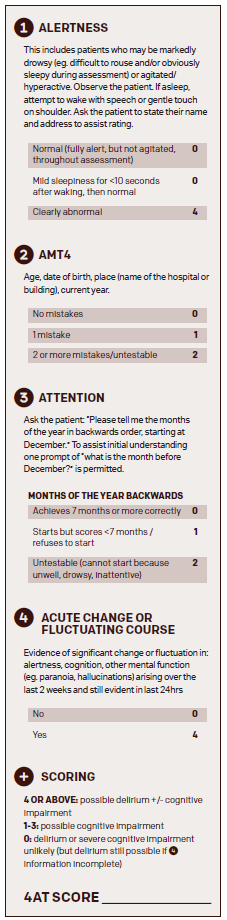
The 4AT tool.

Delirium affects as much as 15 percent of older adults in the ED.2,3 Despite this, emergency physicians do not recognize delirium in about half or more of cases. One prospective study of about 1,500 patients aged 65 or older found that nurses missed delirium in 55 percent of cases, and physicians in about 50 percent.4

Sending patients home with delirium unrecognized is not a minor oversight and comes with serious consequences. A recent retrospective study of 22,940 ED visits showed that patients discharged with delirium experienced nearly three times the 30‑day mortality rate (adjusted relative risk 2.86) and significantly higher rates of return ED visits compared with those discharged without delirium.5 Beyond mortality, unrecognized delirium is linked to prolonged hospital stays, increased risk for institutionalization, and long-term functional decline.3,6

Efficient Screening

Once delirium is suspected, we need a validated, rapid tool to screen for it. The 4AT rapid clinical test  is ideal as it assesses alertness, attention, acute change/fluctuation, and cognition.7 The test takes less than two minutes, is training-free, and demonstrates approximately 88 percent sensitivity/specificity in adults.8,9 The tool also outperforms Confusion Assessment Method-based screens in ED environments.10 A score of four or greater indicates delirium; a score of one to three suggests cognitive impairment and a potential need for further observation.7

A Structured Workup Matters

When a patient presents to the ED with an acute change in mental status, it’s our job as emergency physicians to uncover whether the etiology is treatable or life-threatening. A structured framework can help identify reversible causes and those who require escalation. The distinction between toxic-metabolic encephalopathy, focal neurologic deficit, and psychiatric dysfunction is more than just semantics — it’s a determinant of treatment and outcomes. Early clarity improves decision making, speeds treatment, and enhances safe disposition planning.

Click to enlarge.

Structured Workup: Reversible Causes

When delirium is identified — or even strongly suspected — it’s crucial to search for a cause. The DELIRIUM mnemonic offers a simple framework (see graphic).

Documentation: A Legal and Clinical Shield

Documenting that a patient is simply “confused” without further detail is not just medically inadequate; it could leave you legally exposed. Confusion is a symptom, not a diagnosis, and failing to clarify its nature, severity, and cause can expose physicians to significant liability, particularly when issues of competence and decision-making capacity arise.11-14 Courts have repeatedly identified gaps in documentation of altered mental status as evidence of substandard care, especially in cases involving unsafe discharges, failure to obtain informed consent, or missed diagnoses like sepsis, hypoxia, or toxic-metabolic encephalopathy.15

Instead of vague descriptors, clinicians should clearly articulate:

  • Baseline versus current mental status (with collateral when possible)
  • Objective findings (e.g., inattention, fluctuating alertness, or disorganized thinking)
  • Clinical decision tools (e.g., 4AT score and interpretation) to anchor your exam in a validated framework
  • Suspected etiology (e.g., infection, medications, or organ dysfunction)
  • Disposition and treatment plan (e.g., acute interventions, consults, and decisions around admission versus outpatient follow-up)

A clear documentation of mental status changes reinforces clinical reasoning, supports safe care, protects legally, and ensures billing compliance. How you document influences how you deliver care and how that care is judged.

Future Directions

The ED is chaotic. We’re pressed for time, faced with frequent interruptions, and often lack baseline context (especially overnight). This is precisely why and where structure matters most. A brief screening checklist shouldn’t be a burden but instead a safeguard. Integrating 4AT into triage or nursing workflows, prompting collateral questions (if available), and adopting the DELIRIUMS mnemonic in electronic health records smart phrases are low-cost yet high‑impact strategies. Better structure results in better care with minimal workflow disruption.

Conclusion

We’re no strangers to the nuances of detecting delirium in the chaotic, fast-paced setting of the ED. Just the other day, a 78-year-old woman presented to my ED with a chief complaint of “confusion.” Upon evaluation, she was alert, oriented, and perfectly conversational. She insisted she felt fine and had only come because her daughter was worried. However, it was the collateral history that told the real story: the night before, she’d been disoriented, wandering her own home, convinced she was somewhere unfamiliar. Her workup revealed a urinary tract infection that I was able to quickly identify and treat.

Delirium isn’t a harmless observation — it’s a red flag of serious underlying pathology. And although encephalopathy may underlie it, naming the process isn’t enough. Treat delirium as a syndrome that demands the question: What prompted this and what can we do about it? Use 4AT. Use structured frameworks. Document thoroughly. Protect patients and your practice.

Let’s stop calling it “confusion.” Let’s start recognizing it as what it might be — delirium — and manage it accordingly. Our patients deserve nothing less.


Dr. Sonja Foo is a board-certified emergency medicine critical care physician completing her Neurocritical Care Fellowship at the Massachusetts General Hospital, Brigham and Women’s Hospital, and Harvard Medical School Training Program.


References

  1. Slooter AJC, Otte WM, Devlin JW, et al. Updated nomenclature of delirium and acute encephalopathy: statement of ten Societies. Intensive Care Med. 2020;46(5):1020-1022
  2. Chen F, Liu L, Wang Y, et al. Delirium prevalence in geriatric emergency department patients: a systematic review and meta-analysis. Am J Emerg Med. 2022;59:121-128.
  3. Kennedy M, Enander RA, Tadiri SP, et al. Delirium risk prediction, healthcare use and mortality of elderly adults in the emergency department. J Am Geriatr Soc. 2014;62(3):462-9.
  4. Lee JS, Tong T, Chignell M, et al. Prevalence, management and outcomes of unrecognized delirium in a national sample of 1,493 older emergency department patients: how many were sent home and what happened to them? Age Ageing. 2022;51(2):afab214.
  5. Howick AS, Thao P, Carpenter KP, et al. Outcomes of older adults with delirium discharged from the emergency department. Ann Emerg Med. 2025:S0196-0644(25)00064-2.
  6. Goldberg TE, Chen C, Wang Y, et al. Association of delirium with long-term cognitive decline: a meta-analysis. JAMA Neurol. 2020;77(11):1373-1381. Erratum in: JAMA Neurol. 2020;77(11):1452.
  7. Shenkin SD, Fox C, Godfrey M, et al. Protocol for validation of the 4AT, a rapid screening tool for delirium: a multicentre prospective diagnostic test accuracy study. BMJ Open. 2018;8(2):e015572.
  8. Tieges Z, Maclullich AMJ, Anand A, et al. Diagnostic accuracy of the 4AT for delirium detection in older adults: systematic review and meta-analysis. Age Ageing. 2021;50(3):733-743.
  9. Jeong E, Park J, Lee J. Diagnostic test accuracy of the 4AT for delirium detection: a systematic review and meta-analysis. Int J Environ Res Public Health. 2020;17(20):7515.
  10. Shenkin SD, Fox C, Godfrey M, et al. Delirium detection in older acute medical inpatients: a multicentre prospective comparative diagnostic test accuracy study of the 4AT and the confusion assessment method. BMC Med. 2019;17(1):138.
  11. Thomas J, Moore G. Medical-legal Issues in the agitated patient: cases and caveats. West J Emerg Med. 2013;14(5):559-65.
  12. Reeves RR, Pinkofsky HB, Stevens L. Medicolegal errors in the ED related to the involuntary confinement of psychiatric patients. Am J Emerg Med. 1998;16(7):631-3.
  13. Barstow C, Shahan B, Roberts M. Evaluating medical decision-making capacity in practice. Am Fam Physician. 2018;98(1):40-46.
  14. Griglak MJ, Bucci RL. Medicolegal management of the organically impaired patient in the emergency department. Ann Emerg Med. 1985;14(7):685-9.
  15. Ghaith S, Moore GP, Colbenson KM, Lindor RA. charting practices to protect against malpractice: case reviews and learning points. West J Emerg Med. 2022;23(3):412-417.

Topics: acute cognitive changeDeliriumencephalopathyGeriatric

Related

  • Readers Respond: ED Boarding Tactics and Excited Delirium

    May 8, 2024 - 0 Comment
  • ACEP Rejects “Excited Delirium”

    April 5, 2024 - 0 Comment
  • ACEP’s New MicroEd Videos Cover a Variety of Clinical Topics

    September 9, 2022 - 0 Comment

Current Issue

ACEP Now: December 2025 (Digital)

Read More

No Responses to “A Practical Guide to Diagnosing Delirium and Acute Cognitive Change in the ED”

Leave a Reply Cancel Reply

Your email address will not be published. Required fields are marked *


*
*


Wiley
  • Home
  • About Us
  • Contact Us
  • Privacy
  • Terms of Use
  • Advertise
  • Cookie Preferences
Copyright © 2025 by John Wiley & Sons, Inc. All rights reserved, including rights for text and data mining and training of artificial technologies or similar technologies. ISSN 2333-2603