
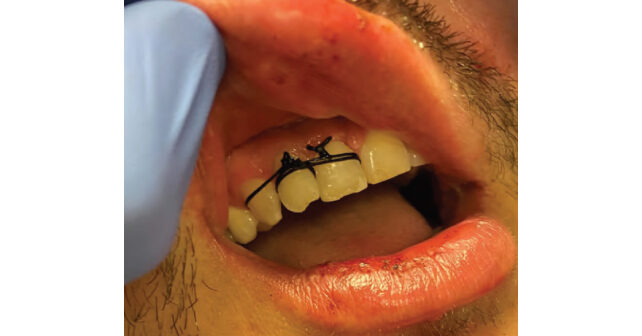
In this case, which describes using silk suture to secure an avulsed tooth in the emergency department, we offer another method to provide flexible splinting with good long-term outcomes in the setting of dental trauma. This patient had successful re-implantation on follow-up over a year after the original injury (Figure 2).
Explore This Issue
ACEP Now: Vol 41 – No 11 – November 2022Dr. Dark (@RealCedricDark) is associate professor of emergency medicine at Baylor College of Medicine and the medical editor in chief of ACEP Now.
Dr. Brock is a pediatric dentist in Houston, Texas.
Dr. Miksanek is an emergency physician at OSF Saint Francis Medical Center.
References
- Bustamante-Hernández N, Amengual-Lorenzo J, Fernández-Estevan L, et al. What can we do with a dental avulsion? A multidisciplinary clinical protocol. J Clin Exp Dent. 2020;12(10):e991-e998.
- Fouad AF, Abbott PV, Tsilingaridis G, et al. International Association of Dental Traumatology guidelines for the management of traumatic dental injuries: 2. Avulsion of permanent teeth. Dent Traumatol. 2020;36(4):331-342.
- McIntosh MS, Konzelmann J, Smith J, et al. Stabilization and treatment of dental avulsions and fractures by emergency physicians using just-in-time training. Ann Emerg Med. 2009;54(4):585-92.
- Rosenberg H, Rosenberg H, Hickey M. Emergency management of a traumatic tooth avulsion. Ann Emerg Med. 2011;57(4):375-7.
- Kahler B, Hu JY, Marriot-Smith CS. Splinting of teeth following trauma: a review and a new splinting recommendation. Aust Dent J. 2016;61 Suppl 1:59-73.
Pages: 1 2 | Single Page


One Response to “A Novel Technique to Treat a Dental Avulsion”
November 13, 2022
Kenneth V. Iserson, MDAny non-dentist attempting to replace avulsed teeth will be justifiably nervous. Even in a well-equipped ED, working in a small space and doing a novel procedure can be challenging; a remote setting is even more problematic. It behooves the clinician to use the simplest possible methods. While Dr. Dark and colleagues describe one method on interdental stabilization using sutures (previously described), it is, as they note, not the easiest and probably not the most successful technique.
Using cyanoacrylate (Superglue or the equivalent) may be the easiest and best makeshift method. After drying the affected tooth and the adjacent teeth and gums, apply the adhesive to the teeth and to the gingiva below them. Apply the adhesive to both the mesial (closest to mid-line) and distal (away from midline) sides of the tooth so that it bonds to the adjacent teeth. Even better is to combine adhesive and a wire that can be the metal bridge from a surgical mask, a thin orthopedic wire; a small-gauge spinal needle with the ends clipped; a thin paperclip; or similar thin-gauge, malleable, but relatively rigid, wire. Bend the wire so it conforms to the convexity of the normal tooth configuration and covers four or five teeth (more if the technique is used to stabilize and mandibular or maxillary fracture).[1]
All these methods are only temporizing. The patient should be placed on a liquid or soft diet and be seen by a dental professional as soon as possible.
[1] Iserson KV: Dental: Fillings, Extractions, and Trauma, In: Improvised Medicine: Providing Care in Extreme Environments, 2nd ed. McGraw-Hill Publishing, New York, NY. 2016:440-442.