
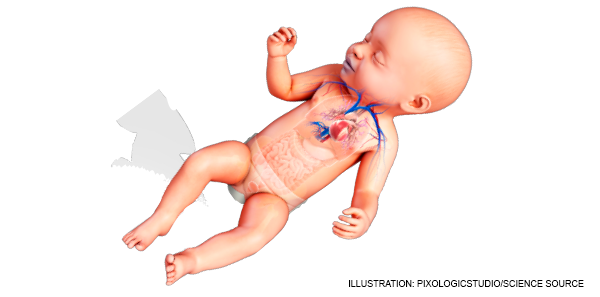
Be judicious with fluids and oxygen. Consider 5–10 mL/kg normal saline boluses rather than the usual 20 mL/kg boluses in the hemodynamically unstable infant to improve preload and encourage further opening of the PDA and pulmonary blood flow through the duct.8 Although the pulse oximetry goal in non-CHD patients is greater than 92 percent, in some CHD patients, aiming for this high of an oxygenation can prove deleterious to pulmonary blood flow, and it can worsen hypoxemia. Some CHD patients require a pulse oximetry of only 75 to 85 percent. Inotropes and/or vasopressors may be necessary to maintain adequate systemic perfusion and encourage pulmonary perfusion—consider them in consultation with a pediatric intensivist.
Explore This Issue
ACEP Now: Vol 37 – No 05 – May 2018Avoid ketamine in patients suspected of CHD because it increases systemic vascular resistance (SVR), which worsens left-to-right shunting and can lead to cardiovascular collapse. Etomidate is preferred to minimize changes in hemodynamics.9
Be judicious with positive-pressure ventilation. Start with a very low positive end-expiratory pressure (PEEP). Positive-pressure ventilation can increase PVR and decrease SVR as well as preload, which can adversely affect shunt flow.10
Summary
The next time you’re faced with a crashing infant, rather than racking your brain for the details of every congenital heart lesion, simply consider CHD in your differential diagnosis, whether the infant is younger than 1 month of age or not, and whether they appear pink, gray, or blue. Look for silent tachypnea and assess limb differentials. Complete a hyperoxia test. Look for signs of ventricular hypertrophy on ECG. Use bedside ultrasound to determine global cardiac function, the presence of a septal defect, and the chamber count. Be judicious with fluids, oxygen, and positive-pressure ventilation. Consider prostaglandins for all blue and gray neonates, and avoid ketamine.
If you remember these simple principles, you could save an infant’s life.
Special thanks to Dr. Gary Joubert and Dr. Ashley Strobel for their contributions to the podcast from which this article was inspired.
References
- Strobel AM, Lu le N. The critically ill infant with congenital heart disease. Emerg Med Clin North Am. 2015;33(3):501-518.
- Kantor PF, Lougheed J, Dancea A, et al. Presentation, diagnosis, and medical management of heart failure in children: Canadian Cardiovascular Society guidelines. Can J Cardiol. 2013;29(12):1535-1552.
- Mahle WT, Newburger JW, Matherne GP, et al. Role of pulse oximetry in examining newborns for congenital heart disease. A scientific statement from the American Heart Association and American Academy of Pediatrics. Circulation. 2009;120(5):447-458.
- Lee JY. Clinical presentations of critical cardiac defects in the newborn: Decision making and initial management. Korean J Pediatr. 2010;53(6):669-679.
- O’Connor M, McDaniel N, Brady WJ. The pediatric electrocardiogram. Part I: Age-related interpretation. Am J Emerg Med. 2008;26(4):506-512.
- O’Connor M, McDaniel N, Brady WJ. The pediatric electrocardiogram. Part III: Congenital heart disease and other cardiac syndromes. Am J Emerg Med. 2008;26(4):497-503.
- Pershad J, Chin T. Early detection of cardiac disease masquerading as acute bronchospasm: The role of bedside limited echocardiography by the emergency physician. Pediatr Emerg Care. 2003;19(2):E1-3.
- Ricci Z, Iacoella C, Cogo P. Fluid management in critically ill pediatric patients with congenital heart disease. Minerva Pediatr. 2011;63(5):399-410.
- Zuckerbraun NS, Pitetti RD, Herr SM, et al. Use of etomidate as an induction agent for rapid sequence intubation in a pediatric emergency department. Acad Emerg Med. 2006;13(6):602-609.
- Shekerdemian L, Bohn D. Cardiovascular effects of mechanical ventilation. Arch Dis Child. 1999;80(5):475-480.
Pages: 1 2 3 4 | Single Page




4 Responses to “A 3-Step Approach for Infants with Congenital Heart Disease”
June 7, 2018
Hexham khaledExcellent
February 25, 2019
Iman Ali Ba-SaddikA simplified approach which serves as a very good practical guide to congenital heart disease
July 5, 2019
Sunita Harkar ShallaWell written and very informative.
July 22, 2020
AmeenVery informative, Thank you so much.