Logo

Log In Sign Up |  An official publication of: American College of Emergency Physicians
Navigation
  • Home
  • Multimedia
    • Podcasts
    • Videos
  • Clinical
    • Airway Managment
    • Case Reports
    • Critical Care
    • Guidelines
    • Imaging & Ultrasound
    • Pain & Palliative Care
    • Pediatrics
    • Resuscitation
    • Trauma & Injury
  • Resource Centers
    • mTBI Resource Center
  • Career
    • Practice Management
      • Benchmarking
      • Reimbursement & Coding
      • Care Team
      • Legal
      • Operations
      • Quality & Safety
    • Awards
    • Certification
    • Compensation
    • Early Career
    • Education
    • Leadership
    • Profiles
    • Retirement
    • Work-Life Balance
  • Columns
    • ACEP4U
    • Airway
    • Benchmarking
    • Brief19
    • By the Numbers
    • Coding Wizard
    • EM Cases
    • End of the Rainbow
    • Equity Equation
    • FACEPs in the Crowd
    • Forensic Facts
    • From the College
    • Images in EM
    • Kids Korner
    • Medicolegal Mind
    • Opinion
      • Break Room
      • New Spin
      • Pro-Con
    • Pearls From EM Literature
    • Policy Rx
    • Practice Changers
    • Problem Solvers
    • Residency Spotlight
    • Resident Voice
    • Skeptics’ Guide to Emergency Medicine
    • Sound Advice
    • Special OPs
    • Toxicology Q&A
    • WorldTravelERs
  • Resources
    • ACEP.org
    • ACEP Knowledge Quiz
    • Issue Archives
    • CME Now
    • Annual Scientific Assembly
      • ACEP14
      • ACEP15
      • ACEP16
      • ACEP17
      • ACEP18
      • ACEP19
    • Annals of Emergency Medicine
    • JACEP Open
    • Emergency Medicine Foundation
  • About
    • Our Mission
    • Medical Editor in Chief
    • Editorial Advisory Board
    • Awards
    • Authors
    • Article Submission
    • Contact Us
    • Advertise
    • Subscribe
    • Privacy Policy
    • Copyright Information

6-Step Approach to Acute Motor Weakness

By Anton Helman, MD, CCFP(EM), FCFP | on July 27, 2021 | 0 Comment
EM Cases
  • Tweet
  • Click to email a link to a friend (Opens in new window) Email
Print-Friendly Version
shutterstock.com

Step 6: Differentiate the Types of Lower Motor Neuron Lesions

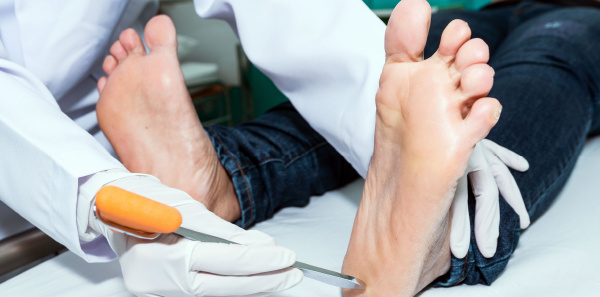
Peripheral neuropathies tend to present with sensory deficits before motor ones, with the longest nerves typically affected first, as is common in patients with Guillain-Barré syndrome.10 In contrast, neuromuscular junction diseases such as myasthenia gravis as well as myopathies usually present with pure motor deficits. Myopathies are painful, with proximal muscles being affected most (difficulty getting out of a chair, climbing stairs, or brushing one’s hair) as opposed to neuromuscular junction diseases, which tend to be painless, and peripheral neuropathies, which tend to attack the distal nerves first.3

You Might Also Like
  • A 3-Step Approach for Infants with Congenital Heart Disease
  • A 5-Step Approach to the Agitated Patient
  • 7-Step Approach To Diagnosing & Treating Hepatic Encephalopathy
Explore This Issue
ACEP Now: Vol 40 – No 07 – July 2021

Quick Screen Motor Exam

A detailed motor exam is often not practical in the emergency department given time constraints. However, there are six quick screening physical exam maneuvers that, if normal, can influence the need for a detailed segmental motor exam in all except patients in whom you suspect a spinal cord lesion. Two of them are familiar to emergency physicians: facial symmetry/power testing and arm pronator drift. The other four, although less familiar, are well-validated and can be time-saving.

The forearm roll test: Ask the patient to make fists with both hands and roll their forearms around each other quickly for 10 seconds in both directions.11,12 With an upper motor neuron lesion, the affected arm will be noticeably slower than the unaffected arm.

If the forearm roll test is normal (equal speed between the arms), ask the patient to roll their index fingers around one another. Again, the affected side will be slower than the unaffected side.

Many emergency physicians are unaware of the lower extremity drift test (the “Mingazzini maneuver,” see Figure 1), where the supine patient flexes the hips so their thighs are at right angles to the trunk and the lower legs are flexed so they are horizontal to the stretcher.12,13 The patient is asked to hold this position for 30 seconds. The affected thigh will lower toward the stretcher, and the leg will lower in the patient with an upper motor neuron lesion.

Foot tapping test: The seated patient is asked to repeatedly tap their foot at a quick, steady tempo, and the clinician observes progressive slowing of the tempo. This suggests an upper motor neuron lesion.

Next time you evaluate a patient in the emergency department with the chief complaint of limb weakness, this six-step approach employing a careful history and this four-item quick screening motor exam will help you home in on the diagnosis before any tests are considered. When it comes to acute motor weakness, the history and physical are a not-so-secret weapon. 

Pages: 1 2 3 4 | Single Page

Topics: Guillain-Barré SyndromeNeurologyStroketest

Related

  • ACEP Clinical Policy on Thrombolytics for Management of Acute Ischemic Stroke

    July 3, 2025 - 0 Comment
  • Case Report: When Syncope Gets Hairy

    June 17, 2025 - 0 Comment
  • Thrombolytics in Stroke: Moving Beyond Controversy to Comprehensive Care

    December 7, 2024 - 0 Comment

Current Issue

ACEP Now: November 2025

Download PDF

Read More

About the Author

Anton Helman, MD, CCFP(EM), FCFP

Dr. Helman is an emergency physician at North York General Hospital in Toronto. He is an assistant professor at the University of Toronto, Division of Emergency Medicine, and the education innovation lead at the Schwartz/Reisman Emergency Medicine Institute. He is the founder and host of Emergency Medicine Cases podcast and website (www.emergencymedicinecases.com).

View this author's posts »

No Responses to “6-Step Approach to Acute Motor Weakness”

Leave a Reply Cancel Reply

Your email address will not be published. Required fields are marked *


*
*


Wiley
  • Home
  • About Us
  • Contact Us
  • Privacy
  • Terms of Use
  • Advertise
  • Cookie Preferences
Copyright © 2025 by John Wiley & Sons, Inc. All rights reserved, including rights for text and data mining and training of artificial technologies or similar technologies. ISSN 2333-2603