
Logo

Log In Sign Up |  An official publication of: American College of Emergency Physicians
Navigation
  • Home
  • Multimedia
    • Podcasts
    • Videos
  • Clinical
    • Airway Managment
    • Case Reports
    • Critical Care
    • Guidelines
    • Imaging & Ultrasound
    • Pain & Palliative Care
    • Pediatrics
    • Resuscitation
    • Trauma & Injury
  • Resource Centers
    • mTBI Resource Center
  • Career
    • Practice Management
      • Benchmarking
      • Reimbursement & Coding
      • Care Team
      • Legal
      • Operations
      • Quality & Safety
    • Awards
    • Certification
    • Compensation
    • Early Career
    • Education
    • Leadership
    • Profiles
    • Retirement
    • Work-Life Balance
  • Columns
    • ACEP4U
    • Airway
    • Benchmarking
    • Brief19
    • By the Numbers
    • Coding Wizard
    • EM Cases
    • End of the Rainbow
    • Equity Equation
    • FACEPs in the Crowd
    • Forensic Facts
    • From the College
    • Images in EM
    • Kids Korner
    • Medicolegal Mind
    • Opinion
      • Break Room
      • New Spin
      • Pro-Con
    • Pearls From EM Literature
    • Policy Rx
    • Practice Changers
    • Problem Solvers
    • Residency Spotlight
    • Resident Voice
    • Skeptics’ Guide to Emergency Medicine
    • Sound Advice
    • Special OPs
    • Toxicology Q&A
    • WorldTravelERs
  • Resources
    • ACEP.org
    • ACEP Knowledge Quiz
    • Issue Archives
    • CME Now
    • Annual Scientific Assembly
      • ACEP14
      • ACEP15
      • ACEP16
      • ACEP17
      • ACEP18
      • ACEP19
    • Annals of Emergency Medicine
    • JACEP Open
    • Emergency Medicine Foundation
  • About
    • Our Mission
    • Medical Editor in Chief
    • Editorial Advisory Board
    • Awards
    • Authors
    • Article Submission
    • Contact Us
    • Advertise
    • Subscribe
    • Privacy Policy
    • Copyright Information

10 Essentials for Your Emergency Department Fanny Pack

By Andrew Park, MD, and Chandana Cherukupalli, DO | on June 17, 2025 | 0 Comment
Features
  • Tweet
  • Click to email a link to a friend (Opens in new window) Email
Print-Friendly Version

There is significance in the things we carry.1

You Might Also Like
  • 4-Step Approach to Treating Alcohol Withdrawal
  • The Frequency of Alcohol-Related Emergency Dept. Visits and Mortality
  • 10 Tips for Ultrasound-Guided Peripheral Venous Access
Explore This Issue
ACEP Now: June 2025 (Digital)

The objects we choose to fill a limited space reflect a lot about the lives we lead, the way we think, what we anticipate, and what we prioritize. The hierarchical culture in academic medicine dictates that as we advance in seniority, we carry less. Think about the medical student on rounds whose pockets are stuffed with all manner of items compared to  the attending who carries nothing more than a phone, eschewing even a pen or stethoscope to the burden of others.

The fanny pack (or, as some apologists may argue, “utility satchel”) has become an increasingly popular option to haul around hard-to-find materials out of convenience or necessity. As they have become a more familiar sight in the emergency department, it’s been an interesting experience to see what others carry in their fanny packs and their motivations for carrying them.

Burrow Ink Test

A burrow ink test—also known as an ink burrow test— is a decades old method used to diagnose scabies. A cartridge pen, which has free-flowing ink, or a skin marker, is used to rub ink on the suspected scabies papule. Excess ink is wiped off with an alcohol pad and remaining ink will have penetrated any existing burrows under.1,2
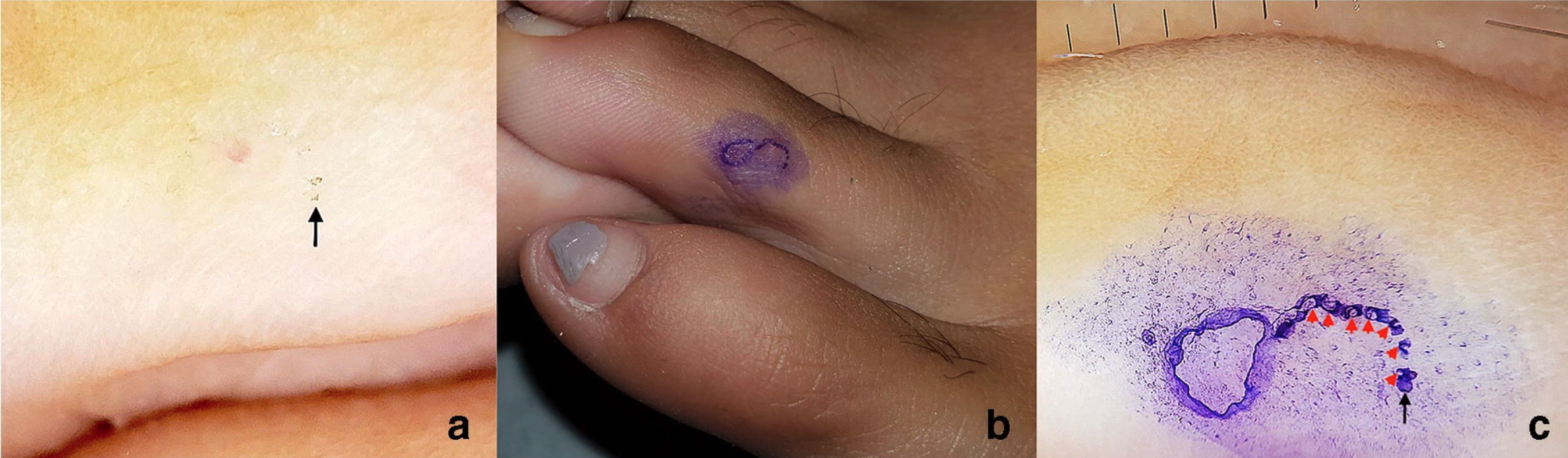
Panel a. Classic dermatoscopy image of “triangle sign,” which corresponds to the anterior part of the mite (black arrows). Magnification × 10. Panel b. Burrow ink test: staining of the same lesion with washable blue ink. Without magnification, a clear outline and classic S-shaped burrow. Panel c. Polarized dermatoscopy (× 10) after ink staining. The “mother” mite is visible to the extreme side of the burrow (black arrow). Also, many eggs are evident (short red arrows). From Del Barrio-Díaz, P., Vera-Kellet, C. The Burrow Ink Test: a simple method to improve the diagnosis of scabies. J Gen Intern Med. 2022. Reprinted with permission from Springer Nature. (Click to enlarge.)

References

  1. De Caprariis PJ, Della-Latta P. Additional techniques for diagnosing scabies. Am Fam Physician. 2013 Apr 15;87(8):536.
  2. Woodley D, Saurat JH. Burrow Ink Test and the scabies mite. J Am Acad Dermatol. 1981;4(6):715-722.

For some, it’s an easy extension of a habit inculcated in daily life, a purely utilitarian practice born out of a series of lost phones, IDs, or wallets that has turned into a crucial part of feeling ready for the familiar chaos of the emergency department. It saves time searching for needed items in a rushed situation and saves recreating the trope of fumbling for keys in a critical moment. For others, it may serve as a symbol of equality: The emergency department is the great equalizer of health care, and even attending physicians need to remain grounded, accountable, and most of all, prepared.

Pages: 1 2 3 4 | Single Page

Topics: Cricothyrotomyemergency department fanny packEpistaxisLumbar PunctureNauseaNerve BlockProcedures and SkillsSupraventricular TachycardiaUltrasoundValsalva Maneuver

Related

  • Case Report: Rare Pulmonary Embolism After Routine PIVC Insertion

    September 22, 2025 - 1 Comment
  • Nail Bed Injuries: What to Do—or Not to Do

    August 18, 2025 - 0 Comment
  • Case Report: Rapid Diagnosis of Acute Aortic Dissection with POCUS

    June 11, 2025 - 1 Comment

Current Issue

ACEP Now: November 2025

Download PDF

Read More

No Responses to “10 Essentials for Your Emergency Department Fanny Pack”

Leave a Reply Cancel Reply

Your email address will not be published. Required fields are marked *


*
*


Wiley
  • Home
  • About Us
  • Contact Us
  • Privacy
  • Terms of Use
  • Advertise
  • Cookie Preferences
Copyright © 2025 by John Wiley & Sons, Inc. All rights reserved, including rights for text and data mining and training of artificial technologies or similar technologies. ISSN 2333-2603
