

Case Vignette
AD is a 52-year-old man with a past medical history significant for osteomyelitis. He is currently receiving antibiotics via a peripherally inserted central catheter (PICC) line and presents to the ED in supraventricular tachycardia (SVT). After failing vagal maneuvers, the nurse is preparing adenosine to administer via the catheter and asking what dose to prepare.
Explore This Issue
ACEP NOW: October 2026 (Digital)When?
Using an initial dose of 6 mg of adenosine for every patient may lead to suboptimal results. Initial doses greater than 6 mg (consider 12 mg) may be indicated in overweight or obese individuals, or those with recent caffeine administration. Initial doses less than 6 mg (consider 3 mg) may be indicated in those receiving the medication through a central line, with history of heart transplant, or taking dipyridamole.
Why?
- Overweight or obese: data suggest an initial dose of 12 mg may be a more optimal starting dose
- Recent caffeine ingestion (within 4 hours): caffeine is an adenosine receptor antagonist and may interfere with successful conversion
- Central line administration: delivers the medication directly to the site of action, so less is needed to achieve effect
- History of heart transplant: recipients have postoperative parasympathetic denervation, which increases the sensitivity of the sinoatrial (SA) and atrioventricular (AV) node receptors, requiring less medication to achieve effect
- Dipyridamole: can increase extracellular adenosine through inhibition of cellular nucleoside uptake, and may thereby increase the effect of exogenous adenosine at the SA and AV nodes
How?
- Onset: rapid
- Duration: less than 10 seconds
- Adverse effects: facial flushing, dyspnea, chest pressure, nausea, dizziness, headache, numbness
- Warnings and precautions: second- or third-degree AV block, pre-excited atrial fibrillation or flutter, bronchoconstrictive or bronchospastic lung disease
Overview of Evidence
| Author; Year | Design / Sample Size | Intervention & Comparison | Outcome |
|---|---|---|---|
| An J, et al.; 2023. | Retrospective study of patients with SVT treated with adenosine 6 mg, then 12 mg, then 12 mg
N = 124 |
Following Valsalva maneuver and carotid massage when SVT was suspected, patients were then given 6 mg of adenosine | -Mean weight difference between success and failure after the first 6-mg dose: 61.0 + 11.5 kg versus 78.4 + 17.0 kg -Weight-based dose: .10 + .02 mg/kg versus .079 + .02 mg/kg -Conclusion: Weight is a significant determinant of first-dose success rate of conversion in patients with SVT |
| Deck C, et al.; 2023. | Retrospective cohort analysis in patients with known or suspected supraventricular tachycardia
N = 76 |
>.1 mg/kg (N = 24)
Versus <.1 mg/kg (N = 52) |
-Successful conversion: 92.7 percent in the higher dose group versus 59.6 percent in the lower dose group (P=.006) -Mean weight: 91 kg in the higher dose group versus 61.7 kg in the lower dose group (p<.001) -Mean weight-based dose: .12 mg/kg in the higher dose group versus .07 mg/kg in the lower dose group (p<.001) |
| Satzer M , et al.; 202. | Prospective study looking at a subset of patients who were actively taking oral dipyridamole and compared to the parent study which included patients not on dipyridamole
N = 30 |
Adenosine was administered starting with 12.5 mcg/kg (up to .8 mg for patients >60 kg) and doubling with each subsequent dose up to a max of 200 mcg/kg (or 12 mg) | -The median dose at which AV block occurred was 50 mcg/kg (or 3 mg in patients > 60 kg) compared to 100 mcg/kg (or 6 mg in patients > 60 kg) in those who suspended dipyridamole (p = .01) -There was no significant difference in AV block duration, total number of blocked P waves, total adenosine effect, baseline PR interval, heart rate during AV block, heart rate 10 seconds following AV block, incidence of atrioventricular ectopy, or patient-reported symptoms |
| Flyer J, et al.; 2017. | Single-center prospective clinical study in heart transplant recipient patients
N = 80 |
Patients <60 kg were serially dosed by weight (12.5, 25, 50, 100, and 200 mcg/kg) and patients >60 kg were given escalating doses (.8, 1.5, 3, 6, and 12 mg). Doses were given incrementally until AV block was achieved or clinically significant asystole was encountered | No patients demonstrated AV block after receiving adenosine at .8 mg (or 12.5 mcg/kg), 12 percent after 1.5 mg (or 25 mcg/kg), 31 percent after 3 mg (or 50 mcg/kg), 72 percent after 6 mg (or 100 mcg/kg), and 96 percent after 12 mg (or 200 mcg/kg).
-Adenosine could be effective at lower doses than are typically used in patients without cardiac transplantation |
| Bailey A. et al.; 2016. | Case report | Patient received adenosine 6 mg, then 12 mg, then 12 mg with unsuccessful conversion Cardiology was consulted and patient was given an additional dose of 24 mg and 36 mg |
-The 36 mg dose produced successful, sustained conversion and return to a normal sinus rhythm -Optimal dosing strategy not yet defined, but may require doses >12 mg |
 Dr. May Watts is an emergency medicine pharmacy specialist at Carolinas Medical Center in Charlotte, NC.
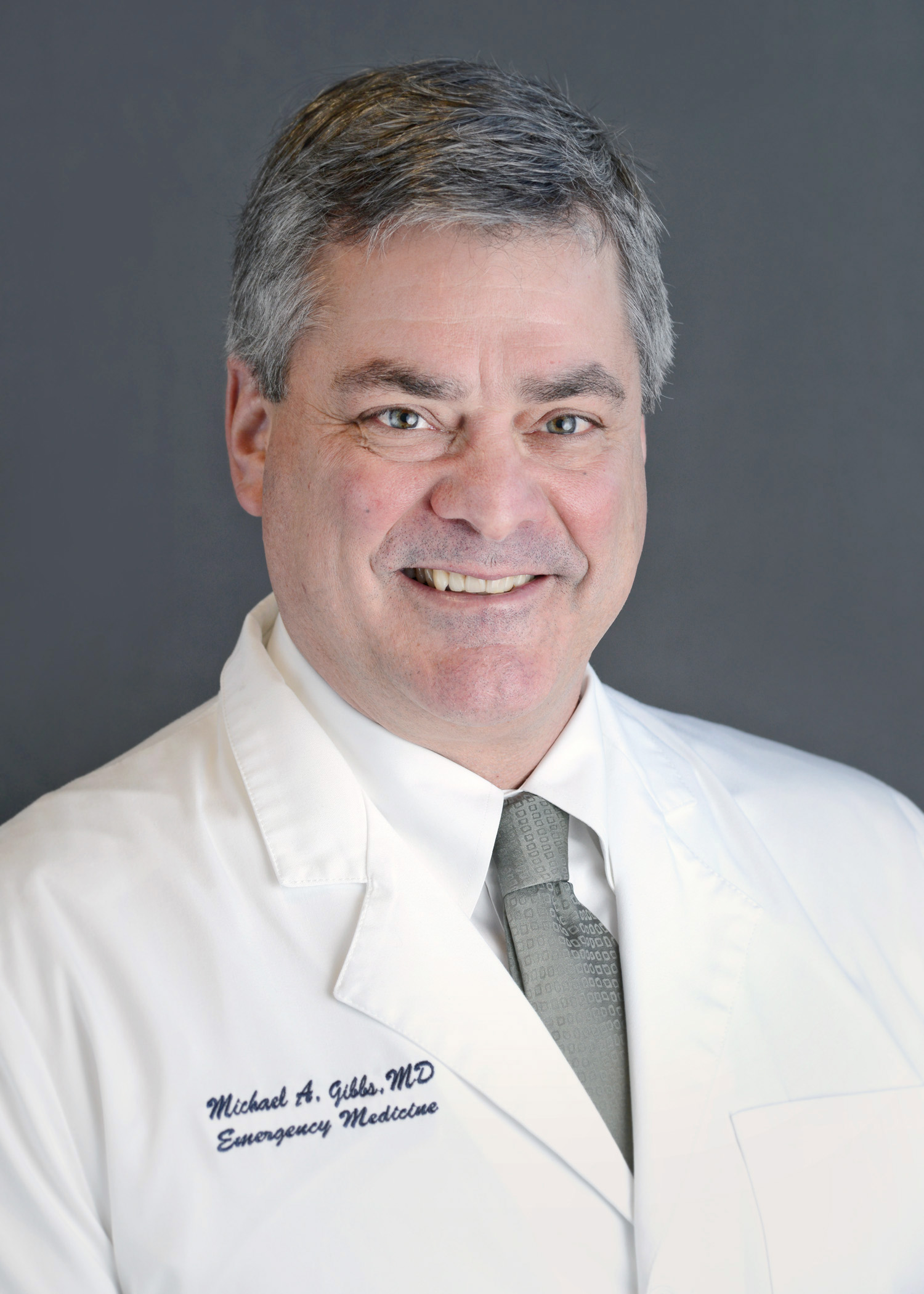 Dr. Gibbs is the chair of the department of emergency medicine at Carolinas Medical Center in Charlotte, NC.
References
- Micromedex 2.0 (Healthcare Series) [electronic version]. Truven Health Analytics, Greenwood Village, Colorado. www.micromedexsolutions.com.
- Panchal AR, Bartos JA, Cabañas JG, et al. Part 3: adult basic and advanced life support: 2020 American Heart Association guidelines for cardiopulmonary resuscitation and emergency cardiovascular care. 2020;142(16 suppl 2):S366-S468.
- Weismuller P, et al. “Comparison of the efficacy of 12 mg and 18 mg adenosine in terminating supraventricular tachycardias.” Thieme. 2000; 125(33): 961-969.
- An J, Kim H, Ko Y, et al. Comparison of sinus conversion rates and body weights after 6 mg adenosine administration in supraventricular tachycardia. Am J Emerg Med. 2023;63:55-60.
- Deck C, Kwon H, Zhang M, et al. Improved first dose conversion of supraventricular tachycardia using weight-based adenosine. 2023;15(3):e35995.
- Bailey AM, Baum RA, Rose J, et al. High-dose adenosine for treatment of refractory supraventricular tachycardia in an emergency department of an academic medical center: a case report and literature review. J Emerg Med. 2016;50(3):477-481.


No Responses to “Optimizing Adenosine Dosing for Adult Patients With Supraventricular Tachycardia”